1,001 IPs, 64 countries, one operation: mapping a botnet by its back end
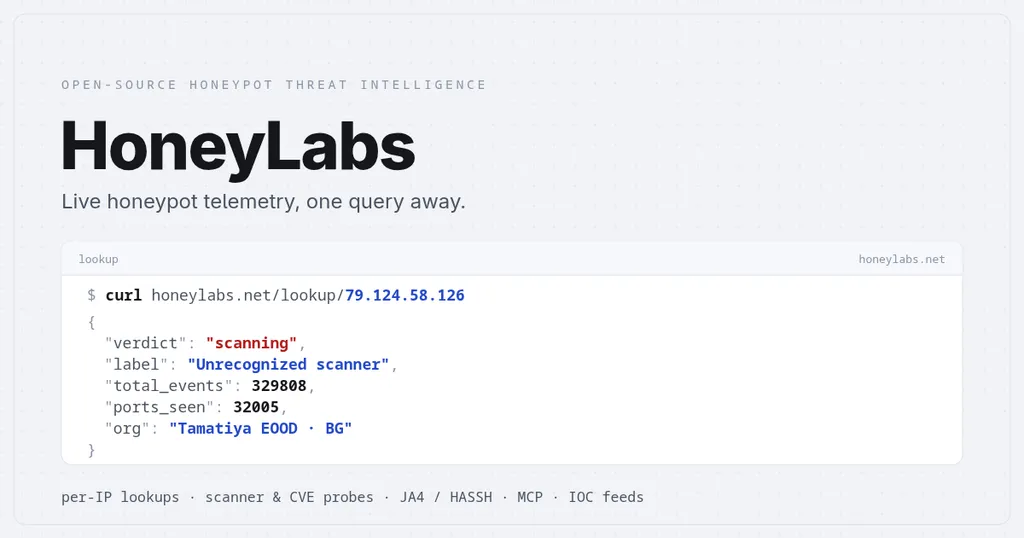
A recent analysis has mapped a significant botnet operation involving 1,001 IPs across 64 countries. This operation is linked by eight shared staging servers and unique TLS and HTTP fingerprints. The findings highlight the importance of the back end in identifying and correlating malicious activities on the internet.
- ▪The botnet consists of 1,001 source IPs connected to eight staging servers across 306 networks.
- ▪The shared back end and unique fingerprints help distinguish this operation from others.
- ▪The exploit used is an Apache path traversal vulnerability, which has been consistently active over the past hundred days.
Hacker News (Newest) files mainly under programming. We currently carry 5,306 of its stories.
Story provenance
Source · retrieval · rights · ranking — open for full record
inspect →
Story provenance
Attribution is not the same as permission. This drawer separates discovery metadata, excerpts, WeSearch-generated summaries, reuse status, and whether the publisher receives the visit. Nothing here claims a legal grant the publisher has not made.
Record
| Original publisher | HoneyLabs |
| Canonical URL | https://honeylabs.net/blog/mapping-a-botnet-by-its-back-end |
| Publication time | Fri, 29 May 2026 08:33:02 +0000 |
| Retrieval time | 2026-05-29T08:49:59.808Z |
| Last seen | 2026-05-29T08:49:59.808Z |
| Headline source | Publisher (no WeSearch rewrite) |
| Excerpt source | publisher body |
| Excerpt method | First ~120 words (~800 chars) of extracted publisher body, fair-use limited. |
| Summary | WeSearch · cerebras-chat (WeSearch summarizer) |
| Summary source text | contentText |
| Citation coverage | Summary is a WeSearch-generated derivative; primary citation is the original publisher URL. |
| Cluster | EkGWZZ4kgiLR |
| Cluster logic | Grouped by semantic title/content similarity across sources within a rolling window. Same-publisher template collisions are excluded from coverage comparison. |
| Ranking reason | Story pages are not engagement-ranked. Hub feeds use recency, with optional source-diversified chronological ordering (cap consecutive stories per source). No personalized ranking. |
| Publisher visit | Yes — open original |
| Substitutes article? | No — link-out required for full text |
Rights status (four layers)
WeSearch handling by dimension
| Indexing | May the item be indexed (stored, ranked, made findable)? | Allowed |
| Snippet | May a short excerpt of the publisher's text be shown? | Allowed |
| AI summary | May WeSearch generate its own short summary of the article? | Limited |
| Retrieval / RAG | May the content be exposed for third-party retrieval-augmented generation? | Not asserted |
| Model training | May the content be used to train AI models? | Not asserted |
| Commercial reuse | May the content be reused commercially? | Not permitted |
Basis: Derived from the published RSS/Atom feed. Contact: [email protected]. Reviewed: 2026-07-24.
Opening excerpt (first ~120 words) tap to expand
Blog · 2026-05-291,001 IPs, 64 countries, one operation: mapping a botnet by its back endA single attacking IP tells you little. The back end it pulls its payload from, and the client fingerprint it presents, are the parts operators reuse. Correlating both across the sensor network collapses internet noise into discrete operations: one cluster of 1,001 IPs across 306 networks and 64 countries, tied to eight shared staging servers and a single TLS and HTTP fingerprint that appears nowhere else, plus smaller botnets that fall into clean separate islands. With node graphs.A single attacking IP does not tell you much on its own. It is one compromised box out of a sea of them, and by the time it reaches your logs it has usually been cleaned, reassigned, or rotated out.
…
Excerpt limited to ~120 words for fair-use compliance. The full article is at HoneyLabs.
Discussion
0 commentsMore from HoneyLabs