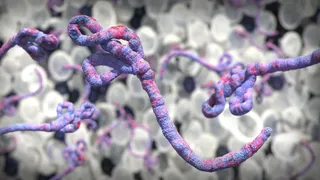
3D Imaging Reveals How a Taste Receptor Detects Coffee’s Bitter Compounds

Researchers at the University of North Carolina have used advanced imaging techniques to reveal how the TAS2R43 taste receptor detects bitter compounds in coffee. This discovery could lead to new therapeutic approaches and methods to reduce bitterness in food and medicine. The findings highlight the role of bitter taste receptors in gut function and immune responses.
- ▪The TAS2R43 receptor is responsible for detecting bitter compounds in coffee.
- ▪Researchers used cryogenic electron microscopy to create detailed images of the TAS2R43 receptor.
- ▪The study's findings could support the development of new therapies for various health conditions.
Discover Magazine files mainly under science. We currently carry 86 of its stories.
Story provenance
Source · retrieval · rights · ranking — open for full record
inspect →
Story provenance
Attribution is not the same as permission. This drawer separates discovery metadata, excerpts, WeSearch-generated summaries, reuse status, and whether the publisher receives the visit. Nothing here claims a legal grant the publisher has not made.
Record
| Original publisher | Discover Magazine |
| Canonical URL | https://www.discovermagazine.com/3d-imaging-reveals-how-a-taste-receptor-detects-coffee-s-bitter-compounds-49118 |
| Publication time | Mon, 18 May 2026 21:35:00 GMT |
| Retrieval time | 2026-05-18T21:44:56.950Z |
| Last seen | 2026-05-18T21:44:56.950Z |
| Headline source | Publisher (no WeSearch rewrite) |
| Excerpt source | publisher body |
| Excerpt method | First ~120 words (~800 chars) of extracted publisher body, fair-use limited. |
| Summary | WeSearch · cerebras-chat (WeSearch summarizer) |
| Summary source text | contentText |
| Citation coverage | Summary is a WeSearch-generated derivative; primary citation is the original publisher URL. |
| Cluster | CtTljxQDZG6e |
| Cluster logic | Grouped by semantic title/content similarity across sources within a rolling window. Same-publisher template collisions are excluded from coverage comparison. |
| Ranking reason | Story pages are not engagement-ranked. Hub feeds use recency, with optional source-diversified chronological ordering (cap consecutive stories per source). No personalized ranking. |
| Publisher visit | Yes — open original |
| Substitutes article? | No — link-out required for full text |
Rights status (four layers)
WeSearch handling by dimension
| Indexing | May the item be indexed (stored, ranked, made findable)? | Allowed |
| Snippet | May a short excerpt of the publisher's text be shown? | Allowed |
| AI summary | May WeSearch generate its own short summary of the article? | Limited |
| Retrieval / RAG | May the content be exposed for third-party retrieval-augmented generation? | Not asserted |
| Model training | May the content be used to train AI models? | Not asserted |
| Commercial reuse | May the content be reused commercially? | Not permitted |
Basis: Derived from the published RSS/Atom feed. Contact: [email protected]. Reviewed: 2026-07-24.
Opening excerpt (first ~120 words) tap to expand
Why does coffee taste bitter? It comes down to its molecular profile. Specifically, bitter tastants are detected by taste receptors like TAS2R43. Using advanced imaging techniques, a team of researchers at the University of North Carolina (UNC) School of Medicine has shown how the receptor binds to chemical compounds in your morning brew, a process that results in a bitter — sometimes acrid — flavor. “In this work, we solved the structures of TAS2R43 bound to bitter compounds and showed, in molecular detail, how this receptor detects bitter molecules,” first author Yoojoong Kim, a post-doctoral research associate at UNC, explained in a statement.
…
Excerpt limited to ~120 words for fair-use compliance. The full article is at Discover Magazine.
Discussion
0 commentsMore from Discover Magazine