A Moonlit Earth as Seen From Artemis II
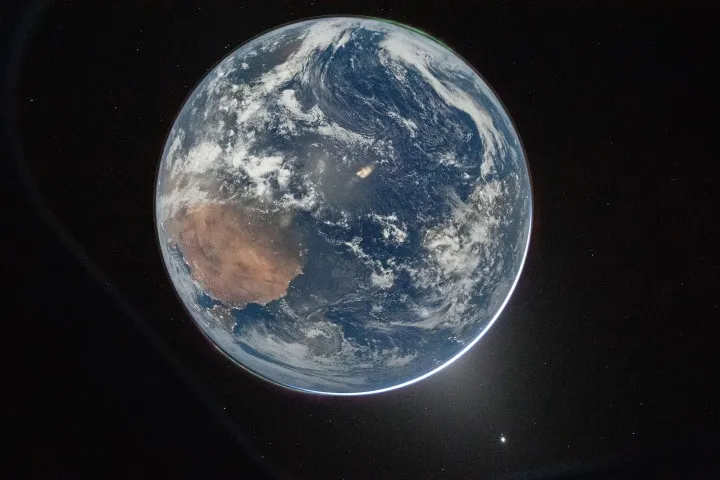
An astronaut aboard the Artemis II mission captured a stunning image of Earth illuminated by moonlight. The photo showcases Earth's full disk along with celestial phenomena, including auroras and zodiacal light. This unique perspective highlights human habitation and the planet's dynamic interaction with the solar system.
- ▪The image was taken after the Orion spacecraft completed its translunar injection burn.
- ▪Earth appears lit by moonlight, with city lights visible in various regions including Spain, Portugal, and Brazil.
- ▪The photo provides a rare view of Earth as a solar system body, showcasing its interaction with solar wind.
NASA — Breaking News files mainly under science. We currently carry 93 of its stories.
Story provenance
Source · retrieval · rights · ranking — open for full record
inspect →
Story provenance
Attribution is not the same as permission. This drawer separates discovery metadata, excerpts, WeSearch-generated summaries, reuse status, and whether the publisher receives the visit. Nothing here claims a legal grant the publisher has not made.
Record
| Original publisher | NASA |
| Canonical URL | https://science.nasa.gov/earth/earth-observatory/a-moonlit-earth-as-seen-from-artemis-ii/ |
| Publication time | Thu, 04 Jun 2026 04:01:00 +0000 |
| Retrieval time | 2026-06-04T04:36:05.300Z |
| Last seen | 2026-06-04T04:55:34.862Z |
| Headline source | Publisher (no WeSearch rewrite) |
| Excerpt source | publisher body |
| Excerpt method | First ~120 words (~800 chars) of extracted publisher body, fair-use limited. |
| Summary | WeSearch · cerebras-chat (WeSearch summarizer) |
| Summary source text | contentText |
| Citation coverage | Summary is a WeSearch-generated derivative; primary citation is the original publisher URL. |
| Cluster | LjjS3mvNx6HG |
| Cluster logic | Grouped by semantic title/content similarity across sources within a rolling window. Same-publisher template collisions are excluded from coverage comparison. |
| Ranking reason | Story pages are not engagement-ranked. Hub feeds use recency, with optional source-diversified chronological ordering (cap consecutive stories per source). No personalized ranking. |
| Publisher visit | Yes — open original |
| Substitutes article? | No — link-out required for full text |
Rights status (four layers)
WeSearch handling by dimension
| Indexing | May the item be indexed (stored, ranked, made findable)? | Allowed |
| Snippet | May a short excerpt of the publisher's text be shown? | Allowed |
| AI summary | May WeSearch generate its own short summary of the article? | Limited |
| Retrieval / RAG | May the content be exposed for third-party retrieval-augmented generation? | Not asserted |
| Model training | May the content be used to train AI models? | Not asserted |
| Commercial reuse | May the content be reused commercially? | Not permitted |
Basis: Derived from the published RSS/Atom feed. Contact: [email protected]. Reviewed: 2026-07-24.
Opening excerpt (first ~120 words) tap to expand
Earth ObservatoryScienceEarth ObservatoryA Moonlit Earth as Seen From...EarthEarth ObservatoryImage of the DayEO ExplorerTopicsAll TopicsAtmosphereLandHeat & RadiationLife on EarthHuman DimensionsNatural EventsOceansRemote Sensing TechnologySnow & IceWaterMore ContentCollectionsGlobal MapsWorld of ChangeArticlesNotes from the Field BlogEarth Matters BlogBlue Marble: Next GenerationEO KidsMission: BiomesAboutAbout UsSubscribe🛜 RSSContact UsSearch 4 min readA Moonlit Earth as Seen From Artemis IIImage of the Day for June 4, 2026An astronaut’s photo, taken en route to the Moon, reveals our planet and its place in space in a novel way.NASA Earth ObservatoryJun 04, 2026 Article View more Images of the Day:Jun 3, 2026Instruments:PhotographCollections:Astronaut PhotographyBlue MarbleEarth at…
Excerpt limited to ~120 words for fair-use compliance. The full article is at NASA.
Discussion
0 commentsMore from NASA