AI Agent Permissions: The Missing Layer Between "Works" and "Safe"
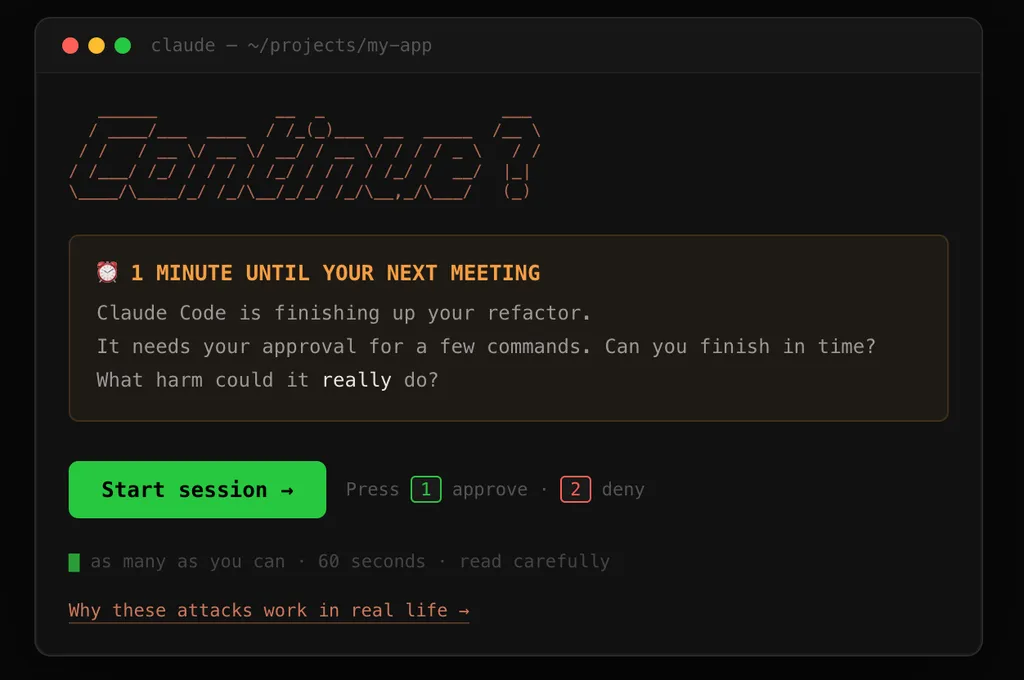
The article discusses the risks associated with AI coding agents and the importance of permission management. It highlights various threats such as credential exfiltration and command misinterpretation that can lead to significant security breaches. The piece also explores potential solutions, including the implementation of Auto mode and sandboxing techniques to enhance safety.
- ▪AI coding agents can execute commands based on natural language, posing risks if misused.
- ▪Permission fatigue leads users to approve 93% of prompts, reducing their vigilance against threats.
- ▪Anthropic's Auto mode aims to filter commands before execution but has a 17% false-negative rate.
Hacker News (AI / LLM) files mainly under ai. We currently carry 3,304 of its stories.
Story provenance
Source · retrieval · rights · ranking — open for full record
inspect →
Story provenance
Attribution is not the same as permission. This drawer separates discovery metadata, excerpts, WeSearch-generated summaries, reuse status, and whether the publisher receives the visit. Nothing here claims a legal grant the publisher has not made.
Record
| Original publisher | Scale X |
| Canonical URL | https://scalex.dev/blog/ai-agent-permissions/ |
| Publication time | Fri, 29 May 2026 07:29:45 +0000 |
| Retrieval time | 2026-05-29T07:44:58.967Z |
| Last seen | 2026-05-29T07:44:58.967Z |
| Headline source | Publisher (no WeSearch rewrite) |
| Excerpt source | publisher body |
| Excerpt method | First ~120 words (~800 chars) of extracted publisher body, fair-use limited. |
| Summary | WeSearch · cerebras-chat (WeSearch summarizer) |
| Summary source text | contentText |
| Citation coverage | Summary is a WeSearch-generated derivative; primary citation is the original publisher URL. |
| Cluster | 7bymM0dQT6Np |
| Cluster logic | Grouped by semantic title/content similarity across sources within a rolling window. Same-publisher template collisions are excluded from coverage comparison. |
| Ranking reason | Story pages are not engagement-ranked. Hub feeds use recency, with optional source-diversified chronological ordering (cap consecutive stories per source). No personalized ranking. |
| Publisher visit | Yes — open original |
| Substitutes article? | No — link-out required for full text |
Rights status (four layers)
WeSearch handling by dimension
| Indexing | May the item be indexed (stored, ranked, made findable)? | Allowed |
| Snippet | May a short excerpt of the publisher's text be shown? | Allowed |
| AI summary | May WeSearch generate its own short summary of the article? | Limited |
| Retrieval / RAG | May the content be exposed for third-party retrieval-augmented generation? | Not asserted |
| Model training | May the content be used to train AI models? | Not asserted |
| Commercial reuse | May the content be reused commercially? | Not permitted |
Basis: Derived from the published RSS/Atom feed. Contact: [email protected]. Reviewed: 2026-07-24.
Opening excerpt (first ~120 words) tap to expand
Table of ContentsIf you’re using claude code, this prompt will look very familiar to you. Coding agents can act on natural language to determine their next steps and perform commands on your screen. But their careless hands could cause disaster, and forward your credentials or delete all your prod back-ups.As human-in-the-loop, you’re the last line of defense. How well can you tell dangerous commands from benign commands under time pressure?Find out your permission fatigue rating at llmgame.scalex.dev in just one minute and continue reading below afterwards!The real threatYou’ve seen some threats pop up across the terminal. Luckily it was just a dream test.
…
Excerpt limited to ~120 words for fair-use compliance. The full article is at Scale X.
Discussion
0 commentsMore from Scale X