Autoregressive next token prediction and KV Cache in transformers
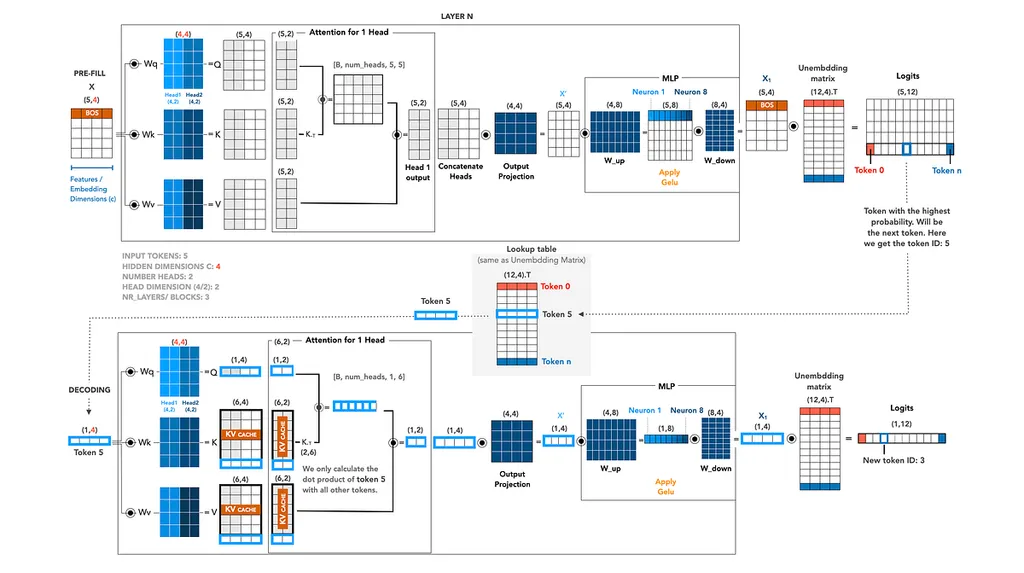
The article discusses the autoregressive next token prediction and the use of KV caches in transformers. It explains how a prompt is processed through a series of transformations to generate the next token in a sequence. The focus is on the mechanics of attention heads and the optimization techniques that enhance the efficiency of long sequence generation.
- ▪Autoregressive language models generate text by predicting the next token based on previous tokens.
- ▪The KV cache is an optimization technique that allows for efficient processing of long sequences in transformers.
- ▪The forward pass involves transforming input tokens into query, key, and value matrices for attention calculations.
Hacker News (Newest) files mainly under programming. We currently carry 5,306 of its stories.
Story provenance
Source · retrieval · rights · ranking — open for full record
inspect →
Story provenance
Attribution is not the same as permission. This drawer separates discovery metadata, excerpts, WeSearch-generated summaries, reuse status, and whether the publisher receives the visit. Nothing here claims a legal grant the publisher has not made.
Record
| Original publisher | Medium |
| Canonical URL | https://medium.com/advanced-deep-learning/autoregressive-next-token-prediction-kv-cache-in-transformers-afad22285baf |
| Publication time | Sun, 17 May 2026 20:07:14 +0000 |
| Retrieval time | 2026-05-17T20:33:20.987Z |
| Last seen | 2026-05-17T20:33:20.987Z |
| Headline source | Publisher (no WeSearch rewrite) |
| Excerpt source | publisher body |
| Excerpt method | First ~120 words (~800 chars) of extracted publisher body, fair-use limited. |
| Summary | WeSearch · cerebras-chat (WeSearch summarizer) |
| Summary source text | contentText |
| Citation coverage | Summary is a WeSearch-generated derivative; primary citation is the original publisher URL. |
| Cluster | vLWf8H3r48S_ |
| Cluster logic | Grouped by semantic title/content similarity across sources within a rolling window. Same-publisher template collisions are excluded from coverage comparison. |
| Ranking reason | Story pages are not engagement-ranked. Hub feeds use recency, with optional source-diversified chronological ordering (cap consecutive stories per source). No personalized ranking. |
| Publisher visit | Yes — open original |
| Substitutes article? | No — link-out required for full text |
Rights status (four layers)
WeSearch handling by dimension
| Indexing | May the item be indexed (stored, ranked, made findable)? | Allowed |
| Snippet | May a short excerpt of the publisher's text be shown? | Allowed |
| AI summary | May WeSearch generate its own short summary of the article? | Limited |
| Retrieval / RAG | May the content be exposed for third-party retrieval-augmented generation? | Not asserted |
| Model training | May the content be used to train AI models? | Not asserted |
| Commercial reuse | May the content be reused commercially? | Not permitted |
Basis: Derived from the published RSS/Atom feed. Contact: [email protected]. Reviewed: 2026-07-24.
Opening excerpt (first ~120 words) tap to expand
Autoregressive next token prediction & KV Cache in transformersFrederik vom Lehn7 min read·1 hour ago--ListenShareUnderstand the optimization technique in LLMs to speed up token generationPress enter or click to view image in full sizeThe general overview (Image by author).The Big PictureBefore we dive into attention heads, KV caches, and the mechanics of generation, it helps to zoom out and see what an autoregressive language model actually is at a glance.A prompt enters as plain text: “How are you?”. A tokenizer chops it into vocabulary IDs — here 3, 7, 1, 9, prefixed with a BOS ("beginning of sequence") token. Each ID is just an integer pointing into a lookup table: a learned matrix of shape (vocab_size, c) where every row is the embedding vector for one token in the vocabulary.
…
Excerpt limited to ~120 words for fair-use compliance. The full article is at Medium.
Discussion
0 commentsMore from Medium