Britain's £36 million peanut farm harvested less than it planted
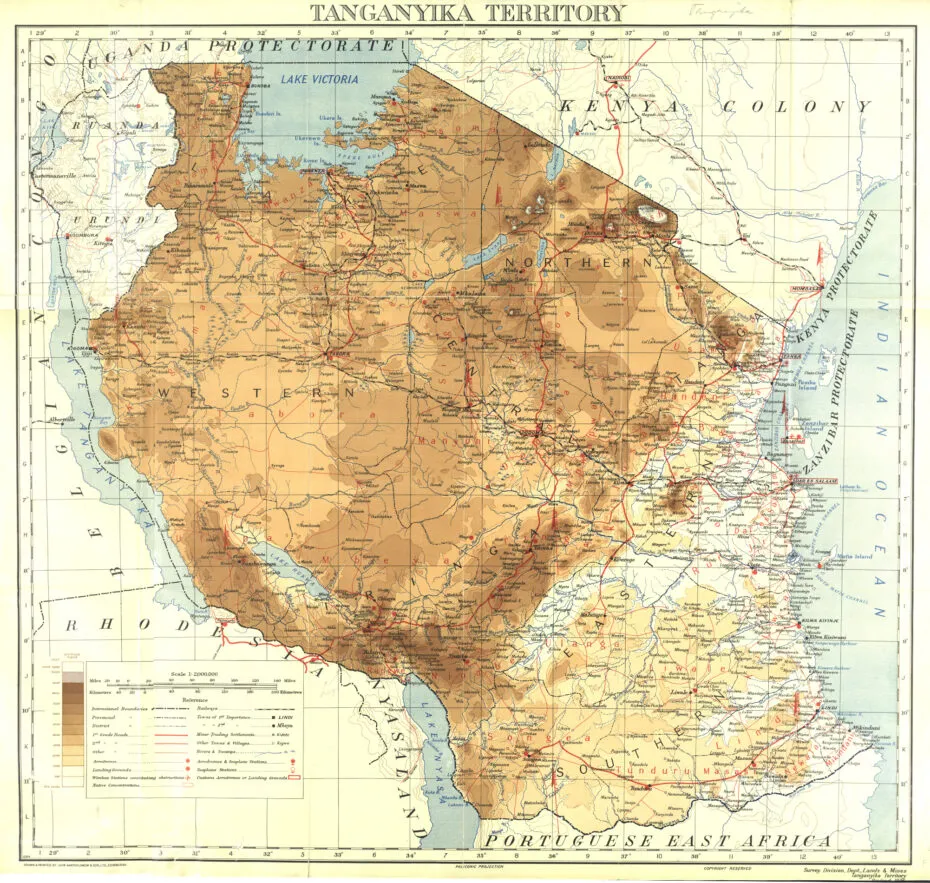
A hundred thousand former soldiers applied for the 1,200 jobs in the "Groundnut Army." Warnings about the rainfall and the soil were brushed aside. Bulldozers arrived from Canada and from US Army surplus in the Philippines, much of it too rusted to run. The baobab trees resisted clearing: one served as a local jail, another was sacred to ancestor worship, and many held bees' nests that put workers in the hospital.
- ▪A hundred thousand former soldiers applied for the 1,200 jobs in the "Groundnut Army." Warnings about the rainfall and the soil were brushed aside.
- ▪Bulldozers arrived from Canada and from US Army surplus in the Philippines, much of it too rusted to run.
- ▪The baobab trees resisted clearing: one served as a local jail, another was sacred to ancestor worship, and many held bees' nests that put workers in the hospital.
Boing Boing files mainly under tech. We currently carry 375 of its stories.
Story provenance
Source · retrieval · rights · ranking — open for full record
inspect →
Story provenance
Attribution is not the same as permission. This drawer separates discovery metadata, excerpts, WeSearch-generated summaries, reuse status, and whether the publisher receives the visit. Nothing here claims a legal grant the publisher has not made.
Record
| Original publisher | Boing Boing |
| Canonical URL | https://boingboing.net/2026/07/24/tanganyika-groundnut-scheme.html |
| Publication time | Fri, 24 Jul 2026 14:00:00 +0000 |
| Retrieval time | 2026-07-24T14:09:46.411Z |
| Last seen | 2026-07-24T14:09:46.411Z |
| Headline source | Publisher (no WeSearch rewrite) |
| Excerpt source | publisher body |
| Excerpt method | First ~120 words (~800 chars) of extracted publisher body, fair-use limited. |
| Summary | WeSearch · cerebras-chat (WeSearch summarizer) |
| Summary source text | contentText |
| Citation coverage | Summary is a WeSearch-generated derivative; primary citation is the original publisher URL. |
| Cluster | 60zQIOHhSDQ0 |
| Cluster logic | Grouped by semantic title/content similarity across sources within a rolling window. Same-publisher template collisions are excluded from coverage comparison. |
| Ranking reason | Story pages are not engagement-ranked. Hub feeds use recency, with optional source-diversified chronological ordering (cap consecutive stories per source). No personalized ranking. |
| Publisher visit | Yes — open original |
| Substitutes article? | No — link-out required for full text |
Rights status (four layers)
WeSearch handling by dimension
| Indexing | May the item be indexed (stored, ranked, made findable)? | Allowed |
| Snippet | May a short excerpt of the publisher's text be shown? | Allowed |
| AI summary | May WeSearch generate its own short summary of the article? | Limited |
| Retrieval / RAG | May the content be exposed for third-party retrieval-augmented generation? | Not asserted |
| Model training | May the content be used to train AI models? | Not asserted |
| Commercial reuse | May the content be reused commercially? | Not permitted |
Basis: Derived from the published RSS/Atom feed. Contact: [email protected]. Reviewed: 2026-07-24.
Opening excerpt (first ~120 words) tap to expand
Britain's £36 million peanut farm harvested less than it planted Ellsworth Toohey 7:00 am Fri Jul 24, 2026 Tanganyika groundnut scheme — Survey division, dept. lands and mines Tanganyika territory / Public domain (via Wikipedia) In 1946, with Britain still on wartime rationing and short of cooking fat, Clement Attlee's government approved a plan to plant peanuts across 3 million acres of Tanganyika, a stretch of bush roughly the size of Yorkshire, and turn the crop into margarine. A hundred thousand former soldiers applied for the 1,200 jobs in the "Groundnut Army." Warnings about the rainfall and the soil were brushed aside. Bulldozers arrived from Canada and from US Army surplus in the Philippines, much of it too rusted to run.
…
Excerpt limited to ~120 words for fair-use compliance. The full article is at Boing Boing.
Discussion
0 commentsMore from Boing Boing