China ramps up missile buildup for a Taiwan war
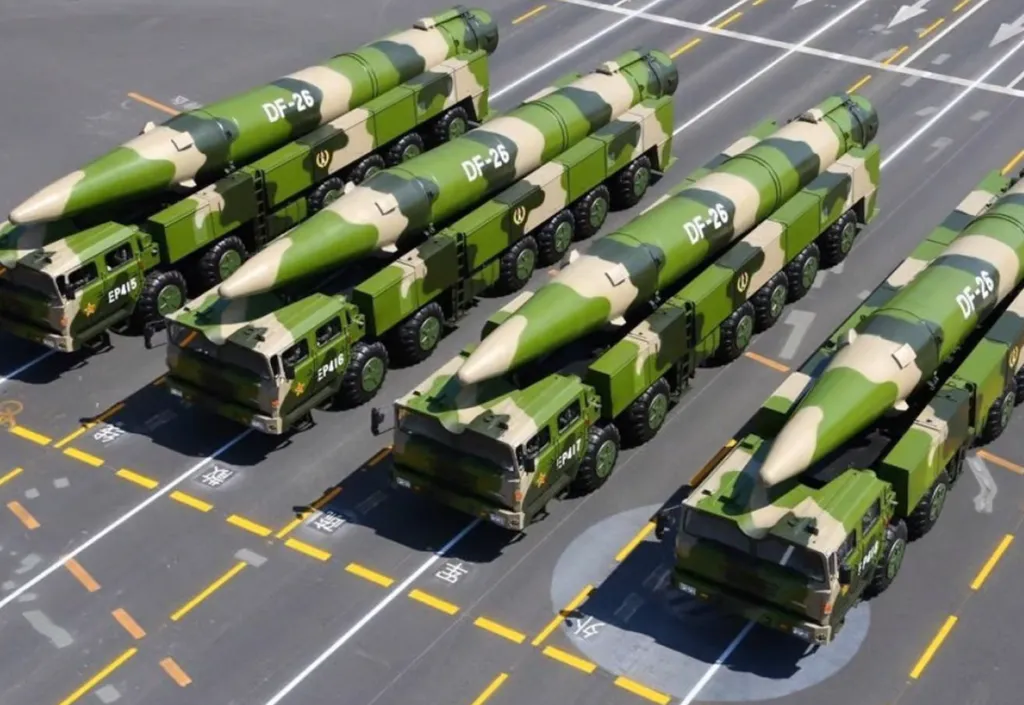
China is significantly increasing its missile production capabilities, which is impacting the military balance in the Indo-Pacific region, particularly regarding Taiwan. Recent reports indicate that the number of companies supplying components for missile production has more than doubled since 2013, with substantial revenue growth among these firms. This expansion is part of China's strategy to enhance its military deterrence and prepare for potential conflicts in the region.
- ▪China's missile production has accelerated sharply, with 81 firms supplying key components, more than double the number in 2013.
- ▪The People’s Liberation Army Rocket Force's arsenal has grown by nearly 50% over four years, reaching about 3,500 missiles.
- ▪China has expanded its missile-related facilities by 60% between 2020 and 2025, adding over 21 million square feet of space.
Asia Times files mainly under world. We currently carry 156 of its stories.
Story provenance
Source · retrieval · rights · ranking — open for full record
inspect →
Story provenance
Attribution is not the same as permission. This drawer separates discovery metadata, excerpts, WeSearch-generated summaries, reuse status, and whether the publisher receives the visit. Nothing here claims a legal grant the publisher has not made.
Record
| Original publisher | Asia Times |
| Canonical URL | https://asiatimes.com/2026/05/china-ramps-up-missile-buildup-for-a-taiwan-war/ |
| Publication time | Sun, 17 May 2026 04:02:06 +0000 |
| Retrieval time | 2026-05-17T04:03:58.374Z |
| Last seen | 2026-05-17T04:03:58.374Z |
| Headline source | Publisher (no WeSearch rewrite) |
| Excerpt source | publisher body |
| Excerpt method | First ~120 words (~800 chars) of extracted publisher body, fair-use limited. |
| Summary | WeSearch · cerebras-chat (WeSearch summarizer) |
| Summary source text | contentText |
| Citation coverage | Summary is a WeSearch-generated derivative; primary citation is the original publisher URL. |
| Cluster | XaAWbWSuI6FJ |
| Cluster logic | Grouped by semantic title/content similarity across sources within a rolling window. Same-publisher template collisions are excluded from coverage comparison. |
| Ranking reason | Story pages are not engagement-ranked. Hub feeds use recency, with optional source-diversified chronological ordering (cap consecutive stories per source). No personalized ranking. |
| Publisher visit | Yes — open original |
| Substitutes article? | No — link-out required for full text |
Rights status (four layers)
WeSearch handling by dimension
| Indexing | May the item be indexed (stored, ranked, made findable)? | Allowed |
| Snippet | May a short excerpt of the publisher's text be shown? | Allowed |
| AI summary | May WeSearch generate its own short summary of the article? | Limited |
| Retrieval / RAG | May the content be exposed for third-party retrieval-augmented generation? | Not asserted |
| Model training | May the content be used to train AI models? | Not asserted |
| Commercial reuse | May the content be reused commercially? | Not permitted |
Basis: Derived from the published RSS/Atom feed. Contact: [email protected]. Reviewed: 2026-07-24.
Opening excerpt (first ~120 words) tap to expand
China’s accelerating missile buildup is increasingly turning industrial capacity, stockpile depth, and sustained precision-strike capability into decisive factors in the emerging military balance over Taiwan and the wider Indo-Pacific. This month, Bloomberg reported that China sharply accelerated missile production in 2025, citing an analysis of corporate filings that showed 81 listed Chinese firms disclosed supplying key components to the country’s missile industry, more than double the number recorded when President Xi Jinping took office in 2013. According to Bloomberg, nearly 40% of those companies posted record revenues last year, with combined sales rising 20% to 189 billion yuan (US$28 billion), even as revenues among China’s 300 largest listed firms declined overall.
…
Excerpt limited to ~120 words for fair-use compliance. The full article is at Asia Times.
Discussion
0 commentsMore from Asia Times