Cosmic Dust Around Young Stars Could Reveal How to Weigh Newborn Planets
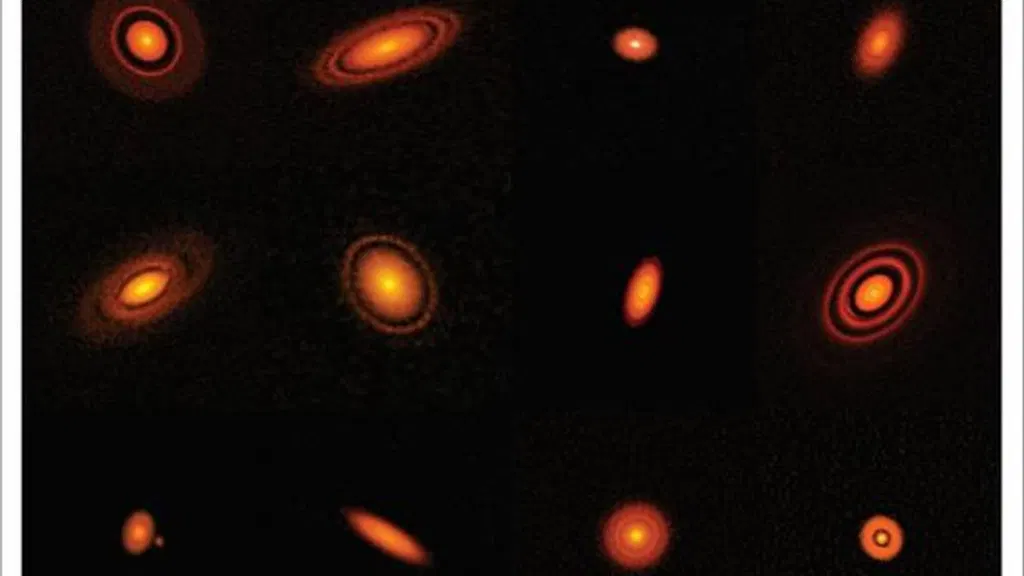
Astronomers have developed a method to estimate the mass of newborn planets using cosmic dust surrounding young stars. This technique utilizes the characteristics of dust rings to infer planetary masses, providing a new way to study protoplanetary disks. The findings have been validated through observations of the PDS 70 star system and could enhance our understanding of planetary formation.
- ▪Researchers from the University of Warwick, MIT, and McMaster University have created a method to estimate the mass of newborn planets using cosmic dust.
- ▪The study reveals that the width and brightness of dust rings can indicate the mass of planets within protoplanetary disks.
- ▪The method has been successfully applied to the PDS 70 star system, confirming its effectiveness in real observations.
Discover Magazine files mainly under science. We currently carry 86 of its stories.
Story provenance
Source · retrieval · rights · ranking — open for full record
inspect →
Story provenance
Attribution is not the same as permission. This drawer separates discovery metadata, excerpts, WeSearch-generated summaries, reuse status, and whether the publisher receives the visit. Nothing here claims a legal grant the publisher has not made.
Record
| Original publisher | Discover Magazine |
| Canonical URL | https://www.discovermagazine.com/cosmic-dust-around-young-stars-could-reveal-how-to-weigh-newborn-planets-49168 |
| Publication time | Thu, 28 May 2026 21:00:00 GMT |
| Retrieval time | 2026-05-28T21:09:38.339Z |
| Last seen | 2026-05-28T21:09:38.339Z |
| Headline source | Publisher (no WeSearch rewrite) |
| Excerpt source | publisher body |
| Excerpt method | First ~120 words (~800 chars) of extracted publisher body, fair-use limited. |
| Summary | WeSearch · cerebras-chat (WeSearch summarizer) |
| Summary source text | contentText |
| Citation coverage | Summary is a WeSearch-generated derivative; primary citation is the original publisher URL. |
| Cluster | Qf9XtQCAMxbA |
| Cluster logic | Grouped by semantic title/content similarity across sources within a rolling window. Same-publisher template collisions are excluded from coverage comparison. |
| Ranking reason | Story pages are not engagement-ranked. Hub feeds use recency, with optional source-diversified chronological ordering (cap consecutive stories per source). No personalized ranking. |
| Publisher visit | Yes — open original |
| Substitutes article? | No — link-out required for full text |
Rights status (four layers)
WeSearch handling by dimension
| Indexing | May the item be indexed (stored, ranked, made findable)? | Allowed |
| Snippet | May a short excerpt of the publisher's text be shown? | Allowed |
| AI summary | May WeSearch generate its own short summary of the article? | Limited |
| Retrieval / RAG | May the content be exposed for third-party retrieval-augmented generation? | Not asserted |
| Model training | May the content be used to train AI models? | Not asserted |
| Commercial reuse | May the content be reused commercially? | Not permitted |
Basis: Derived from the published RSS/Atom feed. Contact: [email protected]. Reviewed: 2026-07-24.
Opening excerpt (first ~120 words) tap to expand
Astronomers may have figured out a way to weigh newborn planets in other solar systems, not with a scale, but with dust. Surrounding young stars are often swirls of cosmic dust and gases that create the perfect conditions for new planets to form. Peering through those cosmic materials isn’t always easy, and even advanced telescopes can struggle to capture images of what dwells within the cosmic dust. While astronomers can pick up clues about possible planets orbiting these new stars, it is still difficult to interpret what those clues may be, until now. Researchers from the University of Warwick, MIT, and McMaster University may have developed a new method to estimate the mass of some newborn planets.
…
Excerpt limited to ~120 words for fair-use compliance. The full article is at Discover Magazine.
Discussion
0 commentsMore from Discover Magazine