Cosmic Voids May Contain the Universe’s Best Secrets
Cosmic voids, previously considered empty spaces between galaxies, are now recognized as significant areas for understanding the universe's mysteries. These regions may provide insights into gravity, dark energy, and the Hubble tension. Advances in telescopes and simulations have led to a surge in research focused on these voids, revealing their potential as unique cosmological laboratories.
- ▪Cosmic voids are vast regions mostly free of matter that exist between dense threads of the cosmic web.
- ▪New telescopes and simulations have enabled scientists to study voids more effectively, leading to a growing community of researchers.
- ▪Voids may hold answers to persistent cosmic mysteries, including the behavior of gravity and the nature of dark energy.
WIRED files mainly under tech. We currently carry 597 of its stories.
Story provenance
Source · retrieval · rights · ranking — open for full record
inspect →
Story provenance
Attribution is not the same as permission. This drawer separates discovery metadata, excerpts, WeSearch-generated summaries, reuse status, and whether the publisher receives the visit. Nothing here claims a legal grant the publisher has not made.
Record
| Original publisher | WIRED |
| Canonical URL | https://www.wired.com/story/cosmic-voids-might-contain-universes-best-secrets/ |
| Publication time | Sat, 23 May 2026 10:00:00 +0000 |
| Retrieval time | 2026-05-23T10:02:26.266Z |
| Last seen | 2026-05-23T11:22:43.911Z |
| Headline source | Publisher (no WeSearch rewrite) |
| Excerpt source | publisher body |
| Excerpt method | First ~120 words (~800 chars) of extracted publisher body, fair-use limited. |
| Summary | WeSearch · cerebras-chat (WeSearch summarizer) |
| Summary source text | contentText |
| Citation coverage | Summary is a WeSearch-generated derivative; primary citation is the original publisher URL. |
| Cluster | KKNYRaNC7wKv |
| Cluster logic | Grouped by semantic title/content similarity across sources within a rolling window. Same-publisher template collisions are excluded from coverage comparison. |
| Ranking reason | Story pages are not engagement-ranked. Hub feeds use recency, with optional source-diversified chronological ordering (cap consecutive stories per source). No personalized ranking. |
| Publisher visit | Yes — open original |
| Substitutes article? | No — link-out required for full text |
Rights status (four layers)
WeSearch handling by dimension
| Indexing | May the item be indexed (stored, ranked, made findable)? | Allowed |
| Snippet | May a short excerpt of the publisher's text be shown? | Allowed |
| AI summary | May WeSearch generate its own short summary of the article? | Limited |
| Retrieval / RAG | May the content be exposed for third-party retrieval-augmented generation? | Not asserted |
| Model training | May the content be used to train AI models? | Not asserted |
| Commercial reuse | May the content be reused commercially? | Not permitted |
Basis: Derived from the published RSS/Atom feed. Contact: [email protected]. Reviewed: 2026-07-24.
Opening excerpt (first ~120 words) tap to expand
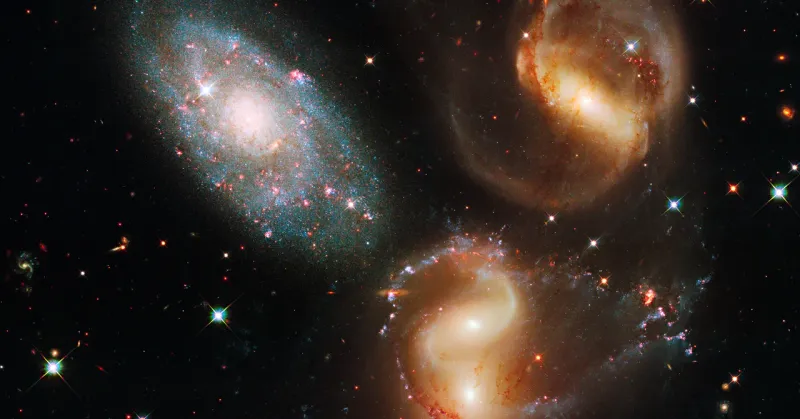
Becky FerreiraScienceMay 23, 2026 6:00 AMThe Emptiest Places in the Universe Might Contain Its Best SecretsOnce dismissed as empty expanses between galaxies, cosmic voids are becoming one of the most promising tools for probing the universe’s biggest mysteries.A composite image of Stephan's Quintet (HCG 92) in the Pegasus constellation.Photograph: NASA/Getty ImagesCommentLoaderSave StorySave this storyCommentLoaderSave StorySave this storyNature abhors a vacuum, so the saying goes, but nobody told the universe.
…
Excerpt limited to ~120 words for fair-use compliance. The full article is at WIRED.
Discussion
0 commentsMore from WIRED


.jpg&w=320)