
East Africa wants to curb imports of used clothes. But it's not easy
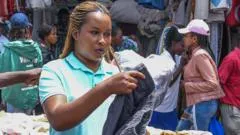
East Africa is facing challenges in curbing imports of used clothing, particularly in Kenya and Uganda. The region's markets are flooded with second-hand garments, making it difficult for local fashion industries to thrive. Recent tax measures have been introduced to protect local manufacturers, but they have sparked backlash from traders who argue for a free economy.
- ▪Kenya is Africa's leading importer of second-hand clothing, receiving almost 180,000 tonnes in 2022.
- ▪Uganda has introduced a 30% tax on used clothing imports to support local production and address environmental concerns.
- ▪Critics argue that the second-hand clothing trade, while providing jobs, does not significantly contribute to the local economy.
BBC News — World publishes from United Kingdom and files mainly under world. We currently carry 650 of its stories.
Story provenance
Source · retrieval · rights · ranking — open for full record
inspect →
Story provenance
Attribution is not the same as permission. This drawer separates discovery metadata, excerpts, WeSearch-generated summaries, reuse status, and whether the publisher receives the visit. Nothing here claims a legal grant the publisher has not made.
Record
| Original publisher | BBC News |
| Canonical URL | https://www.bbc.com/news/articles/c2l2k5pxrgdo?at_medium=RSS&at_campaign=rss |
| Publication time | Sat, 23 May 2026 23:55:13 GMT |
| Retrieval time | 2026-05-24T07:49:30.290Z |
| Last seen | 2026-05-24T07:59:39.788Z |
| Headline source | Publisher (no WeSearch rewrite) |
| Excerpt source | publisher body |
| Excerpt method | First ~120 words (~800 chars) of extracted publisher body, fair-use limited. |
| Summary | WeSearch · cerebras-chat (WeSearch summarizer) |
| Summary source text | contentText |
| Citation coverage | Summary is a WeSearch-generated derivative; primary citation is the original publisher URL. |
| Cluster | mhOxJHSZTXm7 |
| Cluster logic | Grouped by semantic title/content similarity across sources within a rolling window. Same-publisher template collisions are excluded from coverage comparison. |
| Ranking reason | Story pages are not engagement-ranked. Hub feeds use recency, with optional source-diversified chronological ordering (cap consecutive stories per source). No personalized ranking. |
| Publisher visit | Yes — open original |
| Substitutes article? | No — link-out required for full text |
Rights status (four layers)
WeSearch handling by dimension
| Indexing | May the item be indexed (stored, ranked, made findable)? | Allowed |
| Snippet | May a short excerpt of the publisher's text be shown? | Allowed |
| AI summary | May WeSearch generate its own short summary of the article? | Limited |
| Retrieval / RAG | May the content be exposed for third-party retrieval-augmented generation? | Not asserted |
| Model training | May the content be used to train AI models? | Not asserted |
| Commercial reuse | May the content be reused commercially? | Not permitted |
Basis: Derived from the published RSS/Atom feed. Contact: [email protected]. Reviewed: 2026-07-24.
Opening excerpt (first ~120 words) tap to expand
East Africa wants to curb imports of used clothes. But it's not easy8 hours agoShareSaveAdd as preferred on GoogleWedaeli ChibelushiAnadolu via Getty ImagesGikomba in Nairobi is just one of many huge markets dedicated to worn clothing in East AfricaNot even heavy rain can keep shoppers away from Gikomba, a lively Kenyan market that stands as the largest open-air trading hub in East Africa.Sections of the site were waterlogged on the day the BBC visited, yet shoppers, some wearing rubber boots, still inched their way through the congested pathways, hunting for Gikomba's speciality - second-hand clothing.The trade in garments imported from the US, Europe and China poses a perennial problem for the East African Community (EAC), a regional bloc of which Kenya is a member.
…
Excerpt limited to ~120 words for fair-use compliance. The full article is at BBC News.
Discussion
0 commentsMore from BBC News


