Effective Context Engineering for AI Agents: A Developer's Guide
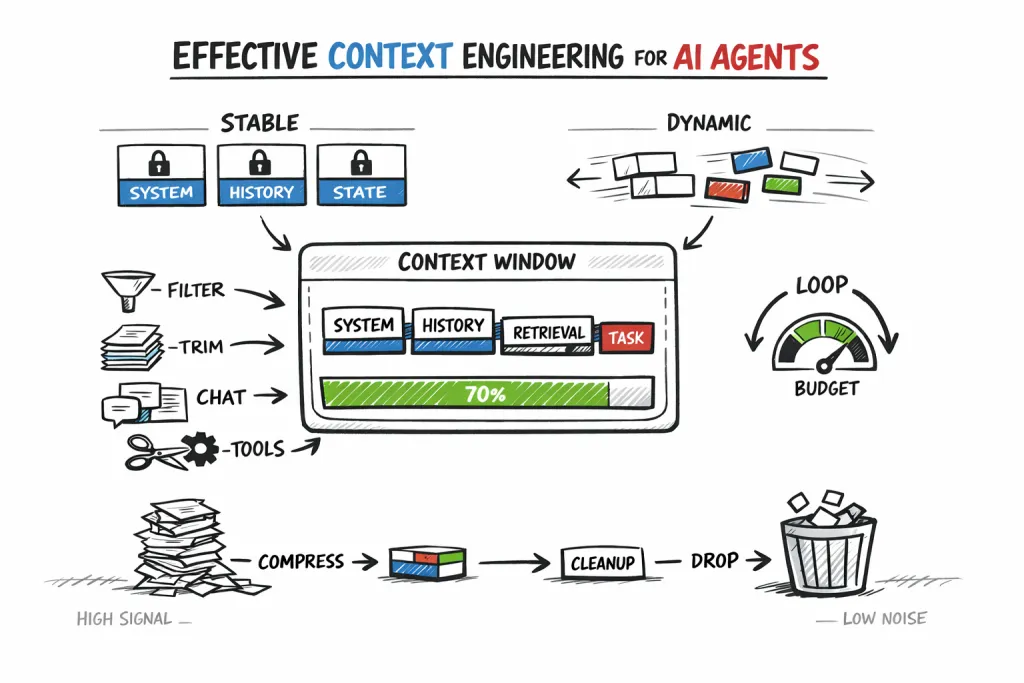
The article discusses effective context engineering for AI agents, emphasizing its importance in maintaining reliability and efficiency. It outlines key practices such as managing the context window, structuring context layers, and evaluating context quality. By treating the context window as a constrained resource, developers can optimize AI performance and reduce costs.
- ▪Context engineering involves deciding what information enters the context window and what gets compressed or dropped.
- ▪Mismanagement of the context window can lead to bloated inputs and degraded reasoning in AI agents.
- ▪The article highlights the need to separate static from dynamic content and manage conversation history effectively.
Story provenance
Source · retrieval · rights · ranking — open for full record
inspect →
Story provenance
Attribution is not the same as permission. This drawer separates discovery metadata, excerpts, WeSearch-generated summaries, reuse status, and whether the publisher receives the visit. Nothing here claims a legal grant the publisher has not made.
Record
| Original publisher | MachineLearningMastery.com |
| Canonical URL | https://machinelearningmastery.com/effective-context-engineering-for-ai-agents-a-developers-guide/ |
| Publication time | Tue, 28 Apr 2026 12:16:46 +0000 |
| Retrieval time | 2026-04-28T12:24:31.929Z |
| Last seen | 2026-04-28T12:24:31.929Z |
| Headline source | Publisher (no WeSearch rewrite) |
| Excerpt source | publisher body |
| Excerpt method | First ~120 words (~800 chars) of extracted publisher body, fair-use limited. |
| Summary | WeSearch · cerebras-chat (WeSearch summarizer) |
| Summary source text | contentText |
| Citation coverage | Summary is a WeSearch-generated derivative; primary citation is the original publisher URL. |
| Cluster | aLUvgQsMqQLQ |
| Cluster logic | Grouped by semantic title/content similarity across sources within a rolling window. Same-publisher template collisions are excluded from coverage comparison. |
| Ranking reason | Story pages are not engagement-ranked. Hub feeds use recency, with optional source-diversified chronological ordering (cap consecutive stories per source). No personalized ranking. |
| Publisher visit | Yes — open original |
| Substitutes article? | No — link-out required for full text |
Rights status (four layers)
WeSearch handling by dimension
| Indexing | May the item be indexed (stored, ranked, made findable)? | Allowed |
| Snippet | May a short excerpt of the publisher's text be shown? | Allowed |
| AI summary | May WeSearch generate its own short summary of the article? | Limited |
| Retrieval / RAG | May the content be exposed for third-party retrieval-augmented generation? | Not asserted |
| Model training | May the content be used to train AI models? | Not asserted |
| Commercial reuse | May the content be reused commercially? | Not permitted |
Basis: Derived from the published RSS/Atom feed. Contact: [email protected]. Reviewed: 2026-07-24.
Opening excerpt (first ~120 words) tap to expand
Effective Context Engineering for AI Agents: A Developer’s Guide By Bala Priya C on April 28, 2026 in Artificial Intelligence 4 Share Post Share In this article, you will learn what context engineering is and how to apply it systematically to keep AI agents reliable, cost-efficient, and accurate in production. Topics we will cover include: How to treat the context window as a constrained resource and understand the financial and cognitive costs of token mismanagement. How to structure context layers — separating static from dynamic content, managing conversation history, and designing retrieval as a budget decision. How to evaluate and monitor context quality in production using probe-based evaluation and context-specific metrics.
…
Excerpt limited to ~120 words for fair-use compliance. The full article is at MachineLearningMastery.com.
Discussion
0 commentsMore from MachineLearningMastery.com