Embodying Spirit
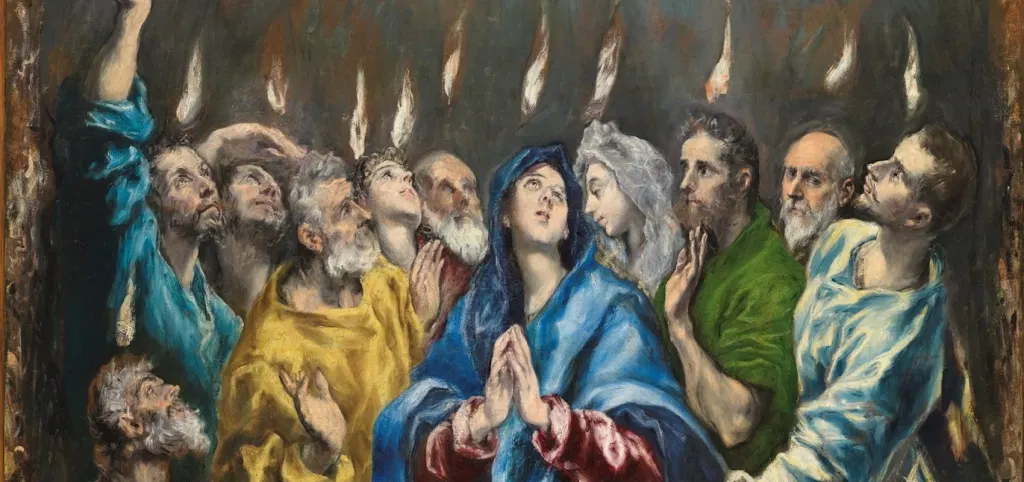
The article discusses the role of the Holy Spirit as depicted in the Bible, particularly during Pentecost. It emphasizes how the Spirit empowers the disciples to speak boldly and act selflessly, leading to the growth of the early Church. The author connects the Spirit's embodiment in believers to the incarnation of Christ, highlighting the transformative power of the Spirit in the community of faith.
- ▪The Holy Spirit is described as breath, wind, smoke, and flame, illustrating his elusive nature.
- ▪At Pentecost, the Spirit empowers the disciples to speak in various languages and emboldens them to preach publicly.
- ▪The Spirit's presence leads to the formation of a community that shares resources and supports one another.
First Things files mainly under religion. We currently carry 17 of its stories.
Story provenance
Source · retrieval · rights · ranking — open for full record
inspect →
Story provenance
Attribution is not the same as permission. This drawer separates discovery metadata, excerpts, WeSearch-generated summaries, reuse status, and whether the publisher receives the visit. Nothing here claims a legal grant the publisher has not made.
Record
| Original publisher | First Things |
| Canonical URL | https://firstthings.com/embodying-spirit/ |
| Publication time | Fri, 22 May 2026 05:00:00 +0000 |
| Retrieval time | 2026-05-22T05:02:00.539Z |
| Last seen | 2026-05-22T05:02:00.539Z |
| Headline source | Publisher (no WeSearch rewrite) |
| Excerpt source | publisher body |
| Excerpt method | First ~120 words (~800 chars) of extracted publisher body, fair-use limited. |
| Summary | WeSearch · cerebras-chat (WeSearch summarizer) |
| Summary source text | contentText |
| Citation coverage | Summary is a WeSearch-generated derivative; primary citation is the original publisher URL. |
| Cluster | None |
| Cluster logic | Not yet clustered, or no peer story found in the clustering window. |
| Ranking reason | Story pages are not engagement-ranked. Hub feeds use recency, with optional source-diversified chronological ordering (cap consecutive stories per source). No personalized ranking. |
| Publisher visit | Yes — open original |
| Substitutes article? | No — link-out required for full text |
Rights status (four layers)
WeSearch handling by dimension
| Indexing | May the item be indexed (stored, ranked, made findable)? | Allowed |
| Snippet | May a short excerpt of the publisher's text be shown? | Allowed |
| AI summary | May WeSearch generate its own short summary of the article? | Limited |
| Retrieval / RAG | May the content be exposed for third-party retrieval-augmented generation? | Not asserted |
| Model training | May the content be used to train AI models? | Not asserted |
| Commercial reuse | May the content be reused commercially? | Not permitted |
Basis: Derived from the published RSS/Atom feed. Contact: [email protected]. Reviewed: 2026-07-24.
Opening excerpt (first ~120 words) tap to expand
Embodying Spirit Peter J. Leithart May 22, 2026 Share Article The Bible figures the Spirit as breath, wind, smoke, and flame. He blows where he will, circulates invisibly, flickers like glory. You can hear his voice, but you can’t determine where he came from or where he’s going. You can no more grasp or control the ethereal Spirit than you can mold the mist. Just so, at Pentecost, he arrives as a rushing, mighty wind and ignites tongues of fire on the heads of the assembled disciples. It seems one could almost be forgiven for mistaking the Spirit for an airy nothing. That’s not the trajectory of Pentecost. The Pentecostal Spirit manifests himself in the bodies of those who receive him.
…
Excerpt limited to ~120 words for fair-use compliance. The full article is at First Things.
Discussion
0 commentsMore from First Things