<em>Marasuchus</em> Was Built for Speed — and 5 Other Facts About the Dinosaur's Ancient Relative
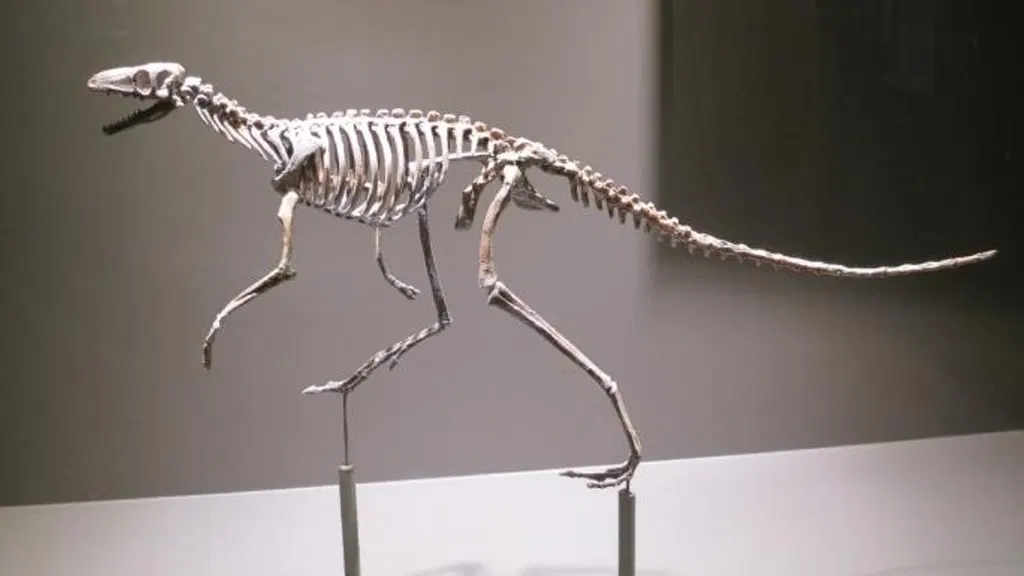
Marasuchus is a small, speedy precursor to dinosaurs that lived during the Late Triassic Period. This tiny reptile thrived in the supercontinent Pangea and filled an ecological niche after a major extinction event. Despite its delicate structure, Marasuchus showcases the evolutionary beginnings of larger reptiles like dinosaurs and pterosaurs.
- ▪Marasuchus was a small reptile that lived around 230 million years ago in modern-day Argentina.
- ▪It was built for speed, with long legs and a tail that aided in balance and muscular power.
- ▪Marasuchus thrived in Pangea, a supercontinent that allowed for easier movement and survival after a mass extinction.
Discover Magazine files mainly under science. We currently carry 86 of its stories.
Story provenance
Source · retrieval · rights · ranking — open for full record
inspect →
Story provenance
Attribution is not the same as permission. This drawer separates discovery metadata, excerpts, WeSearch-generated summaries, reuse status, and whether the publisher receives the visit. Nothing here claims a legal grant the publisher has not made.
Record
| Original publisher | Discover Magazine |
| Canonical URL | https://www.discovermagazine.com/marasuchus-was-built-for-speed-and-5-other-facts-about-the-dinosaur-s-ancient-relative-49171 |
| Publication time | Thu, 28 May 2026 22:05:00 GMT |
| Retrieval time | 2026-05-28T22:14:38.345Z |
| Last seen | 2026-05-28T22:14:38.345Z |
| Headline source | Publisher (no WeSearch rewrite) |
| Excerpt source | publisher body |
| Excerpt method | First ~120 words (~800 chars) of extracted publisher body, fair-use limited. |
| Summary | WeSearch · cerebras-chat (WeSearch summarizer) |
| Summary source text | contentText |
| Citation coverage | Summary is a WeSearch-generated derivative; primary citation is the original publisher URL. |
| Cluster | Znb9B0mPHc3Q |
| Cluster logic | Grouped by semantic title/content similarity across sources within a rolling window. Same-publisher template collisions are excluded from coverage comparison. |
| Ranking reason | Story pages are not engagement-ranked. Hub feeds use recency, with optional source-diversified chronological ordering (cap consecutive stories per source). No personalized ranking. |
| Publisher visit | Yes — open original |
| Substitutes article? | No — link-out required for full text |
Rights status (four layers)
WeSearch handling by dimension
| Indexing | May the item be indexed (stored, ranked, made findable)? | Allowed |
| Snippet | May a short excerpt of the publisher's text be shown? | Allowed |
| AI summary | May WeSearch generate its own short summary of the article? | Limited |
| Retrieval / RAG | May the content be exposed for third-party retrieval-augmented generation? | Not asserted |
| Model training | May the content be used to train AI models? | Not asserted |
| Commercial reuse | May the content be reused commercially? | Not permitted |
Basis: Derived from the published RSS/Atom feed. Contact: [email protected]. Reviewed: 2026-07-24.
Opening excerpt (first ~120 words) tap to expand
Marasuchus is a precursor to dinosaurs, one of its closest relatives from the genus Dinosauriform Archosaur. It belongs to the same reptilian family tree as dinosaurs, birds, and pterosaurs, the flying reptiles from the Age of Dinosaurs. This close relative of the mega-dinosaurs that would come next was tiny and started out really low on the food chain, at risk of being eaten by most any other larger predator that lived around it.“Marasuchus shows us where dinosaurs came from, which were very humble beginnings,” Scott Persons, curator of Natural History at the South Carolina State Museum, told Discover. There’s a lot we don’t know about Marasuchus. Researchers haven’t found many specimens because it’s small and delicate, with thin limbs that easily break.
…
Excerpt limited to ~120 words for fair-use compliance. The full article is at Discover Magazine.
Discussion
0 commentsMore from Discover Magazine