From Silos to Service Topology: Why Netflix Built a Real-Time Service Map
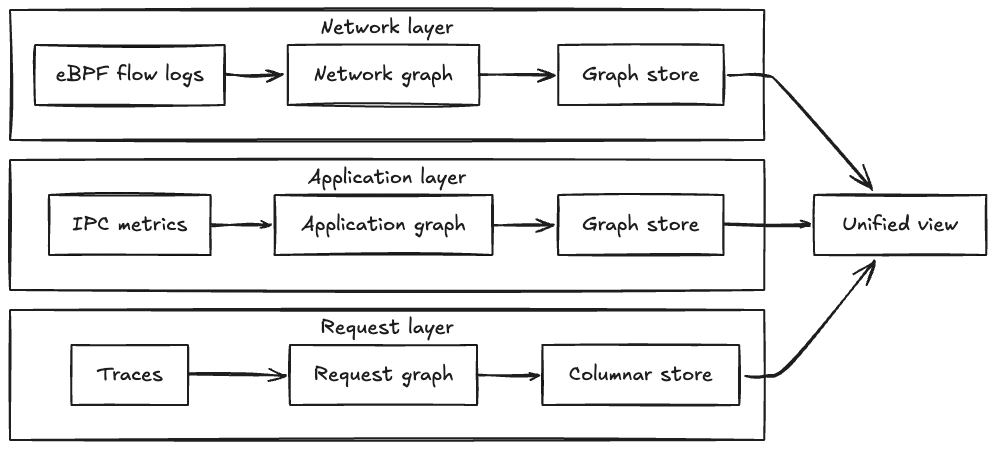
Netflix built a real-time service map to help engineers understand dependencies and troubleshoot issues faster. The map provides a unified view of service dependencies, allowing engineers to navigate and identify the root cause of problems. This tool is crucial for Netflix's distributed infrastructure, which consists of thousands of microservices working together to deliver entertainment to members worldwide.
- ▪Netflix's real-time service map helps engineers understand dependencies and troubleshoot issues faster.
- ▪The map provides a unified view of service dependencies, showing how everything connects.
- ▪The tool is crucial for Netflix's distributed infrastructure, which consists of thousands of microservices.
- ▪The real-time service map updates in near real-time, making it useful in dynamic environments.
- ▪The map helps engineers answer key questions, such as which services depend on each other and what's the blast radius of a failure.
Hacker News (Newest) files mainly under programming. We currently carry 5,306 of its stories.
Story provenance
Source · retrieval · rights · ranking — open for full record
inspect →
Story provenance
Attribution is not the same as permission. This drawer separates discovery metadata, excerpts, WeSearch-generated summaries, reuse status, and whether the publisher receives the visit. Nothing here claims a legal grant the publisher has not made.
Record
| Original publisher | Medium |
| Canonical URL | https://netflixtechblog.com/from-silos-to-service-topology-why-netflix-built-a-real-time-service-map-0165ba13a7bc |
| Publication time | Wed, 03 Jun 2026 02:34:39 +0000 |
| Retrieval time | 2026-06-03T02:41:48.967Z |
| Last seen | 2026-06-03T02:41:50.207Z |
| Headline source | Publisher (no WeSearch rewrite) |
| Excerpt source | publisher body |
| Excerpt method | First ~120 words (~800 chars) of extracted publisher body, fair-use limited. |
| Summary | WeSearch · cerebras-chat (WeSearch summarizer) |
| Summary source text | contentText |
| Citation coverage | Summary is a WeSearch-generated derivative; primary citation is the original publisher URL. |
| Cluster | OdBYuEOU9ZCh |
| Cluster logic | Grouped by semantic title/content similarity across sources within a rolling window. Same-publisher template collisions are excluded from coverage comparison. |
| Ranking reason | Story pages are not engagement-ranked. Hub feeds use recency, with optional source-diversified chronological ordering (cap consecutive stories per source). No personalized ranking. |
| Publisher visit | Yes — open original |
| Substitutes article? | No — link-out required for full text |
Rights status (four layers)
WeSearch handling by dimension
| Indexing | May the item be indexed (stored, ranked, made findable)? | Allowed |
| Snippet | May a short excerpt of the publisher's text be shown? | Allowed |
| AI summary | May WeSearch generate its own short summary of the article? | Limited |
| Retrieval / RAG | May the content be exposed for third-party retrieval-augmented generation? | Not asserted |
| Model training | May the content be used to train AI models? | Not asserted |
| Commercial reuse | May the content be reused commercially? | Not permitted |
Basis: Derived from the published RSS/Atom feed. Contact: [email protected]. Reviewed: 2026-07-24.
Opening excerpt (first ~120 words) tap to expand
From Silos to Service Topology: Why Netflix Built a Real-Time Service MapNetflix Technology Blog12 min read·May 29, 2026--9ListenShareBy Parth Jain, Rakesh Sukumar, Yingwu Zhao, Renzo Sanchez-Silva & Nathan FisherHow we built a living map of our distributed infrastructure to help engineers understand dependencies, troubleshoot faster, and keep Netflix running smoothly for our members around the world.The Puzzle with a Thousand PiecesPicture this: It’s 3am, and an engineer gets paged. One of our critical services is showing elevated error rates. Members trying to watch their favorite films and series are seeing degraded experiences.
…
Excerpt limited to ~120 words for fair-use compliance. The full article is at Medium.
Discussion
0 commentsMore from Medium