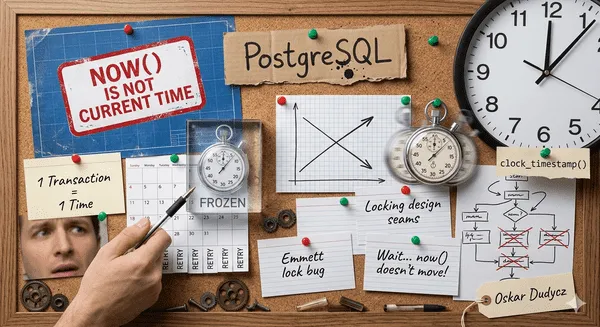
How soon is now in PostgreSQL?
The article discusses a challenge encountered while working with PostgreSQL, specifically related to distributed locking. It highlights the importance of ensuring that only one instance of a message processor is active at a time to avoid issues like duplicated side effects. The author shares insights on a bug found during the implementation of a locking mechanism and the debugging process that followed.
- ▪The author faced difficulties with PostgreSQL while implementing distributed locking in a service called Emmett.
- ▪The system uses PostgreSQL advisory locks and a database table to manage processor ownership and status.
- ▪A bug was discovered in the upsert function that affected the takeover decision when a processor instance crashed.
2 outlets in our directory ran this story, first to last over 3 hours. All of the coverage we found sits in one bucket: centre. That one-sidedness is itself worth noticing.
- ▪ How soon is now in PostgreSQL? — r/programming
Hacker News (Newest) files mainly under programming. We currently carry 5,306 of its stories.
Story provenance
Source · retrieval · rights · ranking — open for full record
inspect →
Story provenance
Attribution is not the same as permission. This drawer separates discovery metadata, excerpts, WeSearch-generated summaries, reuse status, and whether the publisher receives the visit. Nothing here claims a legal grant the publisher has not made.
Record
| Original publisher | Event-driven |
| Canonical URL | https://event-driven.io/en/how-soon-is-now-in-postgresql/ |
| Publication time | Mon, 25 May 2026 15:25:38 +0000 |
| Retrieval time | 2026-05-25T15:37:38.244Z |
| Last seen | 2026-05-25T15:37:38.244Z |
| Headline source | Publisher (no WeSearch rewrite) |
| Excerpt source | publisher body |
| Excerpt method | First ~120 words (~800 chars) of extracted publisher body, fair-use limited. |
| Summary | WeSearch · cerebras-chat (WeSearch summarizer) |
| Summary source text | contentText |
| Citation coverage | Summary is a WeSearch-generated derivative; primary citation is the original publisher URL. |
| Cluster | DJLbgXgu_u0I · 2 stories |
| Cluster logic | Grouped by semantic title/content similarity across sources within a rolling window. Same-publisher template collisions are excluded from coverage comparison. |
| Ranking reason | Story pages are not engagement-ranked. Hub feeds use recency, with optional source-diversified chronological ordering (cap consecutive stories per source). No personalized ranking. |
| Publisher visit | Yes — open original |
| Substitutes article? | No — link-out required for full text |
Rights status (four layers)
WeSearch handling by dimension
| Indexing | May the item be indexed (stored, ranked, made findable)? | Allowed |
| Snippet | May a short excerpt of the publisher's text be shown? | Allowed |
| AI summary | May WeSearch generate its own short summary of the article? | Limited |
| Retrieval / RAG | May the content be exposed for third-party retrieval-augmented generation? | Not asserted |
| Model training | May the content be used to train AI models? | Not asserted |
| Commercial reuse | May the content be reused commercially? | Not permitted |
Basis: Derived from the published RSS/Atom feed. Contact: [email protected]. Reviewed: 2026-07-24.
Opening excerpt (first ~120 words) tap to expand
How soon is now in PostgreSQL? 2026-05-25 oskar dudyczPostgreSQL How soon is now? In PostgreSQL, it’s not always as soon as you’d think. I learned that the hard way recently, so you don’t have to. It took me hours and wasn’t easy to reproduce, even though the fix is one line. I found it in a Cybertec post, as I quite often do when I’m staring at something odd in PostgreSQL. I’m supposed to know my way around the database, but I missed it, which is another reason I want to write this down. I was working on distributed locking in Emmett. When you scale a service horizontally, you can easily end up with two instances of the same message processor running at once. That’s bad.
…
Excerpt limited to ~120 words for fair-use compliance. The full article is at Event-driven.
Discussion
0 commentsMore from Event-driven