How to Debug AI Agents with Traces and Evals
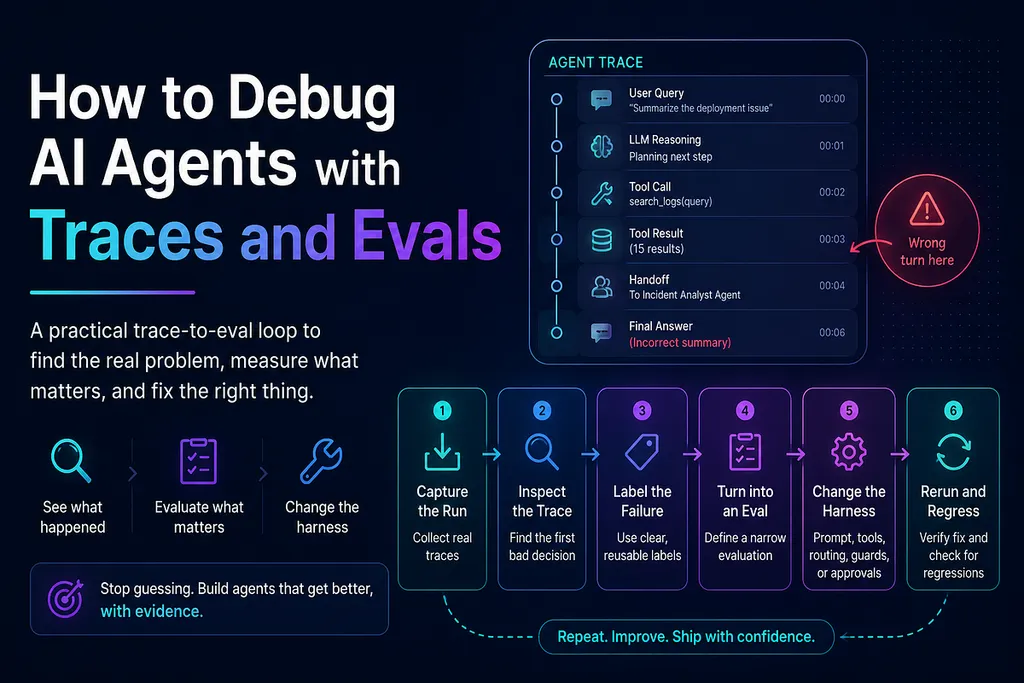
The article discusses the importance of debugging AI agents through a systematic approach rather than simply editing prompts. It emphasizes the need to capture traces of agent performance to identify and label failures before making changes. This method aims to improve the overall quality of AI agents by establishing a trace-to-eval loop.
- ▪AI agents often fail without clear explanations in chat transcripts.
- ▪A better debugging workflow involves capturing traces and labeling errors before modifying prompts.
- ▪OpenAI's Agents SDK provides tools for tracing LLM generations and other events during agent runs.
Hacker News (AI / LLM) files mainly under ai. We currently carry 3,266 of its stories.
Story provenance
Source · retrieval · rights · ranking — open for full record
inspect →
Story provenance
Attribution is not the same as permission. This drawer separates discovery metadata, excerpts, WeSearch-generated summaries, reuse status, and whether the publisher receives the visit. Nothing here claims a legal grant the publisher has not made.
Record
| Original publisher | Medium |
| Canonical URL | https://medium.com/no-time/how-to-debug-ai-agents-with-traces-and-evals-a3b72e9e7c82 |
| Publication time | Wed, 03 Jun 2026 19:46:47 +0000 |
| Retrieval time | 2026-06-03T19:51:05.126Z |
| Last seen | 2026-06-03T19:51:05.126Z |
| Headline source | Publisher (no WeSearch rewrite) |
| Excerpt source | publisher body |
| Excerpt method | First ~120 words (~800 chars) of extracted publisher body, fair-use limited. |
| Summary | WeSearch · cerebras-chat (WeSearch summarizer) |
| Summary source text | contentText |
| Citation coverage | Summary is a WeSearch-generated derivative; primary citation is the original publisher URL. |
| Cluster | K4KdU1aFheUB |
| Cluster logic | Grouped by semantic title/content similarity across sources within a rolling window. Same-publisher template collisions are excluded from coverage comparison. |
| Ranking reason | Story pages are not engagement-ranked. Hub feeds use recency, with optional source-diversified chronological ordering (cap consecutive stories per source). No personalized ranking. |
| Publisher visit | Yes — open original |
| Substitutes article? | No — link-out required for full text |
Rights status (four layers)
WeSearch handling by dimension
| Indexing | May the item be indexed (stored, ranked, made findable)? | Allowed |
| Snippet | May a short excerpt of the publisher's text be shown? | Allowed |
| AI summary | May WeSearch generate its own short summary of the article? | Limited |
| Retrieval / RAG | May the content be exposed for third-party retrieval-augmented generation? | Not asserted |
| Model training | May the content be used to train AI models? | Not asserted |
| Commercial reuse | May the content be reused commercially? | Not permitted |
Basis: Derived from the published RSS/Atom feed. Contact: [email protected]. Reviewed: 2026-07-24.
Opening excerpt (first ~120 words) tap to expand
Member-only storyHow to Debug AI Agents with Traces and EvalsYour AI agent failed, but the chat transcript doesn’t explain why.Sukhpinder Singh8 min read·Just now--ListenSharePress enter or click to view image in full sizeThis image was created using an AI image generation program.So someone edits the prompt, reruns one example, and calls it fixed.That is how agent quality turns into guesswork.A better workflow is slower at first and faster later: capture traces, label what actually went wrong, convert those labels into evals, and only then change the prompt, tools, routing, guardrails, or harness.
…
Excerpt limited to ~120 words for fair-use compliance. The full article is at Medium.
Discussion
0 commentsMore from Medium