How to Mathematically Choose the Optimal Bins for Your Histogram
The article discusses the mathematical considerations for choosing optimal bins in histograms, emphasizing the importance of resolution in data visualization. It explores various mathematical approaches, including Bayesian methods and Taylor expansions, to determine how bin sizes should adjust as datasets grow. The piece highlights the balance between detail and complexity in histogram construction, aiming to improve data representation.
- ▪Histograms are essential for visualizing data density, and their resolution is crucial for accurate analysis.
- ▪The article examines how bin sizes should decrease as the amount of data increases to avoid low-resolution visualizations.
- ▪It discusses mathematical concepts such as perturbation theory and Taylor expansions as methods for determining optimal bin sizes.
Towards Data Science files mainly under ai. We currently carry 104 of its stories.
Story provenance
Source · retrieval · rights · ranking — open for full record
inspect →
Story provenance
Attribution is not the same as permission. This drawer separates discovery metadata, excerpts, WeSearch-generated summaries, reuse status, and whether the publisher receives the visit. Nothing here claims a legal grant the publisher has not made.
Record
| Original publisher | Towards Data Science |
| Canonical URL | https://towardsdatascience.com/fun-with-histograms-and-densities/ |
| Publication time | Sat, 23 May 2026 17:00:00 +0000 |
| Retrieval time | 2026-05-23T17:12:27.500Z |
| Last seen | 2026-05-23T17:12:27.500Z |
| Headline source | Publisher (no WeSearch rewrite) |
| Excerpt source | publisher body |
| Excerpt method | First ~120 words (~800 chars) of extracted publisher body, fair-use limited. |
| Summary | WeSearch · cerebras-chat (WeSearch summarizer) |
| Summary source text | contentText |
| Citation coverage | Summary is a WeSearch-generated derivative; primary citation is the original publisher URL. |
| Cluster | UxMf5zgwvFMl |
| Cluster logic | Grouped by semantic title/content similarity across sources within a rolling window. Same-publisher template collisions are excluded from coverage comparison. |
| Ranking reason | Story pages are not engagement-ranked. Hub feeds use recency, with optional source-diversified chronological ordering (cap consecutive stories per source). No personalized ranking. |
| Publisher visit | Yes — open original |
| Substitutes article? | No — link-out required for full text |
Rights status (four layers)
WeSearch handling by dimension
| Indexing | May the item be indexed (stored, ranked, made findable)? | Allowed |
| Snippet | May a short excerpt of the publisher's text be shown? | Allowed |
| AI summary | May WeSearch generate its own short summary of the article? | Limited |
| Retrieval / RAG | May the content be exposed for third-party retrieval-augmented generation? | Not asserted |
| Model training | May the content be used to train AI models? | Not asserted |
| Commercial reuse | May the content be reused commercially? | Not permitted |
Basis: Derived from the published RSS/Atom feed. Contact: [email protected]. Reviewed: 2026-07-24.
Opening excerpt (first ~120 words) tap to expand
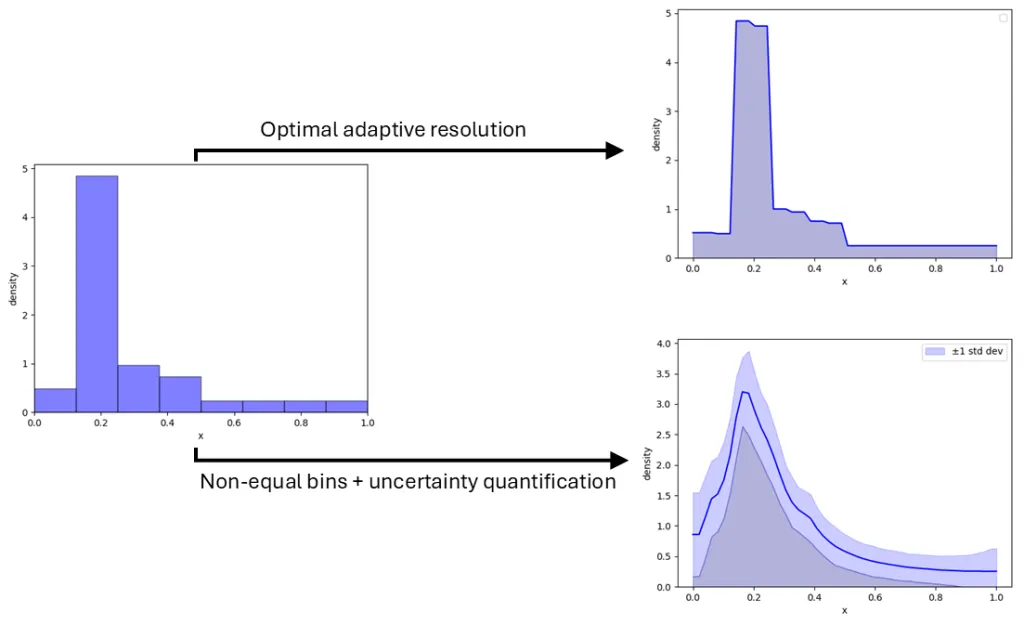
Data Science How to Mathematically Choose the Optimal Bins for Your Histogram Optimal resolution in histograms: a rigorous Bayesian approach to density fitting Fetze Pijlman May 23, 2026 10 min read Share On the left a standard density with fixed resolution, on the top right a density with adaptive resolution, on the bottom right a density with adaptive non-equal bins and including an uncertainty quantification. Abstract Have you ever wondered how to choose your bins in a histogram? Did you ever ask yourself whether there are deeper reasons for choices that go beyond that it just looks nice? While histograms are the most fundamental tool for data visualization, setting their resolution is important, especially when the histogram itself is used for further analyses.
…
Excerpt limited to ~120 words for fair-use compliance. The full article is at Towards Data Science.
Discussion
0 commentsMore from Towards Data Science