Hubble Sights Galaxy in Transition
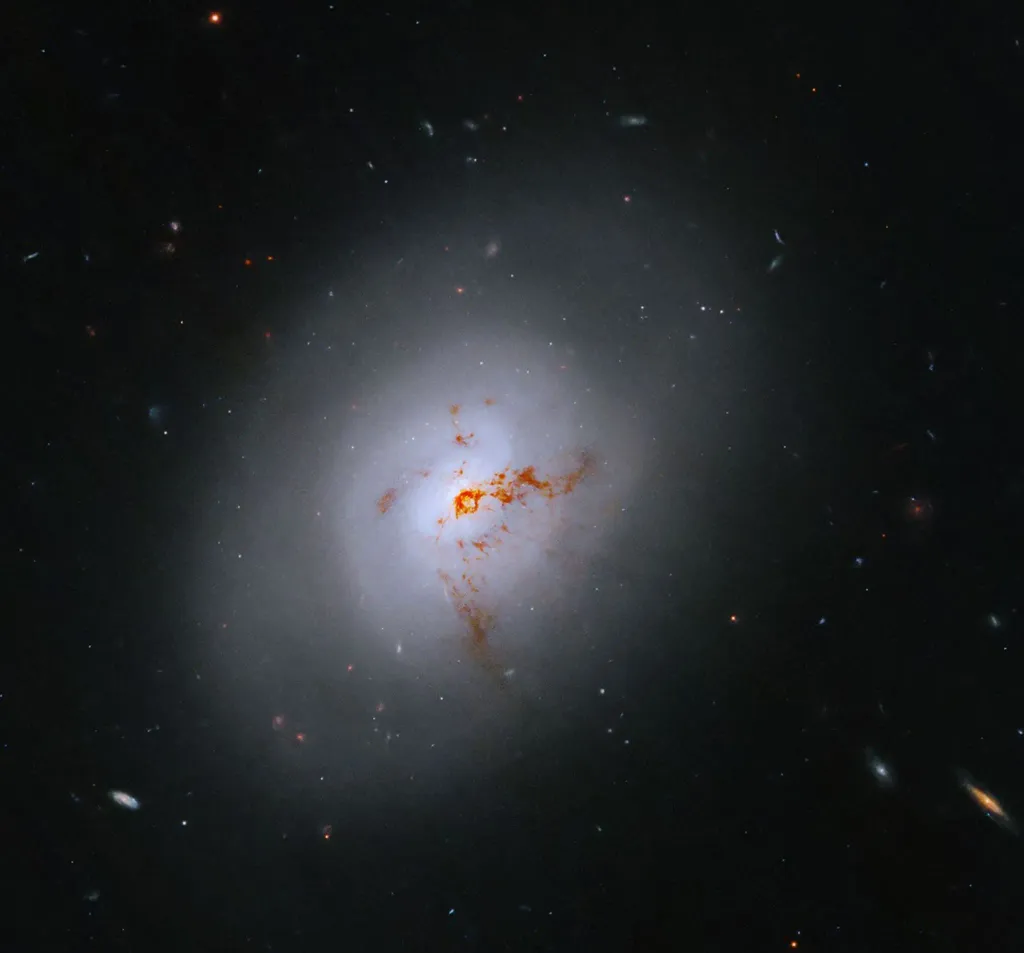
NASA's Hubble Space Telescope has captured an image of the lenticular galaxy NGC 1266, located 100 million light-years away. This galaxy exhibits a bright center and hints of spiral structure, despite lacking obvious spiral arms. Lenticular galaxies like NGC 1266 serve as a transitional form between spiral and elliptical galaxies.
- ▪NGC 1266 is classified as a lenticular galaxy.
- ▪It is located in the constellation Eridanus.
- ▪The galaxy is approximately 100 million light-years away from Earth.
NASA — Breaking News files mainly under science. We currently carry 94 of its stories.
Story provenance
Source · retrieval · rights · ranking — open for full record
inspect →
Story provenance
Attribution is not the same as permission. This drawer separates discovery metadata, excerpts, WeSearch-generated summaries, reuse status, and whether the publisher receives the visit. Nothing here claims a legal grant the publisher has not made.
Record
| Original publisher | NASA — Breaking News |
| Canonical URL | https://www.nasa.gov/image-article/hubble-sights-galaxy-in-transition/ |
| Publication time | Thu, 21 May 2026 17:32:03 +0000 |
| Retrieval time | 2026-05-21T17:46:35.362Z |
| Last seen | 2026-05-21T17:46:35.362Z |
| Headline source | Publisher (no WeSearch rewrite) |
| Excerpt source | publisher body |
| Excerpt method | First ~120 words (~800 chars) of extracted publisher body, fair-use limited. |
| Summary | WeSearch · cerebras-chat (WeSearch summarizer) |
| Summary source text | contentText |
| Citation coverage | Summary is a WeSearch-generated derivative; primary citation is the original publisher URL. |
| Cluster | yBgHx72EjPnV |
| Cluster logic | Grouped by semantic title/content similarity across sources within a rolling window. Same-publisher template collisions are excluded from coverage comparison. |
| Ranking reason | Story pages are not engagement-ranked. Hub feeds use recency, with optional source-diversified chronological ordering (cap consecutive stories per source). No personalized ranking. |
| Publisher visit | Yes — open original |
| Substitutes article? | No — link-out required for full text |
Rights status (four layers)
WeSearch handling by dimension
| Indexing | May the item be indexed (stored, ranked, made findable)? | Allowed |
| Snippet | May a short excerpt of the publisher's text be shown? | Allowed |
| AI summary | May WeSearch generate its own short summary of the article? | Limited |
| Retrieval / RAG | May the content be exposed for third-party retrieval-augmented generation? | Not asserted |
| Model training | May the content be used to train AI models? | Not asserted |
| Commercial reuse | May the content be reused commercially? | Not permitted |
Basis: Derived from the published RSS/Atom feed. Contact: [email protected]. Reviewed: 2026-07-24.
Opening excerpt (first ~120 words) tap to expand
1 min readHubble Sights Galaxy in TransitionNASA Hubble Mission TeamGoddard Space Flight CenterMay 21, 2026 Image Article NASA, ESA, K. Alatalo (STScI); Image Processing: G. Kober (NASA/Catholic University of America) This NASA Hubble Space Telescope image reveals an enigmatic galaxy with a bright center and a face that hints at spiral structure, yet it holds no obvious spiral arms. Reddish-brown clumps and filaments of dust partially obscure the galaxy’s full face, while red, blue, and orange light from distant galaxies shines through its diffuse outer regions and dots the inky-black background. NGC 1266 is a lenticular galaxy located some 100 million light-years away in the constellation Eridanus (the Celestial River).
…
Excerpt limited to ~120 words for fair-use compliance. The full article is at NASA — Breaking News.
Discussion
0 commentsMore from NASA — Breaking News