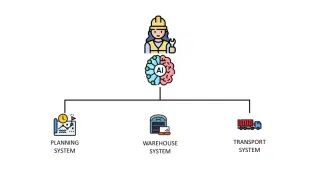
It used to be a beautifully imperfect world

The article discusses the impact of AI and large language models (LLMs) on human reasoning and productivity. It highlights the tension between the efficiency gained from using AI and the potential loss of critical thinking skills. The author reflects on the societal pressures to adopt AI tools in the workplace, suggesting that this trend may lead to a dehumanizing experience for individuals.
- ▪LLMs make tasks faster and easier, but they may hinder personal reasoning and understanding.
- ▪The use of AI can create pressure to produce results quickly, especially for those early in their careers.
- ▪The author argues that while AI can enhance productivity, it may ultimately make us less capable over time.
Hacker News (Newest) files mainly under programming. We currently carry 5,306 of its stories.
Story provenance
Source · retrieval · rights · ranking — open for full record
inspect →
Story provenance
Attribution is not the same as permission. This drawer separates discovery metadata, excerpts, WeSearch-generated summaries, reuse status, and whether the publisher receives the visit. Nothing here claims a legal grant the publisher has not made.
Record
| Original publisher | User8 |
| Canonical URL | https://user8.bearblog.dev/it-used-to-be-a-beautifully-imperfect-world/ |
| Publication time | Wed, 20 May 2026 07:41:30 +0000 |
| Retrieval time | 2026-05-20T08:05:00.822Z |
| Last seen | 2026-05-20T08:05:00.822Z |
| Headline source | Publisher (no WeSearch rewrite) |
| Excerpt source | publisher body |
| Excerpt method | First ~120 words (~800 chars) of extracted publisher body, fair-use limited. |
| Summary | WeSearch · cerebras-chat (WeSearch summarizer) |
| Summary source text | contentText |
| Citation coverage | Summary is a WeSearch-generated derivative; primary citation is the original publisher URL. |
| Cluster | 8ih75y0csHpK |
| Cluster logic | Grouped by semantic title/content similarity across sources within a rolling window. Same-publisher template collisions are excluded from coverage comparison. |
| Ranking reason | Story pages are not engagement-ranked. Hub feeds use recency, with optional source-diversified chronological ordering (cap consecutive stories per source). No personalized ranking. |
| Publisher visit | Yes — open original |
| Substitutes article? | No — link-out required for full text |
Rights status (four layers)
WeSearch handling by dimension
| Indexing | May the item be indexed (stored, ranked, made findable)? | Allowed |
| Snippet | May a short excerpt of the publisher's text be shown? | Allowed |
| AI summary | May WeSearch generate its own short summary of the article? | Limited |
| Retrieval / RAG | May the content be exposed for third-party retrieval-augmented generation? | Not asserted |
| Model training | May the content be used to train AI models? | Not asserted |
| Commercial reuse | May the content be reused commercially? | Not permitted |
Basis: Derived from the published RSS/Atom feed. Contact: [email protected]. Reviewed: 2026-07-24.
Opening excerpt (first ~120 words) tap to expand
It used to be a beautifully imperfect world 20 May, 2026 LLMs make a lot of tasks faster, more accurate, easier. Like writing a function in code, analyzing long text, or searching for a fuzzy statistic. Before November 2022, you would have to look through wikipedia, a blog post, or images and reason together an answer. Before the internet, you would have to look through a book or ask your family or friends. The use of ai cuts the important part out, the friction that hones your reasoning and understanding. It stops you from arriving at a solution that isn't necessarily the best but is still yours. LLMs have expanded the equivalent of offloading information to a Google search to offloading reasoning to a prompt.
…
Excerpt limited to ~120 words for fair-use compliance. The full article is at User8.
Discussion
0 commentsMore from User8