Jupiter Flings Particles to Nearly the Speed of Light. The Weird Part Is How
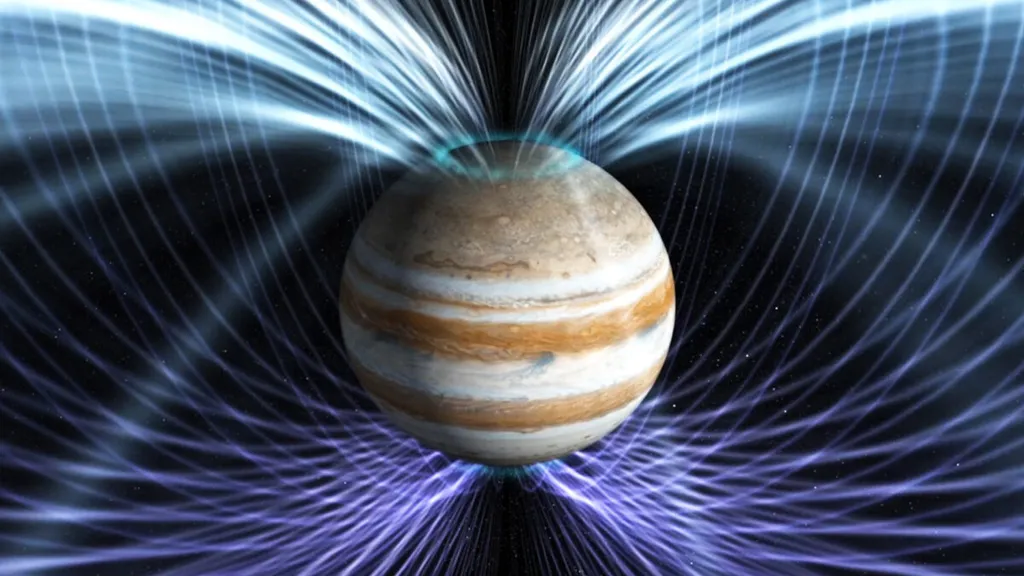
Researchers have discovered that Jupiter's bow shock creates large, naturally occurring particle accelerators that can accelerate electrons to near the speed of light. This process, observed in Jupiter's turbulent foreshock, may also apply to cosmic scales beyond our solar system. The findings suggest that the physics governing particle acceleration on Earth could be similar to that in extreme cosmic environments.
- ▪Jupiter's bow shock is a region where its magnetosphere collides with the solar wind, creating intense density and pressure changes.
- ▪The foreshock upstream of the bow shock acts as a natural particle accelerator, outperforming forces in the shock boundary.
- ▪Data from NASA's Juno spacecraft revealed that particles in the foreshock can reach relativistic speeds, challenging previous models of particle acceleration.
Gizmodo files mainly under tech. We currently carry 702 of its stories.
Story provenance
Source · retrieval · rights · ranking — open for full record
inspect →
Story provenance
Attribution is not the same as permission. This drawer separates discovery metadata, excerpts, WeSearch-generated summaries, reuse status, and whether the publisher receives the visit. Nothing here claims a legal grant the publisher has not made.
Record
| Original publisher | Gizmodo |
| Canonical URL | https://gizmodo.com/jupiter-flings-particles-to-nearly-the-speed-of-light-the-weird-part-is-how-2000766987 |
| Publication time | Wed, 03 Jun 2026 15:25:30 +0000 |
| Retrieval time | 2026-06-03T15:27:10.222Z |
| Last seen | 2026-06-03T15:27:10.222Z |
| Headline source | Publisher (no WeSearch rewrite) |
| Excerpt source | publisher body |
| Excerpt method | First ~120 words (~800 chars) of extracted publisher body, fair-use limited. |
| Summary | WeSearch · cerebras-chat (WeSearch summarizer) |
| Summary source text | contentText |
| Citation coverage | Summary is a WeSearch-generated derivative; primary citation is the original publisher URL. |
| Cluster | zSiPY-Z0LkaC |
| Cluster logic | Grouped by semantic title/content similarity across sources within a rolling window. Same-publisher template collisions are excluded from coverage comparison. |
| Ranking reason | Story pages are not engagement-ranked. Hub feeds use recency, with optional source-diversified chronological ordering (cap consecutive stories per source). No personalized ranking. |
| Publisher visit | Yes — open original |
| Substitutes article? | No — link-out required for full text |
Rights status (four layers)
WeSearch handling by dimension
| Indexing | May the item be indexed (stored, ranked, made findable)? | Allowed |
| Snippet | May a short excerpt of the publisher's text be shown? | Allowed |
| AI summary | May WeSearch generate its own short summary of the article? | Limited |
| Retrieval / RAG | May the content be exposed for third-party retrieval-augmented generation? | Not asserted |
| Model training | May the content be used to train AI models? | Not asserted |
| Commercial reuse | May the content be reused commercially? | Not permitted |
Basis: Derived from the published RSS/Atom feed. Contact: [email protected]. Reviewed: 2026-07-24.
Opening excerpt (first ~120 words) tap to expand
Our most powerful particle accelerators mimic near-light speeds of cosmic particles. But no upgrade may be capable of replicating the extreme complexity of the most violent objects in the universe. To understand these environments, astronomers are using entire planets as natural labs, including Jupiter’s tumultuous magnetosphere.cnx.cmd.push(function(){cnx({"playerId":"92b7b46b-43ed-4e0e-b21b-2c999302d9d7","settings":{"advertising":{"macros":{"AD_UNIT":"/23178111854/od.gizmodo.com/article","CHILD_UNIT":"article","POST_ID":"2000766987","POST_TYPE":"post","CHANNEL":"science","SECTION":"space","SUBSECTION":"","CATEGORIES":"space","TAGS":"jupiter,planetary-science,plasma-physics","NOP":"0"},"timeBeforeFirstAd":0}}}).render("cnx-player-main")}); In a Nature paper published today, researchers…
Excerpt limited to ~120 words for fair-use compliance. The full article is at Gizmodo.
Discussion
0 commentsMore from Gizmodo