Learning From Pairwise Preferences: An Introduction to the Bradley Terry Model
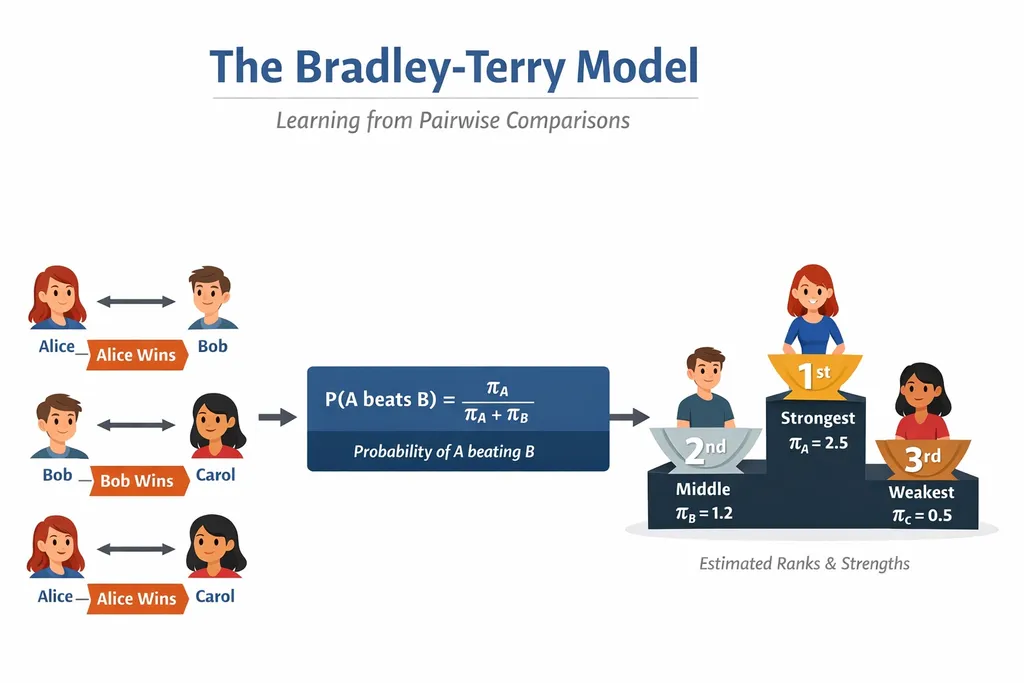
The Bradley-Terry model provides a framework for deriving probabilistic rankings from pairwise comparisons rather than absolute judgments. It operates on the principle that each item has a latent strength, which influences the likelihood of one item being preferred over another. This model is particularly useful in scenarios where direct scoring is difficult, allowing for a coherent ranking based on comparative preferences.
- ▪The Bradley-Terry model infers latent strengths from pairwise preferences to create probabilistic rankings.
- ▪It assumes each item has an unobserved positive strength parameter that determines its likelihood of being preferred over another item.
- ▪The model is closely related to logistic modeling, focusing on the relative differences in strengths rather than absolute scores.
Towards Data Science files mainly under ai. We currently carry 104 of its stories.
Story provenance
Source · retrieval · rights · ranking — open for full record
inspect →
Story provenance
Attribution is not the same as permission. This drawer separates discovery metadata, excerpts, WeSearch-generated summaries, reuse status, and whether the publisher receives the visit. Nothing here claims a legal grant the publisher has not made.
Record
| Original publisher | Towards Data Science |
| Canonical URL | https://towardsdatascience.com/learning-from-pairwise-preferences-an-introduction-to-the-bradley-terry-model/ |
| Publication time | Wed, 27 May 2026 15:00:00 +0000 |
| Retrieval time | 2026-05-27T15:08:01.785Z |
| Last seen | 2026-05-27T15:08:01.785Z |
| Headline source | Publisher (no WeSearch rewrite) |
| Excerpt source | publisher body |
| Excerpt method | First ~120 words (~800 chars) of extracted publisher body, fair-use limited. |
| Summary | WeSearch · cerebras-chat (WeSearch summarizer) |
| Summary source text | contentText |
| Citation coverage | Summary is a WeSearch-generated derivative; primary citation is the original publisher URL. |
| Cluster | Qi9zMVCna5as |
| Cluster logic | Grouped by semantic title/content similarity across sources within a rolling window. Same-publisher template collisions are excluded from coverage comparison. |
| Ranking reason | Story pages are not engagement-ranked. Hub feeds use recency, with optional source-diversified chronological ordering (cap consecutive stories per source). No personalized ranking. |
| Publisher visit | Yes — open original |
| Substitutes article? | No — link-out required for full text |
Rights status (four layers)
WeSearch handling by dimension
| Indexing | May the item be indexed (stored, ranked, made findable)? | Allowed |
| Snippet | May a short excerpt of the publisher's text be shown? | Allowed |
| AI summary | May WeSearch generate its own short summary of the article? | Limited |
| Retrieval / RAG | May the content be exposed for third-party retrieval-augmented generation? | Not asserted |
| Model training | May the content be used to train AI models? | Not asserted |
| Commercial reuse | May the content be reused commercially? | Not permitted |
Basis: Derived from the published RSS/Atom feed. Contact: [email protected]. Reviewed: 2026-07-24.
Opening excerpt (first ~120 words) tap to expand
Machine Learning Learning From Pairwise Preferences: An Introduction to the Bradley Terry Model How to turn simple head-to-head choices Into probabilistic rankings Sean Moran May 27, 2026 28 min read Share Source: image by author via GPT-5.4. Much of statistical learning assumes the availability of absolute labels. For example, an instance belongs to a class, a document receives a score, an observation is assigned a probability, a product is rated on a fixed scale. In practice, however, human judgment often appears in a more local and comparative form. People may not know whether an answer deserves 7.4 out of 10, but they can often say which of two answers is better.
…
Excerpt limited to ~120 words for fair-use compliance. The full article is at Towards Data Science.
Discussion
0 commentsMore from Towards Data Science