Lost 1,200-year-old manuscript contains the first English poem
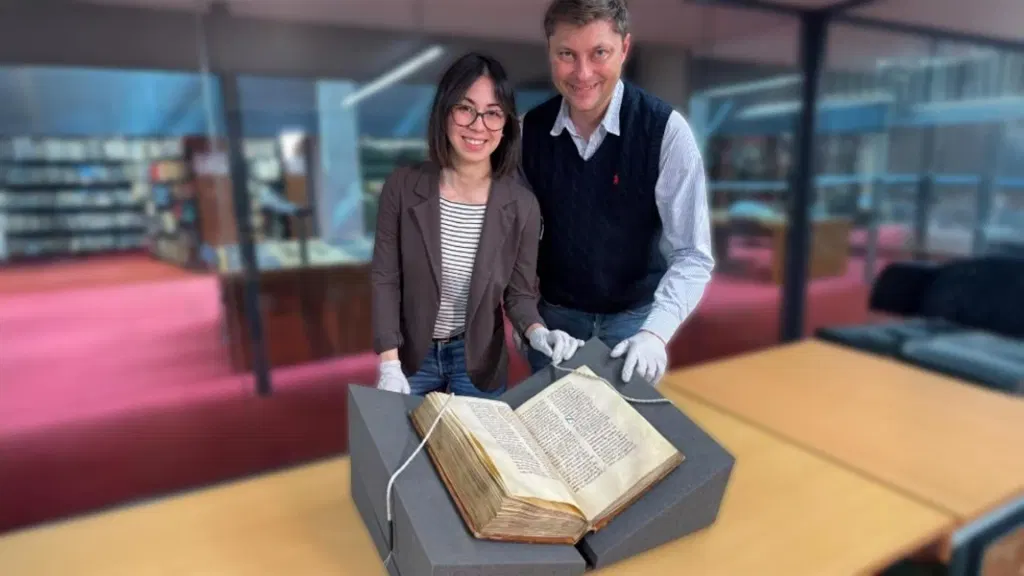
A lost 1,200-year-old manuscript discovered in Rome contains one of the oldest known versions of Caedmon’s Hymn, the earliest surviving poem in English. Unlike earlier copies, the Old English text is integrated directly into the Latin manuscript, indicating early medieval recognition of vernacular poetry. The find sheds new light on the development and cultural value of Old English literature.
- ▪The manuscript dates from 800 to 830 and is the third oldest copy of Caedmon’s Hymn ever found.
- ▪In this manuscript, the Old English poem is embedded in the main Latin text, unlike in older copies where it appears in margins.
- ▪Caedmon’s Hymn is a nine-line poem praising God for the creation of the world, attributed to a 7th-century Northumbrian cowherd.
- ▪The discovery was made by Dr. Elisabetta Magnanti and Dr. Mark Faulkner of Trinity College Dublin.
- ▪The manuscript is now held in the National Central Library of Rome and was digitized for research access.
ScienceDaily files mainly under science. We currently carry 84 of its stories.
Story provenance
Source · retrieval · rights · ranking — open for full record
inspect →
Story provenance
Attribution is not the same as permission. This drawer separates discovery metadata, excerpts, WeSearch-generated summaries, reuse status, and whether the publisher receives the visit. Nothing here claims a legal grant the publisher has not made.
Record
| Original publisher | ScienceDaily |
| Canonical URL | https://www.sciencedaily.com/releases/2026/05/260515233337.htm |
| Publication time | Sun, 17 May 2026 02:22:40 EDT |
| Retrieval time | 2026-05-17T06:53:59.053Z |
| Last seen | 2026-05-17T06:53:59.053Z |
| Headline source | Publisher (no WeSearch rewrite) |
| Excerpt source | publisher body |
| Excerpt method | First ~120 words (~800 chars) of extracted publisher body, fair-use limited. |
| Summary | WeSearch · cerebras-chat (WeSearch summarizer) |
| Summary source text | contentText |
| Citation coverage | Summary is a WeSearch-generated derivative; primary citation is the original publisher URL. |
| Cluster | vEcXMkxJLE3f |
| Cluster logic | Grouped by semantic title/content similarity across sources within a rolling window. Same-publisher template collisions are excluded from coverage comparison. |
| Ranking reason | Story pages are not engagement-ranked. Hub feeds use recency, with optional source-diversified chronological ordering (cap consecutive stories per source). No personalized ranking. |
| Publisher visit | Yes — open original |
| Substitutes article? | No — link-out required for full text |
Rights status (four layers)
WeSearch handling by dimension
| Indexing | May the item be indexed (stored, ranked, made findable)? | Allowed |
| Snippet | May a short excerpt of the publisher's text be shown? | Allowed |
| AI summary | May WeSearch generate its own short summary of the article? | Limited |
| Retrieval / RAG | May the content be exposed for third-party retrieval-augmented generation? | Not asserted |
| Model training | May the content be used to train AI models? | Not asserted |
| Commercial reuse | May the content be reused commercially? | Not permitted |
Basis: Derived from the published RSS/Atom feed. Contact: [email protected]. Reviewed: 2026-07-24.
Opening excerpt (first ~120 words) tap to expand
Science News from research organizations Lost 1,200-year-old manuscript contains the first English poem A lost 1,200-year-old manuscript found in Rome is rewriting the story of how English literature began. Date: May 17, 2026 Source: Trinity College Dublin Summary: A long-lost manuscript discovered in Rome has revealed one of the oldest surviving versions of the very first known poem written in English. Hidden for decades and once believed lost, the 1,200-year-old manuscript contains Caedmon’s Hymn — a nine-line Old English poem said to have been miraculously composed by a shy Northumbrian cowherd after a divine dream. Share: Facebook Twitter Pinterest LinkedIN Email FULL STORY Dr. Elisabetta Magnanti and Dr.
…
Excerpt limited to ~120 words for fair-use compliance. The full article is at ScienceDaily.
Discussion
0 commentsMore from ScienceDaily