Megawatts by Microwave
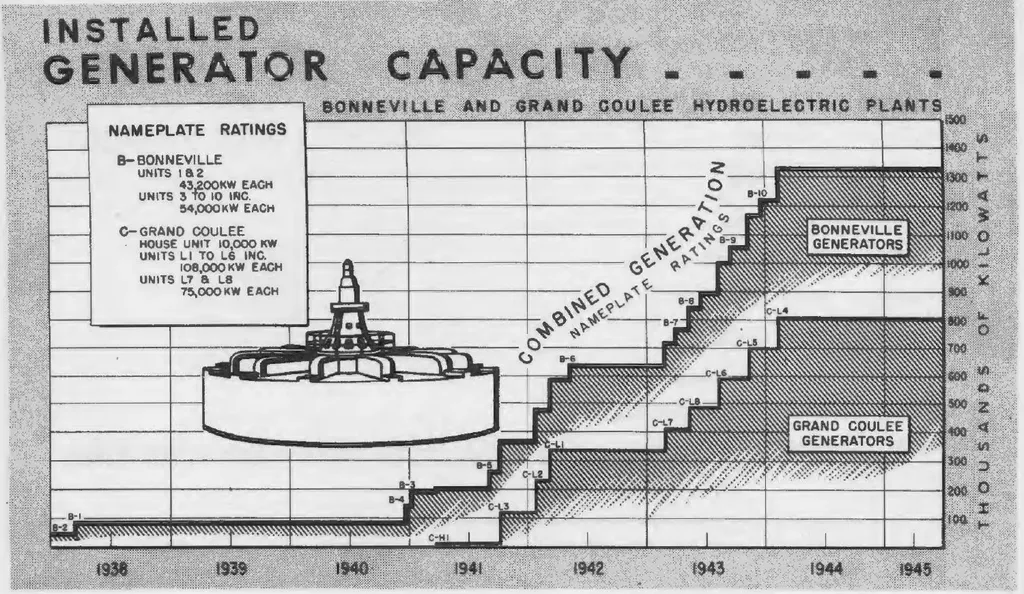
The development of the Columbia River began in 1914 with the Department of the Interior investigating its potential for irrigation and electricity generation. The construction of the Bonneville Dam was a significant project that aimed to provide flood control, irrigation, and electricity to the region. The dam's completion in 1938 marked a major milestone in the development of the Columbia River, with its powerhouses producing up to 1.2 GW of electricity.
- ▪The Department of the Interior investigated the Columbia River's potential in 1914.
- ▪The Bonneville Dam was completed in 1938 and produces up to 1.2 GW of electricity.
- ▪The dam's primary purpose is electrical production, with flood control being a secondary benefit.
Hacker News (Front Page) files mainly under programming. We currently carry 1,024 of its stories. Top-voted stories on Hacker News.
Story provenance
Source · retrieval · rights · ranking — open for full record
inspect →
Story provenance
Attribution is not the same as permission. This drawer separates discovery metadata, excerpts, WeSearch-generated summaries, reuse status, and whether the publisher receives the visit. Nothing here claims a legal grant the publisher has not made.
Record
| Original publisher | Computers Are Bad |
| Canonical URL | https://computer.rip/2026-07-04-microwave-and-power.html |
| Publication time | Sun, 05 Jul 2026 05:56:03 +0000 |
| Retrieval time | 2026-07-05T07:25:53.651Z |
| Last seen | 2026-07-05T07:25:53.651Z |
| Headline source | Publisher (no WeSearch rewrite) |
| Excerpt source | publisher body |
| Excerpt method | First ~120 words (~800 chars) of extracted publisher body, fair-use limited. |
| Summary | WeSearch · cerebras-chat (WeSearch summarizer) |
| Summary source text | contentText |
| Citation coverage | Summary is a WeSearch-generated derivative; primary citation is the original publisher URL. |
| Cluster | None |
| Cluster logic | Not yet clustered, or no peer story found in the clustering window. |
| Ranking reason | Story pages are not engagement-ranked. Hub feeds use recency, with optional source-diversified chronological ordering (cap consecutive stories per source). No personalized ranking. |
| Publisher visit | Yes — open original |
| Substitutes article? | No — link-out required for full text |
Rights status (four layers)
WeSearch handling by dimension
| Indexing | May the item be indexed (stored, ranked, made findable)? | Allowed |
| Snippet | May a short excerpt of the publisher's text be shown? | Allowed |
| AI summary | May WeSearch generate its own short summary of the article? | Limited |
| Retrieval / RAG | May the content be exposed for third-party retrieval-augmented generation? | Not asserted |
| Model training | May the content be used to train AI models? | Not asserted |
| Commercial reuse | May the content be reused commercially? | Not permitted |
Basis: Derived from the published RSS/Atom feed. Contact: [email protected]. Reviewed: 2026-07-24.
Opening excerpt (first ~120 words) tap to expand
megawatts by microwave 2026-07-04 In 1914 the Department of the Interior, through the Bureau of Reclamation, investigated the possibilities of developing the Columbia River. Thousands of arid but potentially fertile acres needed only water to become the Imperial Valley of the Northwest. Locked in the mountain ranges were valuable ores awaiting electricity to turn them into needed metals. Two years later the State engineer of Oregon urged the development of the Bonneville site as a national-defense measure: he saw in the proposed power project a source of fertilizer in time of peace and nitrates in time of war. The dam also would completely drown out the Cascade Rapids and extend slack-water navigation some 40 miles eastward to The Dalles.
…
Excerpt limited to ~120 words for fair-use compliance. The full article is at Computers Are Bad.
Discussion
0 commentsMore from Computers Are Bad