Most Americans want digital shelf labels and surveillance pricing banned amid grocery price fears
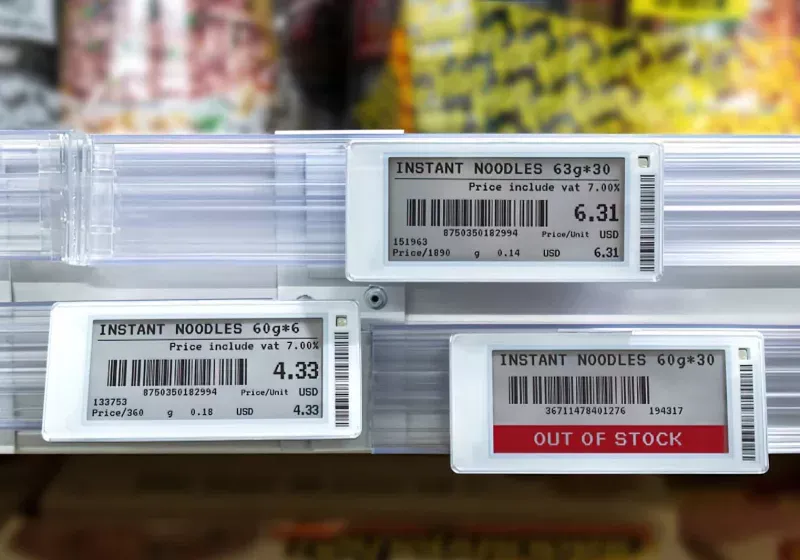
Most Americans are against the use of digital shelf labels and surveillance pricing in grocery stores, fearing they will lead to higher prices. A recent survey found that 67% of Americans want these technologies banned, with 65% believing digital shelf labels will cause prices to increase. The United Food and Commercial Workers International Union is pushing for bans on these technologies, citing concerns over their impact on consumers and workers.
- ▪A survey found that 67% of Americans want digital shelf labels and surveillance pricing banned in grocery stores.
- ▪65% of American voters think digital shelf labels will cause grocery prices to increase.
- ▪The United Food and Commercial Workers International Union is pushing for bans on these technologies in Congress and 12 states.
3 outlets in our directory ran this story, first to last over 22 hours. Coverage spans 2 points on the political spectrum — 1 lean left, 1 centre.
TechSpot files mainly under tech. We currently carry 279 of its stories.
Story provenance
Source · retrieval · rights · ranking — open for full record
inspect →
Story provenance
Attribution is not the same as permission. This drawer separates discovery metadata, excerpts, WeSearch-generated summaries, reuse status, and whether the publisher receives the visit. Nothing here claims a legal grant the publisher has not made.
Record
| Original publisher | TechSpot |
| Canonical URL | https://www.techspot.com/news/112545-most-americans-want-digital-shelf-labels-surveillance-pricing.html |
| Publication time | Wed, 27 May 2026 07:56 -0500 |
| Retrieval time | 2026-05-27T13:13:01.175Z |
| Last seen | 2026-05-27T13:13:03.332Z |
| Headline source | Publisher (no WeSearch rewrite) |
| Excerpt source | publisher body |
| Excerpt method | First ~120 words (~800 chars) of extracted publisher body, fair-use limited. |
| Summary | WeSearch · cerebras-chat (WeSearch summarizer) |
| Summary source text | contentText |
| Citation coverage | Summary is a WeSearch-generated derivative; primary citation is the original publisher URL. |
| Cluster | FUQw26-lJyJ1 · 3 stories |
| Cluster logic | Grouped by semantic title/content similarity across sources within a rolling window. Same-publisher template collisions are excluded from coverage comparison. |
| Ranking reason | Story pages are not engagement-ranked. Hub feeds use recency, with optional source-diversified chronological ordering (cap consecutive stories per source). No personalized ranking. |
| Publisher visit | Yes — open original |
| Substitutes article? | No — link-out required for full text |
Rights status (four layers)
WeSearch handling by dimension
| Indexing | May the item be indexed (stored, ranked, made findable)? | Allowed |
| Snippet | May a short excerpt of the publisher's text be shown? | Allowed |
| AI summary | May WeSearch generate its own short summary of the article? | Limited |
| Retrieval / RAG | May the content be exposed for third-party retrieval-augmented generation? | Not asserted |
| Model training | May the content be used to train AI models? | Not asserted |
| Commercial reuse | May the content be reused commercially? | Not permitted |
Basis: Derived from the published RSS/Atom feed. Contact: [email protected]. Reviewed: 2026-07-24.
Opening excerpt (first ~120 words) tap to expand
Tech Culture Electronics retail surge pricing Most Americans want digital shelf labels and surveillance pricing banned Consumers fear retailers will use the technology to raise prices faster and more often By Rob Thubron May 27, 2026, 7:56 28 comments Serving tech enthusiasts for over 25 years. TechSpot means tech analysis and advice you can trust. A hot potato: Do you think surveillance pricing and electronic shelf labels (ESLs) are a good idea? Probably not, and 67% of Americans feel the same way, believing that the technologies should be banned in grocery stores. The big fear, of course, is that they will increase the cost of goods.
…
Excerpt limited to ~120 words for fair-use compliance. The full article is at TechSpot.
Discussion
0 commentsMore from TechSpot