NASA spacecraft beams back blue images of Mars on its way to a metal asteroid — Space photo of the week
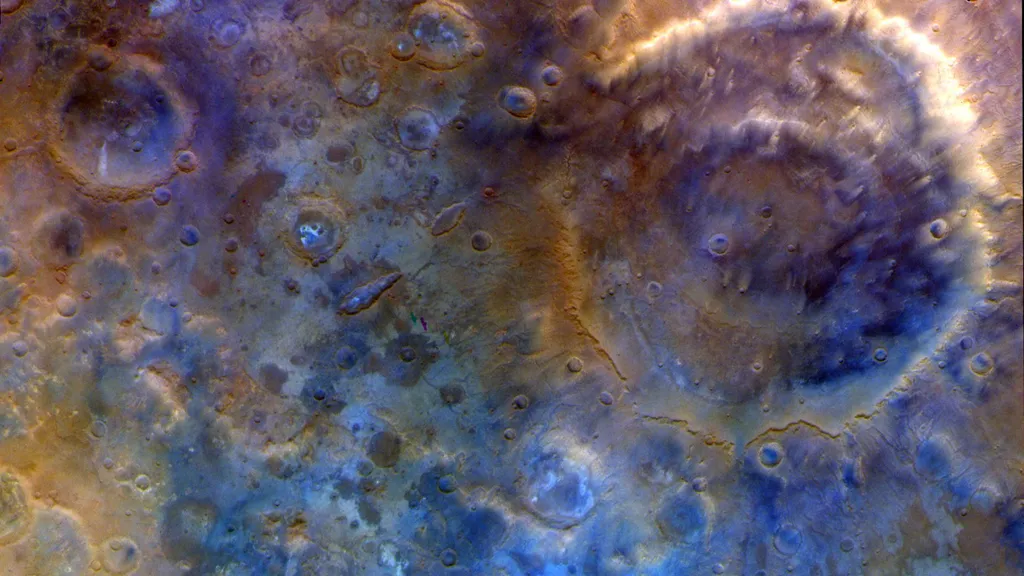
NASA's Psyche spacecraft has successfully captured blue images of Mars during its flyby as it heads towards the metal-rich asteroid 16 Psyche. The spacecraft took a series of color images, including a close-up of the Huygens crater and the southern highlands of Mars. This flyby not only provided stunning visuals but also increased Psyche's speed and adjusted its orbital plane for its journey ahead.
- ▪NASA's Psyche spacecraft passed within 2,864 miles of Mars on May 15, 2026.
- ▪The spacecraft captured thousands of images to calibrate its multispectral cameras before reaching asteroid 16 Psyche.
- ▪The flyby increased Psyche's speed by approximately 1,000 mph and shifted its orbital plane by about 1 degree.
Live Science files mainly under science. We currently carry 137 of its stories.
Story provenance
Source · retrieval · rights · ranking — open for full record
inspect →
Story provenance
Attribution is not the same as permission. This drawer separates discovery metadata, excerpts, WeSearch-generated summaries, reuse status, and whether the publisher receives the visit. Nothing here claims a legal grant the publisher has not made.
Record
| Original publisher | Live Science |
| Canonical URL | https://www.livescience.com/space/mars/nasa-spacecraft-beams-back-blue-images-of-mars-on-its-way-to-a-metal-asteroid-space-photo-of-the-week |
| Publication time | Sun, 24 May 2026 10:00:00 +0000 |
| Retrieval time | 2026-05-24T10:02:32.081Z |
| Last seen | 2026-05-24T10:02:32.081Z |
| Headline source | Publisher (no WeSearch rewrite) |
| Excerpt source | publisher body |
| Excerpt method | First ~120 words (~800 chars) of extracted publisher body, fair-use limited. |
| Summary | WeSearch · cerebras-chat (WeSearch summarizer) |
| Summary source text | contentText |
| Citation coverage | Summary is a WeSearch-generated derivative; primary citation is the original publisher URL. |
| Cluster | 9AUMsdeBJsO4 |
| Cluster logic | Grouped by semantic title/content similarity across sources within a rolling window. Same-publisher template collisions are excluded from coverage comparison. |
| Ranking reason | Story pages are not engagement-ranked. Hub feeds use recency, with optional source-diversified chronological ordering (cap consecutive stories per source). No personalized ranking. |
| Publisher visit | Yes — open original |
| Substitutes article? | No — link-out required for full text |
Rights status (four layers)
WeSearch handling by dimension
| Indexing | May the item be indexed (stored, ranked, made findable)? | Allowed |
| Snippet | May a short excerpt of the publisher's text be shown? | Allowed |
| AI summary | May WeSearch generate its own short summary of the article? | Limited |
| Retrieval / RAG | May the content be exposed for third-party retrieval-augmented generation? | Not asserted |
| Model training | May the content be used to train AI models? | Not asserted |
| Commercial reuse | May the content be reused commercially? | Not permitted |
Basis: Derived from the published RSS/Atom feed. Contact: [email protected]. Reviewed: 2026-07-24.
Opening excerpt (first ~120 words) tap to expand
Space Astronomy Planets Mars NASA spacecraft beams back blue images of Mars on its way to a metal asteroid — Space photo of the week On its way to a metal asteroid, NASA's Psyche probe tested its cameras as it got a gravity assist from the Red Planet. By Jamie Carter published 24 May 2026 in Features When you purchase through links on our site, we may earn an affiliate commission. Here’s how it works. Psyche imaged Mars' southern highlands, including the Huygens crater (upper right) (Image credit: NASA/JPL-Caltech/ASU) Copy link Facebook X Reddit Pinterest Flipboard Share this article 0 Join the conversation Follow us Add us as a preferred source on Google Newsletter Subscribe to our newsletter Quick factsWhat it is: MarsWhere it is: 2.2 astronomical units (Earth-sun distances)When it was…
Excerpt limited to ~120 words for fair-use compliance. The full article is at Live Science.
Discussion
0 commentsMore from Live Science