NASA’s Fermi Glimpses Power Source of Supercharged Supernovae
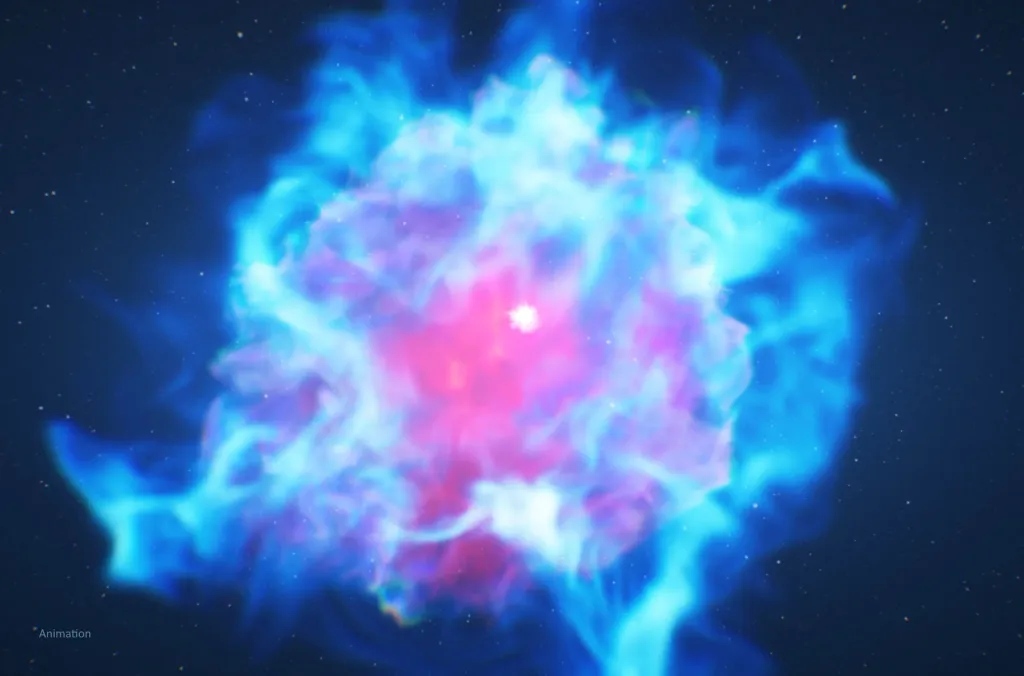
NASA's Fermi Gamma-ray Space Telescope has detected a rare supernova, SN 2017egm, which is unusually luminous. Researchers believe this supernova gained its brightness from a supermagnetized neutron star formed during the stellar collapse. This discovery opens new avenues for understanding the mechanisms behind superluminous supernovae.
- ▪The supernova SN 2017egm is located in galaxy NGC 3191, approximately 440 million light-years away.
- ▪Fermi's Large Area Telescope detected gamma rays from SN 2017egm, confirming its extraordinary luminosity.
- ▪This finding suggests that some supernovae can emit gamma rays as brightly as they do visible light.
2 outlets in our directory ran this story, first to last over 4 hours. All of the coverage we found sits in one bucket: centre. That one-sidedness is itself worth noticing.
NASA — Breaking News files mainly under science. We currently carry 94 of its stories.
Story provenance
Source · retrieval · rights · ranking — open for full record
inspect →
Story provenance
Attribution is not the same as permission. This drawer separates discovery metadata, excerpts, WeSearch-generated summaries, reuse status, and whether the publisher receives the visit. Nothing here claims a legal grant the publisher has not made.
Record
| Original publisher | NASA |
| Canonical URL | https://science.nasa.gov/missions/fermi/nasas-fermi-glimpses-power-source-of-supercharged-supernovae/ |
| Publication time | Wed, 20 May 2026 12:55:00 +0000 |
| Retrieval time | 2026-05-20T13:12:17.165Z |
| Last seen | 2026-05-20T13:13:30.342Z |
| Headline source | Publisher (no WeSearch rewrite) |
| Excerpt source | publisher body |
| Excerpt method | First ~120 words (~800 chars) of extracted publisher body, fair-use limited. |
| Summary | WeSearch · cerebras-chat (WeSearch summarizer) |
| Summary source text | contentText |
| Citation coverage | Summary is a WeSearch-generated derivative; primary citation is the original publisher URL. |
| Cluster | NygA2J87vort · 2 stories |
| Cluster logic | Grouped by semantic title/content similarity across sources within a rolling window. Same-publisher template collisions are excluded from coverage comparison. |
| Ranking reason | Story pages are not engagement-ranked. Hub feeds use recency, with optional source-diversified chronological ordering (cap consecutive stories per source). No personalized ranking. |
| Publisher visit | Yes — open original |
| Substitutes article? | No — link-out required for full text |
Rights status (four layers)
WeSearch handling by dimension
| Indexing | May the item be indexed (stored, ranked, made findable)? | Allowed |
| Snippet | May a short excerpt of the publisher's text be shown? | Allowed |
| AI summary | May WeSearch generate its own short summary of the article? | Limited |
| Retrieval / RAG | May the content be exposed for third-party retrieval-augmented generation? | Not asserted |
| Model training | May the content be used to train AI models? | Not asserted |
| Commercial reuse | May the content be reused commercially? | Not permitted |
Basis: Derived from the published RSS/Atom feed. Contact: [email protected]. Reviewed: 2026-07-24.
Opening excerpt (first ~120 words) tap to expand
5 min readNASA’s Fermi Glimpses Power Source of Supercharged SupernovaeFrancis ReddyMay 20, 2026 Article An international team studying data from NASA’s Fermi Gamma-ray Space Telescope concludes the mission detected a rare, unusually luminous supernova. The researchers say it likely received its power-up from a supermagnetized neutron star born in the stellar collapse that triggered the explosion. Gamma rays detected by NASA’s Fermi Gamma-ray Space Telescope gave scientists a look under the hood of a rare supernova that produced much more light than normal.NASA’s Goddard Space Flight Center Download high-resolution video and images from NASA's Scientific Visualization Studio The Fermi mission is part of NASA’s fleet of observatories monitoring the changing cosmos to help humanity better…
Excerpt limited to ~120 words for fair-use compliance. The full article is at NASA.
Discussion
0 commentsMore from NASA