NASA’s Moon Plan Depends on 15 Starship Launches. There’s Just One Problem
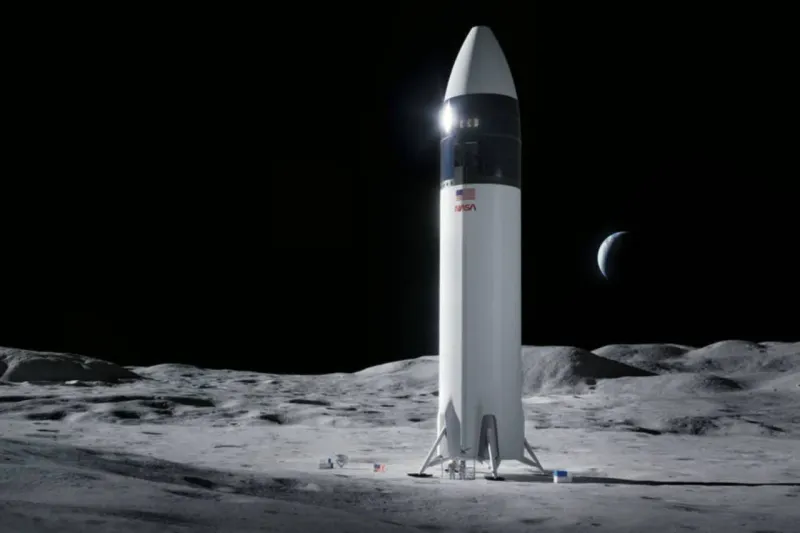
A new watchdog report has found that Kennedy Space Center, the premier spaceport for NASA and its commercial partners, isn’t ready to support increased super-heavy launch cadence. SpaceX’s lander, the Starship Human Landing System (HLS), will be a modified version of the Starship V3 upper stage. Building it has proved challenging enough (the lander is significantly behind schedule), but actually getting it to the Moon will be another feat entirely—one that outdated Kennedy infrastructure may not be able to handle.
- ▪A new watchdog report has found that Kennedy Space Center, the premier spaceport for NASA and its commercial partners, isn’t ready to support increased super-heavy launch cadence.
- ▪SpaceX’s lander, the Starship Human Landing System (HLS), will be a modified version of the Starship V3 upper stage.
- ▪Building it has proved challenging enough (the lander is significantly behind schedule), but actually getting it to the Moon will be another feat entirely—one that outdated Kennedy infrastructure may not be able to handle.
Gizmodo files mainly under tech. We currently carry 698 of its stories.
Story provenance
Source · retrieval · rights · ranking — open for full record
inspect →
Story provenance
Attribution is not the same as permission. This drawer separates discovery metadata, excerpts, WeSearch-generated summaries, reuse status, and whether the publisher receives the visit. Nothing here claims a legal grant the publisher has not made.
Record
| Original publisher | Gizmodo |
| Canonical URL | https://gizmodo.com/nasas-moon-plan-depends-on-15-starship-launches-theres-just-one-problem-2000776200 |
| Publication time | Tue, 23 Jun 2026 20:45:33 +0000 |
| Retrieval time | 2026-06-23T21:22:48.356Z |
| Last seen | 2026-06-23T21:22:48.356Z |
| Headline source | Publisher (no WeSearch rewrite) |
| Excerpt source | publisher body |
| Excerpt method | First ~120 words (~800 chars) of extracted publisher body, fair-use limited. |
| Summary | WeSearch · cerebras-chat (WeSearch summarizer) |
| Summary source text | contentText |
| Citation coverage | Summary is a WeSearch-generated derivative; primary citation is the original publisher URL. |
| Cluster | VPAjq_JTHbk5 |
| Cluster logic | Grouped by semantic title/content similarity across sources within a rolling window. Same-publisher template collisions are excluded from coverage comparison. |
| Ranking reason | Story pages are not engagement-ranked. Hub feeds use recency, with optional source-diversified chronological ordering (cap consecutive stories per source). No personalized ranking. |
| Publisher visit | Yes — open original |
| Substitutes article? | No — link-out required for full text |
Rights status (four layers)
WeSearch handling by dimension
| Indexing | May the item be indexed (stored, ranked, made findable)? | Allowed |
| Snippet | May a short excerpt of the publisher's text be shown? | Allowed |
| AI summary | May WeSearch generate its own short summary of the article? | Limited |
| Retrieval / RAG | May the content be exposed for third-party retrieval-augmented generation? | Not asserted |
| Model training | May the content be used to train AI models? | Not asserted |
| Commercial reuse | May the content be reused commercially? | Not permitted |
Basis: Derived from the published RSS/Atom feed. Contact: [email protected]. Reviewed: 2026-07-24.
Opening excerpt (first ~120 words) tap to expand
A new watchdog report has found that Kennedy Space Center, the premier spaceport for NASA and its commercial partners, isn’t ready to support increased super-heavy launch cadence. If the agency hopes to land humans on the Moon by 2028, it will need to fix that problem fast.cnx.cmd.push(function(){cnx({"playerId":"92b7b46b-43ed-4e0e-b21b-2c999302d9d7","settings":{"advertising":{"macros":{"AD_UNIT":"/23178111854/od.gizmodo.com/article","CHILD_UNIT":"article","POST_ID":"2000776200","POST_TYPE":"post","CHANNEL":"science","SECTION":"space","SUBSECTION":"","CATEGORIES":"space","TAGS":"human-spaceflight,nasa,spacex,the-moon","NOP":"0"},"timeBeforeFirstAd":0}}}).render("cnx-player-main")}); NASA has tapped both SpaceX and Blue Origin to provide prospective crew landers for the Artemis 4 mission,…
Excerpt limited to ~120 words for fair-use compliance. The full article is at Gizmodo.
Discussion
0 commentsMore from Gizmodo