
Natural rubber process boosts tire toughness about tenfold while preserving stiffness
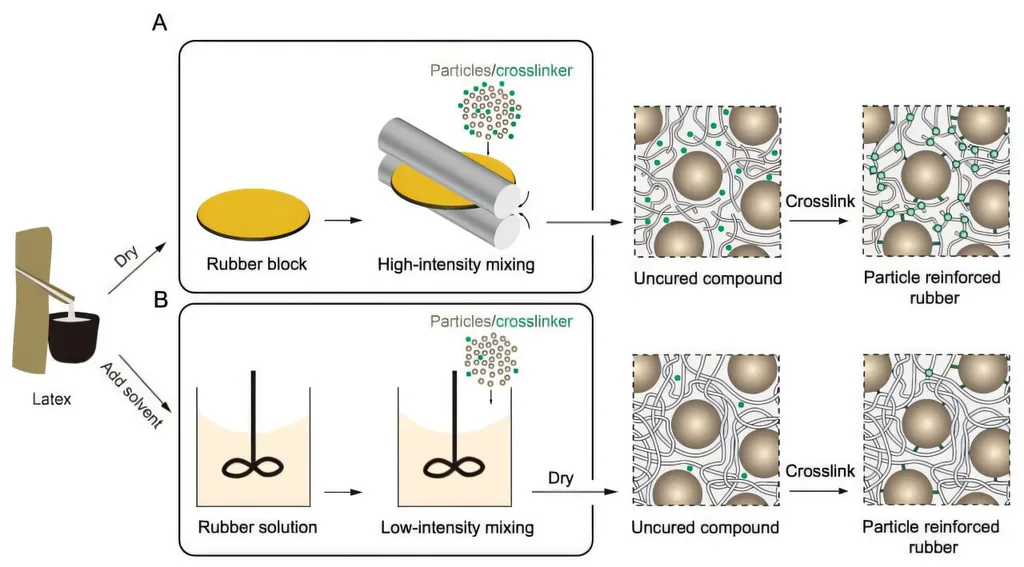
Harvard researchers have developed a new method to process natural rubber that maintains its long molecular chains while incorporating reinforcing particles, resulting in a material that is both stiffer and significantly tougher. Unlike conventional methods that degrade rubber's properties during mixing, this solution-based approach dissolves latex into individual chains using toluene for more uniform particle dispersion. The innovation could lead to longer-lasting, less polluting tires and advance the use of sustainable, bio-based elastomers in high-performance applications.
- ▪The new process uses toluene to dissolve natural rubber latex into individual polymer chains, preserving their length and integrity.
- ▪By avoiding high-intensity mixing, the method prevents chain scission, maintaining rubber’s elasticity and cold resistance.
- ▪The resulting composite is about ten times tougher than conventionally processed rubber while retaining stiffness.
- ▪This advancement could reduce tire wear, dust pollution, and raw material consumption by extending tire lifespan.
- ▪The research may pave the way for sustainable alternatives to petroleum-based synthetic rubber in passenger vehicle tires.
Phys.org files mainly under science. We currently carry 1,272 of its stories.
Story provenance
Source · retrieval · rights · ranking — open for full record
inspect →
Story provenance
Attribution is not the same as permission. This drawer separates discovery metadata, excerpts, WeSearch-generated summaries, reuse status, and whether the publisher receives the visit. Nothing here claims a legal grant the publisher has not made.
Record
| Original publisher | Phys.org |
| Canonical URL | https://phys.org/news/2026-04-natural-rubber-boosts-toughness-tenfold.html |
| Publication time | Tue, 28 Apr 2026 17:20:03 EDT |
| Retrieval time | 2026-04-28T21:24:39.797Z |
| Last seen | 2026-04-28T21:24:39.797Z |
| Headline source | Publisher (no WeSearch rewrite) |
| Excerpt source | publisher body |
| Excerpt method | First ~120 words (~800 chars) of extracted publisher body, fair-use limited. |
| Summary | WeSearch · cerebras-chat (WeSearch summarizer) |
| Summary source text | contentText |
| Citation coverage | Summary is a WeSearch-generated derivative; primary citation is the original publisher URL. |
| Cluster | J4XEbF0vkKwd |
| Cluster logic | Grouped by semantic title/content similarity across sources within a rolling window. Same-publisher template collisions are excluded from coverage comparison. |
| Ranking reason | Story pages are not engagement-ranked. Hub feeds use recency, with optional source-diversified chronological ordering (cap consecutive stories per source). No personalized ranking. |
| Publisher visit | Yes — open original |
| Substitutes article? | No — link-out required for full text |
Rights status (four layers)
WeSearch handling by dimension
| Indexing | May the item be indexed (stored, ranked, made findable)? | Allowed |
| Snippet | May a short excerpt of the publisher's text be shown? | Allowed |
| AI summary | May WeSearch generate its own short summary of the article? | Limited |
| Retrieval / RAG | May the content be exposed for third-party retrieval-augmented generation? | Not asserted |
| Model training | May the content be used to train AI models? | Not asserted |
| Commercial reuse | May the content be reused commercially? | Not permitted |
Basis: Derived from the published RSS/Atom feed. Contact: [email protected]. Reviewed: 2026-07-24.
Opening excerpt (first ~120 words) tap to expand
April 28, 2026 Natural rubber process boosts tire toughness about tenfold while preserving stiffness by Anne J. Manning, Harvard John A. Paulson School of Engineering and Applied Sciences edited by Sadie Harley, reviewed by Robert Egan Sadie Harley Scientific Editor Meet our editorial team Behind our editorial process Robert Egan Associate Editor Meet our editorial team Behind our editorial process Editors' notes This article has been reviewed according to Science X's editorial process and policies. Editors have highlighted the following attributes while ensuring the content's credibility: fact-checked peer-reviewed publication trusted source proofread The GIST Add as preferred source Silica-reinforced natural rubber processed in two routes, with and without mastication.
…
Excerpt limited to ~120 words for fair-use compliance. The full article is at Phys.org.