
On The <dl>
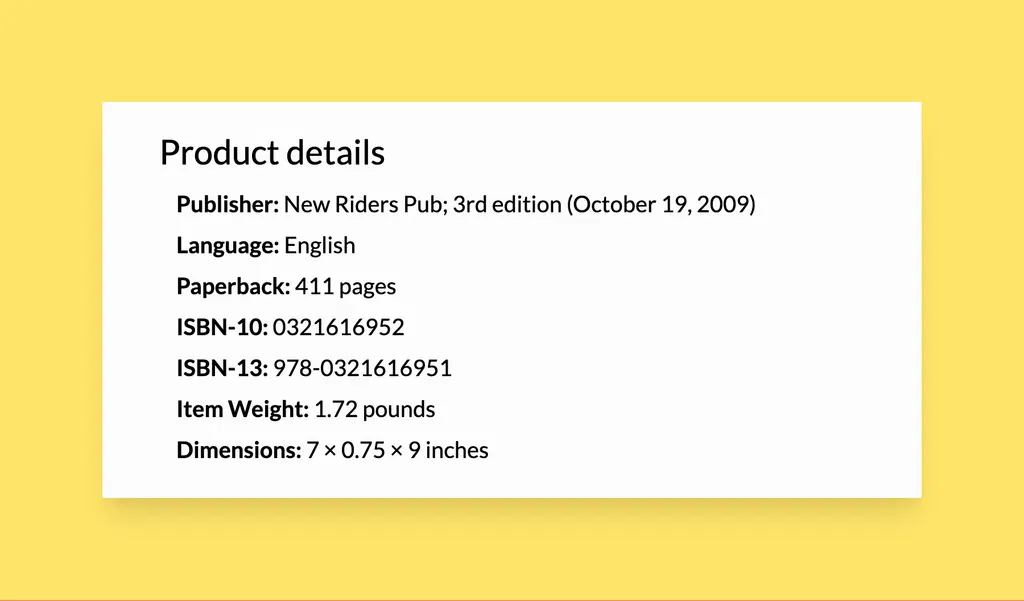
The <dl> element is a useful HTML feature for representing lists of name-value pairs. It consists of three components: <dl> for the list, <dt> for the term, and <dd> for the description. Using <dl> enhances web accessibility by allowing screen readers to interpret the structure of the information more effectively than traditional nested <div>s.
- ▪The <dl> element is designed to represent a list of name-value pairs.
- ▪It includes <dt> for description terms and <dd> for description details.
- ▪Using <dl> improves accessibility for screen reader users by providing a clearer structure.
Hacker News (Front Page) files mainly under programming. We currently carry 993 of its stories. Top-voted stories on Hacker News.
Story provenance
Source · retrieval · rights · ranking — open for full record
inspect →
Story provenance
Attribution is not the same as permission. This drawer separates discovery metadata, excerpts, WeSearch-generated summaries, reuse status, and whether the publisher receives the visit. Nothing here claims a legal grant the publisher has not made.
Record
| Original publisher | Ben Myers |
| Canonical URL | https://benmyers.dev/blog/on-the-dl/ |
| Publication time | Sat, 23 May 2026 13:03:43 +0000 |
| Retrieval time | 2026-05-23T13:47:26.729Z |
| Last seen | 2026-05-23T13:47:26.729Z |
| Headline source | Publisher (no WeSearch rewrite) |
| Excerpt source | publisher body |
| Excerpt method | First ~120 words (~800 chars) of extracted publisher body, fair-use limited. |
| Summary | WeSearch · cerebras-chat (WeSearch summarizer) |
| Summary source text | contentText |
| Citation coverage | Summary is a WeSearch-generated derivative; primary citation is the original publisher URL. |
| Cluster | None |
| Cluster logic | Not yet clustered, or no peer story found in the clustering window. |
| Ranking reason | Story pages are not engagement-ranked. Hub feeds use recency, with optional source-diversified chronological ordering (cap consecutive stories per source). No personalized ranking. |
| Publisher visit | Yes — open original |
| Substitutes article? | No — link-out required for full text |
Rights status (four layers)
WeSearch handling by dimension
| Indexing | May the item be indexed (stored, ranked, made findable)? | Allowed |
| Snippet | May a short excerpt of the publisher's text be shown? | Allowed |
| AI summary | May WeSearch generate its own short summary of the article? | Limited |
| Retrieval / RAG | May the content be exposed for third-party retrieval-augmented generation? | Not asserted |
| Model training | May the content be used to train AI models? | Not asserted |
| Commercial reuse | May the content be reused commercially? | Not permitted |
Basis: Derived from the published RSS/Atom feed. Contact: [email protected]. Reviewed: 2026-07-24.
Opening excerpt (first ~120 words) tap to expand
Introduction The <dl>, or description list, element is underrated. It’s used to represent a list of name–value pairs. This is a common UI pattern that, at the same time, is incredibly versatile. For instance, you’ve probably seen these layouts out in the wild… Each of these examples shows a list (or lists!) of name–value pairs. You might have also seen lists of name–value pairs to describe lodging amenities, or to list out individual charges in your monthly rent, or in glossaries of technical terms. Each of these is a candidate to be represented with the <dl> element. So what does that look like? The Anatomy of a Description List I’ve been saying “<dl>,” when really, I’m talking about three separate elements: <dl>, <dt>, and <dd>. We start with our <dl>.
…
Excerpt limited to ~120 words for fair-use compliance. The full article is at Ben Myers.
Discussion
0 commentsMore from Ben Myers


