Pakistan's lost city of 40k people
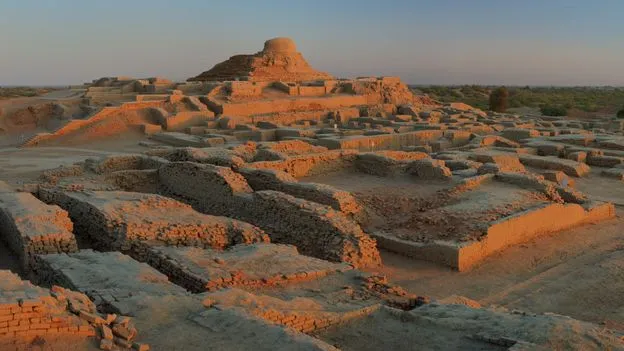
Mohenjo-daro, an ancient city in southern Pakistan, was once home to around 40,000 people and is considered one of the earliest urban centers in the world. This UNESCO World Heritage Site features advanced infrastructure, including a sophisticated sanitation system and extensive trade networks. Despite its historical significance, Mohenjo-daro remains largely unknown compared to other ancient civilizations like Egypt and Mesopotamia.
- ▪Mohenjo-daro was inhabited from 2500 to 1700 BCE and was part of the Indus Valley Civilization.
- ▪The city featured advanced urban planning, including a complex sanitation system with covered drains and private toilets.
- ▪Excavations began in 1922, leading to its recognition as a UNESCO World Heritage Site in 1980.
Hacker News (Newest) files mainly under programming. We currently carry 5,306 of its stories.
Story provenance
Source · retrieval · rights · ranking — open for full record
inspect →
Story provenance
Attribution is not the same as permission. This drawer separates discovery metadata, excerpts, WeSearch-generated summaries, reuse status, and whether the publisher receives the visit. Nothing here claims a legal grant the publisher has not made.
Record
| Original publisher | Bbc |
| Canonical URL | https://www.bbc.com/travel/article/20221114-pakistans-lost-city-of-40000-people |
| Publication time | Wed, 03 Jun 2026 02:18:20 +0000 |
| Retrieval time | 2026-06-03T02:41:48.967Z |
| Last seen | 2026-06-03T02:41:48.967Z |
| Headline source | Publisher (no WeSearch rewrite) |
| Excerpt source | publisher body |
| Excerpt method | First ~120 words (~800 chars) of extracted publisher body, fair-use limited. |
| Summary | WeSearch · cerebras-chat (WeSearch summarizer) |
| Summary source text | contentText |
| Citation coverage | Summary is a WeSearch-generated derivative; primary citation is the original publisher URL. |
| Cluster | jW4kYu5IvpYq |
| Cluster logic | Grouped by semantic title/content similarity across sources within a rolling window. Same-publisher template collisions are excluded from coverage comparison. |
| Ranking reason | Story pages are not engagement-ranked. Hub feeds use recency, with optional source-diversified chronological ordering (cap consecutive stories per source). No personalized ranking. |
| Publisher visit | Yes — open original |
| Substitutes article? | No — link-out required for full text |
Rights status (four layers)
WeSearch handling by dimension
| Indexing | May the item be indexed (stored, ranked, made findable)? | Allowed |
| Snippet | May a short excerpt of the publisher's text be shown? | Allowed |
| AI summary | May WeSearch generate its own short summary of the article? | Limited |
| Retrieval / RAG | May the content be exposed for third-party retrieval-augmented generation? | Not asserted |
| Model training | May the content be used to train AI models? | Not asserted |
| Commercial reuse | May the content be reused commercially? | Not permitted |
Basis: Derived from the published RSS/Atom feed. Contact: [email protected]. Reviewed: 2026-07-24.
Opening excerpt (first ~120 words) tap to expand
Pakistan's lost city of 40,000 people15 November 2022ShareSaveAdd as preferred on GoogleSamantha SheaFeatures correspondentNadeem Khawar/Getty Images(Credit: Nadeem Khawar/Getty Images)In the dusty plains of present-day Sindh in southern Pakistan lie the remains of one of the world's most impressive ancient cities that most people have never heard of.A slight breeze cut through the balmy heat as I surveyed the ancient city around me. Millions of red bricks formed walkways and wells, with entire neighbourhoods sprawled out in a grid-like fashion. An ancient Buddhist stupa towered over the time-worn streets, with a large communal pool complete with a wide staircase below. Somehow, only a handful of other people were here – I practically had the place all to myself.
…
Excerpt limited to ~120 words for fair-use compliance. The full article is at Bbc.
Discussion
0 commentsMore from Bbc