Playing Atari ST Music on the Amiga with Zero CPU
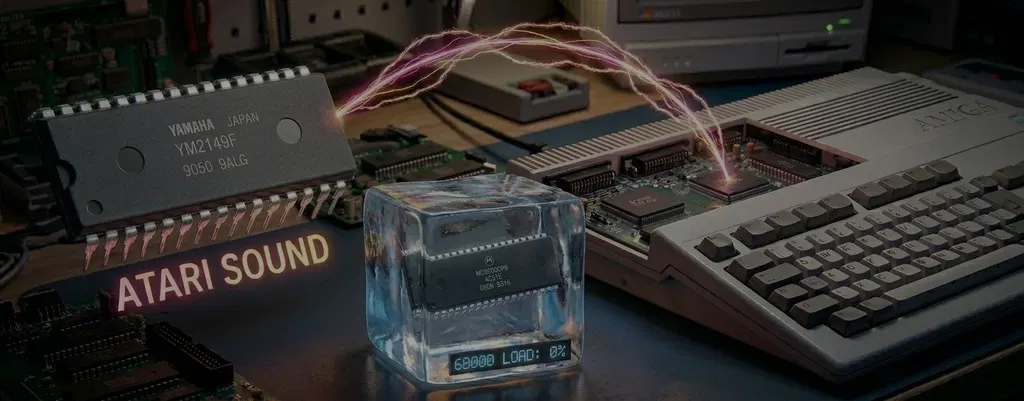
The article details a technical challenge of playing Atari ST music on the Amiga without using CPU resources, inspired by a friendly rivalry in the demoscene community. The author aimed to break a sin-dots rendering record while simultaneously emulating Atari's YM2149 sound chip using the Amiga's PAULA audio hardware. By leveraging precomputed data and clever audio chip manipulation, the goal was to achieve high-performance visual effects alongside authentic retro sound.
- ▪The author sought to surpass a sin-dots rendering record set by fellow demoscener Hannibal as a response to a playful challenge.
- ▪To play Atari music on the Amiga without CPU usage, the author used the PAULA chip to emulate the YM2149 sound chip by looping square wave samples.
- ▪Initial results with pure square waves were underwhelming, prompting exploration of advanced YM2149 envelope techniques used by demoscene musicians like Jochen Hippel.
Hacker News (Front Page) files mainly under programming. We currently carry 996 of its stories. Top-voted stories on Hacker News.
Story provenance
Source · retrieval · rights · ranking — open for full record
inspect →
Story provenance
Attribution is not the same as permission. This drawer separates discovery metadata, excerpts, WeSearch-generated summaries, reuse status, and whether the publisher receives the visit. Nothing here claims a legal grant the publisher has not made.
Record
| Original publisher | Leonard's Blog |
| Canonical URL | https://arnaud-carre.github.io/2026-05-15-ym-fast-emu/ |
| Publication time | Sun, 17 May 2026 08:00:04 +0000 |
| Retrieval time | 2026-05-17T08:42:12.951Z |
| Last seen | 2026-05-17T08:42:12.951Z |
| Headline source | Publisher (no WeSearch rewrite) |
| Excerpt source | publisher body |
| Excerpt method | First ~120 words (~800 chars) of extracted publisher body, fair-use limited. |
| Summary | WeSearch · cerebras-chat (WeSearch summarizer) |
| Summary source text | contentText |
| Citation coverage | Summary is a WeSearch-generated derivative; primary citation is the original publisher URL. |
| Cluster | 6xaS4laSl5fv |
| Cluster logic | Grouped by semantic title/content similarity across sources within a rolling window. Same-publisher template collisions are excluded from coverage comparison. |
| Ranking reason | Story pages are not engagement-ranked. Hub feeds use recency, with optional source-diversified chronological ordering (cap consecutive stories per source). No personalized ranking. |
| Publisher visit | Yes — open original |
| Substitutes article? | No — link-out required for full text |
Rights status (four layers)
WeSearch handling by dimension
| Indexing | May the item be indexed (stored, ranked, made findable)? | Allowed |
| Snippet | May a short excerpt of the publisher's text be shown? | Allowed |
| AI summary | May WeSearch generate its own short summary of the article? | Limited |
| Retrieval / RAG | May the content be exposed for third-party retrieval-augmented generation? | Not asserted |
| Model training | May the content be used to train AI models? | Not asserted |
| Commercial reuse | May the content be reused commercially? | Not permitted |
Basis: Derived from the published RSS/Atom feed. Contact: [email protected]. Reviewed: 2026-07-24.
Opening excerpt (first ~120 words) tap to expand
Audience This post is for anyone who loves the technical and historical aspects of chiptune music, as well as enthusiasts of the Amiga PAULA and Atari YM2149 audio chips. The Context In my Cycle-Op demo, I showcased a classic sin-dots effect that rendered 6405 dots at 50 FPS on the Amiga 500. Two years later, Amiga legend Hannibal released the long-awaited 3D Demo 3, packed with a lot of impressive effects. Among them was his own sin-dots record, beating mine with 6682 dots. To top it all off, and in the classic demo scene tradition of playful roasting, Hannibal left me this message: “Hi Leonard, you optimized your dots well for an Atari programmer. But there were hundreds of dots left if you optimize like an Amiga expert.” That was too good to ignore.
…
Excerpt limited to ~120 words for fair-use compliance. The full article is at Leonard's Blog.
Discussion
0 commentsMore from Leonard's Blog