Realtek's 10GbE NIC performance revisited
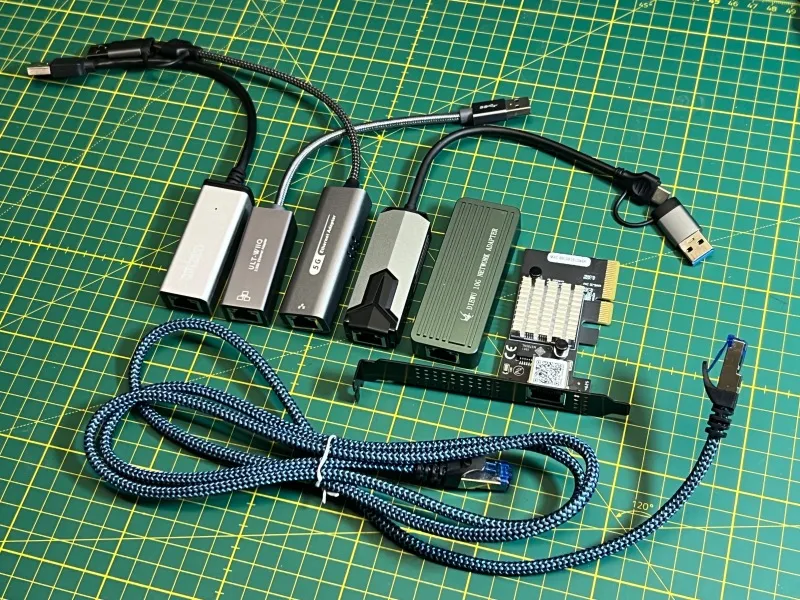
Realtek has introduced low-cost 10 Gigabit Ethernet NICs, making faster home networking more accessible. However, users may face performance issues, particularly on macOS and Linux due to driver limitations. Testing reveals that achieving optimal speeds often requires specific hardware configurations and compatible drivers.
- ▪Realtek's new 10GbE NICs aim to upgrade home networks from standard 1 Gigabit speeds.
- ▪Performance issues have been noted on macOS and Linux, primarily due to inadequate drivers.
- ▪Users may need to ensure they are using the correct USB ports and drivers to achieve desired speeds.
Story provenance
Source · retrieval · rights · ranking — open for full record
inspect →
Story provenance
Attribution is not the same as permission. This drawer separates discovery metadata, excerpts, WeSearch-generated summaries, reuse status, and whether the publisher receives the visit. Nothing here claims a legal grant the publisher has not made.
Record
| Original publisher | Dr. Christian Kohlschütter |
| Canonical URL | https://kohlschuetter.github.io/blog/posts/2026/04/28/rtl10/ |
| Publication time | Tue, 28 Apr 2026 18:24:08 +0000 |
| Retrieval time | 2026-04-28T18:31:49.574Z |
| Last seen | 2026-04-28T18:31:49.574Z |
| Headline source | Publisher (no WeSearch rewrite) |
| Excerpt source | publisher body |
| Excerpt method | First ~120 words (~800 chars) of extracted publisher body, fair-use limited. |
| Summary | WeSearch · cerebras-chat (WeSearch summarizer) |
| Summary source text | contentText |
| Citation coverage | Summary is a WeSearch-generated derivative; primary citation is the original publisher URL. |
| Cluster | EWtOvqpncR4i |
| Cluster logic | Grouped by semantic title/content similarity across sources within a rolling window. Same-publisher template collisions are excluded from coverage comparison. |
| Ranking reason | Story pages are not engagement-ranked. Hub feeds use recency, with optional source-diversified chronological ordering (cap consecutive stories per source). No personalized ranking. |
| Publisher visit | Yes — open original |
| Substitutes article? | No — link-out required for full text |
Rights status (four layers)
WeSearch handling by dimension
| Indexing | May the item be indexed (stored, ranked, made findable)? | Allowed |
| Snippet | May a short excerpt of the publisher's text be shown? | Allowed |
| AI summary | May WeSearch generate its own short summary of the article? | Limited |
| Retrieval / RAG | May the content be exposed for third-party retrieval-augmented generation? | Not asserted |
| Model training | May the content be used to train AI models? | Not asserted |
| Commercial reuse | May the content be reused commercially? | Not permitted |
Basis: Derived from the published RSS/Atom feed. Contact: [email protected]. Reviewed: 2026-07-24.
Opening excerpt (first ~120 words) tap to expand
Even in 2026, ordinary desktop computers regularly ship with measly 1 Gigabit built-in Ethernet ports, 2.5 Gbps if you’re lucky, and maybe 5 Gbps only if the manufacturer is optimizing for tech spec bingo.Maybe it’s because these speeds are “just enough” for the masses?What if you wanted faster speeds (for NAS, moderate homelabbing, fiber internet, etc.) though? You’d have to resort to PCIe cards, or most likely, USB 3 or Thunderbolt adapters.With the recent arrival of a new low-cost 10 Gigabit family of NICs (PCIe RTL8127, ServeTheHome post, and USB RTL8159, Jeff Geerling’s post), Realtek makes upgrading your home network to 10GBASE-T (the 8-wire RJ45 copper kind) seemingly more appealing than ever.
…
Excerpt limited to ~120 words for fair-use compliance. The full article is at Dr. Christian Kohlschütter.
Discussion
0 commentsMore from Dr. Christian Kohlschütter