‘Reverse Okies’ and Blue State Refugees — Another Wave Appears To Be Building
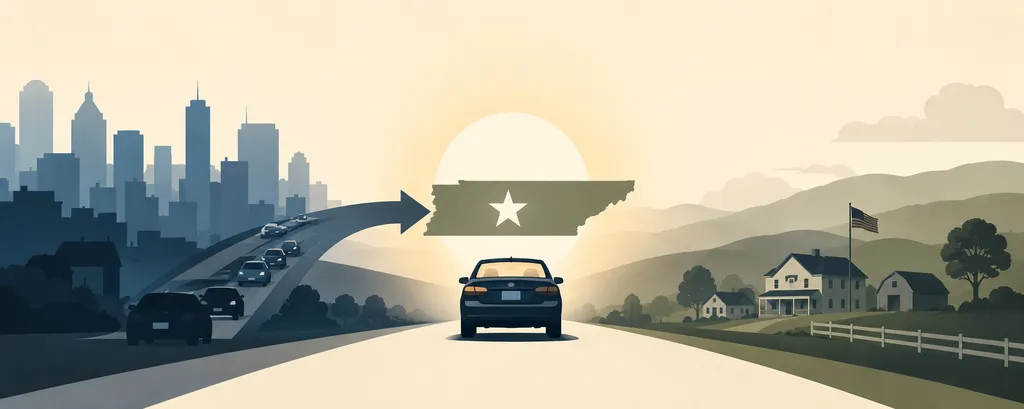
A new wave of migration from blue states to red states, particularly Tennessee, is being observed as residents seek lower costs of living and a more conservative culture. Many newcomers are identified by their out-of-state license plates and express dissatisfaction with their previous governance. This trend suggests that blue-state refugees are increasingly voting Republican in their new communities.
- ▪Blue states experienced a migration exodus during the COVID pandemic due to strict lockdowns and mandates.
- ▪Newcomers from blue states are often seeking a lower cost of living and a conservative culture.
- ▪Recent observations indicate a resurgence of blue-state license plates in Tennessee, particularly from Illinois, California, and Virginia.
The American Spectator files mainly under politics. We currently carry 159 of its stories.
Story provenance
Source · retrieval · rights · ranking — open for full record
inspect →
Story provenance
Attribution is not the same as permission. This drawer separates discovery metadata, excerpts, WeSearch-generated summaries, reuse status, and whether the publisher receives the visit. Nothing here claims a legal grant the publisher has not made.
Record
| Original publisher | The American Spectator | USA News and Politics |
| Canonical URL | https://spectator.org/reverse-okies-and-blue-state-refugees-another-wave-appears-to-be-building/ |
| Publication time | Wed, 03 Jun 2026 03:04:52 +0000 |
| Retrieval time | 2026-06-03T03:06:49.554Z |
| Last seen | 2026-06-03T03:06:49.554Z |
| Headline source | Publisher (no WeSearch rewrite) |
| Excerpt source | publisher body |
| Excerpt method | First ~120 words (~800 chars) of extracted publisher body, fair-use limited. |
| Summary | WeSearch · cerebras-chat (WeSearch summarizer) |
| Summary source text | contentText |
| Citation coverage | Summary is a WeSearch-generated derivative; primary citation is the original publisher URL. |
| Cluster | MqotkuvInCTY |
| Cluster logic | Grouped by semantic title/content similarity across sources within a rolling window. Same-publisher template collisions are excluded from coverage comparison. |
| Ranking reason | Story pages are not engagement-ranked. Hub feeds use recency, with optional source-diversified chronological ordering (cap consecutive stories per source). No personalized ranking. |
| Publisher visit | Yes — open original |
| Substitutes article? | No — link-out required for full text |
Rights status (four layers)
WeSearch handling by dimension
| Indexing | May the item be indexed (stored, ranked, made findable)? | Allowed |
| Snippet | May a short excerpt of the publisher's text be shown? | Allowed |
| AI summary | May WeSearch generate its own short summary of the article? | Limited |
| Retrieval / RAG | May the content be exposed for third-party retrieval-augmented generation? | Not asserted |
| Model training | May the content be used to train AI models? | Not asserted |
| Commercial reuse | May the content be reused commercially? | Not permitted |
Basis: Derived from the published RSS/Atom feed. Contact: [email protected]. Reviewed: 2026-07-24.
Opening excerpt (first ~120 words) tap to expand
Following the declaration of the COVID national emergency in March 2020, blue states rapidly embraced the new command-and-control authority granted them under the pandemic’s “emergency powers.” Their unrelenting lockdowns, mask mandates, and suppression of personal and economic freedom propelled the start of a great national migration.My growing neighborhood in a Tennessee suburb was flooded with blue-state refugees in 2021 and 2022, with very heavy representation from Illinois, but also some from California, New England, and other blue areas. The migration slowed by 2024 and 2025, but a very simple observation indicates to me that the blue state exodus is firing up again.
…
Excerpt limited to ~120 words for fair-use compliance. The full article is at The American Spectator | USA News and Politics.
Discussion
0 comments