
Robotic Mitral Valve Surgery Shows Durable Results
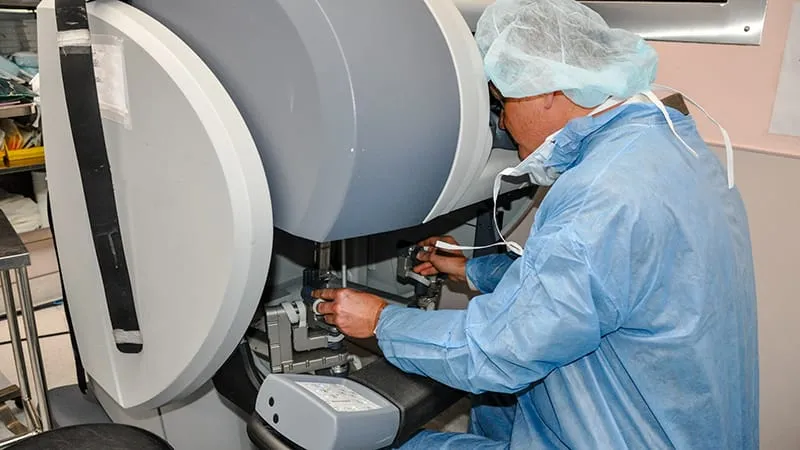
Robotic-assisted mitral valve surgery has demonstrated excellent long-term repair durability and reduced hospital stays compared to traditional methods. A study involving nearly 600 patients showed high repair rates and low failure rates, with only 2.5% requiring reoperation after 10 years. This minimally invasive approach is becoming a preferred option for treating degenerative mitral valve disease.
- ▪Robotic-assisted mitral valve surgery achieved near 100% repair rates for degenerative disease.
- ▪Only around 2.5% of patients required reoperation for repair failure at 10 years.
- ▪The median age of patients in the study was 62 years, with most procedures being elective.
Medscape files mainly under health. We currently carry 231 of its stories.
Story provenance
Source · retrieval · rights · ranking — open for full record
inspect →
Story provenance
Attribution is not the same as permission. This drawer separates discovery metadata, excerpts, WeSearch-generated summaries, reuse status, and whether the publisher receives the visit. Nothing here claims a legal grant the publisher has not made.
Record
| Original publisher | Medscape |
| Canonical URL | https://www.medscape.com/viewarticle/robotic-mitral-valve-surgery-shows-durable-results-2026a1000igu?src=rss |
| Publication time | Wed, 3 Jun 2026 04:57:16 EDT |
| Retrieval time | 2026-06-03T09:12:00.412Z |
| Last seen | 2026-06-03T09:12:00.412Z |
| Headline source | Publisher (no WeSearch rewrite) |
| Excerpt source | publisher body |
| Excerpt method | First ~120 words (~800 chars) of extracted publisher body, fair-use limited. |
| Summary | WeSearch · cerebras-chat (WeSearch summarizer) |
| Summary source text | contentText |
| Citation coverage | Summary is a WeSearch-generated derivative; primary citation is the original publisher URL. |
| Cluster | kBpa3MeQSRC9 |
| Cluster logic | Grouped by semantic title/content similarity across sources within a rolling window. Same-publisher template collisions are excluded from coverage comparison. |
| Ranking reason | Story pages are not engagement-ranked. Hub feeds use recency, with optional source-diversified chronological ordering (cap consecutive stories per source). No personalized ranking. |
| Publisher visit | Yes — open original |
| Substitutes article? | No — link-out required for full text |
Rights status (four layers)
WeSearch handling by dimension
| Indexing | May the item be indexed (stored, ranked, made findable)? | Allowed |
| Snippet | May a short excerpt of the publisher's text be shown? | Allowed |
| AI summary | May WeSearch generate its own short summary of the article? | Limited |
| Retrieval / RAG | May the content be exposed for third-party retrieval-augmented generation? | Not asserted |
| Model training | May the content be used to train AI models? | Not asserted |
| Commercial reuse | May the content be reused commercially? | Not permitted |
Basis: Derived from the published RSS/Atom feed. Contact: [email protected]. Reviewed: 2026-07-24.
Opening excerpt (first ~120 words) tap to expand
MANCHESTER — Robotic-assisted mitral valve surgery achieved excellent long-term repair durability while significantly reducing intensive care and hospital stays compared with conventional minimally invasive approaches, according to data from the largest UK series of robotic and endoscopic mitral valve procedures.Nearly 600 patients with degenerative mitral valve disease were treated over a 14-year period. “There were near 100% repair rates and low failure rates for degenerative disease in all pathologies, with minimally invasive and robotic surgery, even when traversing the learning curve,” reported lead investigator, Paul Modi, professor of cardiac surgery at Liverpool Heart and Chest Hospital.“The repairs are high quality and extremely durable,” he told Medscape News UK in an interview.
…
Excerpt limited to ~120 words for fair-use compliance. The full article is at Medscape.
Discussion
0 commentsMore from Medscape


