Small Model, Big Brain: The 27B Parameter Model Is the New King of Code
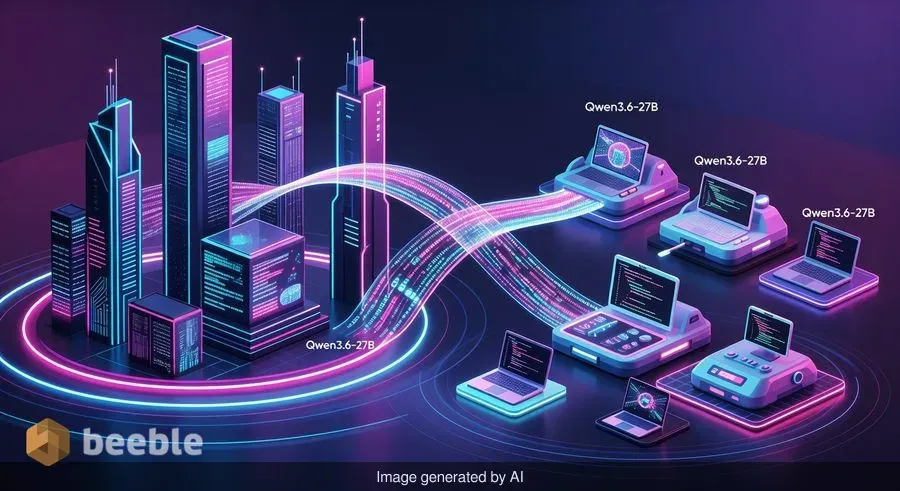
The Qwen3.6-27B model is revolutionizing the AI landscape by proving that smaller models can deliver elite-level coding capabilities. This 27-billion parameter model emphasizes efficiency and precision, challenging the notion that larger models are always better. As a result, developers can now utilize powerful AI tools on personal devices, enhancing data privacy and streamlining workflows.
- ▪The Qwen3.6-27B model has 27 billion parameters and delivers high-level coding capabilities.
- ▪It operates with all parameters active, providing a deeper understanding of code logic.
- ▪This model allows developers to work locally, enhancing data privacy and reducing reliance on cloud services.
Hacker News (Newest) files mainly under programming. We currently carry 5,306 of its stories.
Story provenance
Source · retrieval · rights · ranking — open for full record
inspect →
Story provenance
Attribution is not the same as permission. This drawer separates discovery metadata, excerpts, WeSearch-generated summaries, reuse status, and whether the publisher receives the visit. Nothing here claims a legal grant the publisher has not made.
Record
| Original publisher | Beeble |
| Canonical URL | https://beeble.com/en/blog/small-model-big-brain-why-the-27-billion-parameter-model-is-the-new-king-of-code |
| Publication time | Mon, 25 May 2026 10:31:06 +0000 |
| Retrieval time | 2026-05-25T10:37:36.650Z |
| Last seen | 2026-05-25T10:37:36.650Z |
| Headline source | Publisher (no WeSearch rewrite) |
| Excerpt source | publisher body |
| Excerpt method | First ~120 words (~800 chars) of extracted publisher body, fair-use limited. |
| Summary | WeSearch · cerebras-chat (WeSearch summarizer) |
| Summary source text | contentText |
| Citation coverage | Summary is a WeSearch-generated derivative; primary citation is the original publisher URL. |
| Cluster | icbr-rN-jqvq |
| Cluster logic | Grouped by semantic title/content similarity across sources within a rolling window. Same-publisher template collisions are excluded from coverage comparison. |
| Ranking reason | Story pages are not engagement-ranked. Hub feeds use recency, with optional source-diversified chronological ordering (cap consecutive stories per source). No personalized ranking. |
| Publisher visit | Yes — open original |
| Substitutes article? | No — link-out required for full text |
Rights status (four layers)
WeSearch handling by dimension
| Indexing | May the item be indexed (stored, ranked, made findable)? | Allowed |
| Snippet | May a short excerpt of the publisher's text be shown? | Allowed |
| AI summary | May WeSearch generate its own short summary of the article? | Limited |
| Retrieval / RAG | May the content be exposed for third-party retrieval-augmented generation? | Not asserted |
| Model training | May the content be used to train AI models? | Not asserted |
| Commercial reuse | May the content be reused commercially? | Not permitted |
Basis: Derived from the published RSS/Atom feed. Contact: [email protected]. Reviewed: 2026-07-24.
Opening excerpt (first ~120 words) tap to expand
While the tech world often remains fixated on the gargantuan, trillion-parameter models that require the power of a small city to run, a quiet revolution is taking place in the mid-range. For years, the prevailing narrative suggested that to get 'flagship' performance, you needed a model so massive it could only live in a multi-billion-dollar data center. However, the release of Qwen3.6-27B challenges this assumption head-on. By delivering elite-level coding capabilities in a dense 27-billion parameter package, it is proving that efficiency and intelligence are not mutually exclusive. Historically, the AI industry has followed a bigger-is-better trajectory.
…
Excerpt limited to ~120 words for fair-use compliance. The full article is at Beeble.
Discussion
0 commentsMore from Beeble