South Korea facts of the day
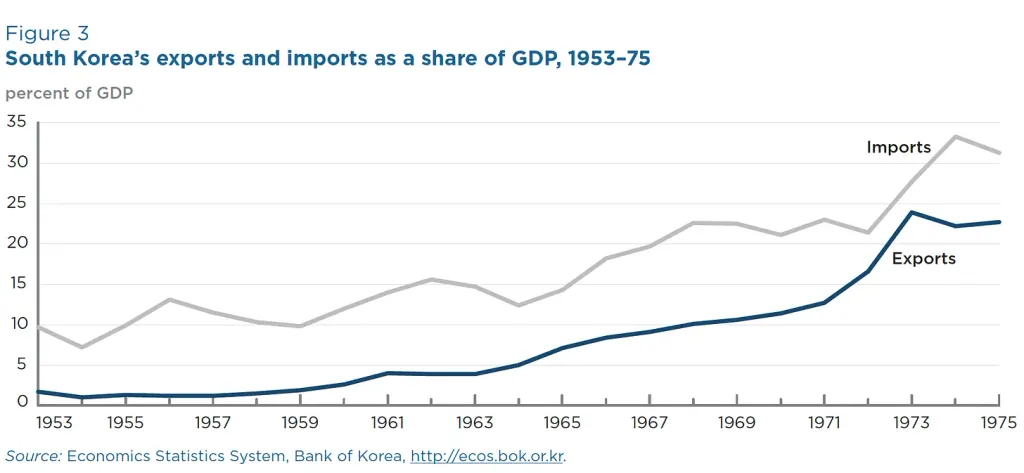
The article discusses the economic history of South Korea, highlighting its unique growth model. Contrary to the common perception of export-led growth, South Korea experienced trade deficits during its rapid economic expansion from 1963 to 1997. The author critiques the oversimplification of South Korea's economic success and emphasizes the complexity of its development.
- ▪South Korea was once poorer than North Korea in the early 1970s.
- ▪The country ran almost nonstop trade deficits during its period of near double-digit growth.
- ▪The author expresses disdain for the term 'export-led growth' as it misrepresents South Korea's economic strategy.
2 outlets in our directory ran this story, first to last over 29 hours. All of the coverage we found sits in one bucket: centre. That one-sidedness is itself worth noticing.
- ▪ Rajnath embarks on 4-day trip to Vietnam and South Korea — Hindustan Times — Top
Marginal Revolution files mainly under finance. We currently carry 105 of its stories.
Story provenance
Source · retrieval · rights · ranking — open for full record
inspect →
Story provenance
Attribution is not the same as permission. This drawer separates discovery metadata, excerpts, WeSearch-generated summaries, reuse status, and whether the publisher receives the visit. Nothing here claims a legal grant the publisher has not made.
Record
| Original publisher | Marginal Revolution |
| Canonical URL | https://marginalrevolution.com/marginalrevolution/2026/05/south-korea-facts-of-the-day.html?utm_source=rss&utm_medium=rss&utm_campaign=south-korea-facts-of-the-day |
| Publication time | Sun, 17 May 2026 04:01:17 +0000 |
| Retrieval time | 2026-05-17T04:03:58.374Z |
| Last seen | 2026-05-17T04:03:58.374Z |
| Headline source | Publisher (no WeSearch rewrite) |
| Excerpt source | publisher body |
| Excerpt method | First ~120 words (~800 chars) of extracted publisher body, fair-use limited. |
| Summary | WeSearch · cerebras-chat (WeSearch summarizer) |
| Summary source text | contentText |
| Citation coverage | Summary is a WeSearch-generated derivative; primary citation is the original publisher URL. |
| Cluster | hFidkZjrEZwk · 2 stories |
| Cluster logic | Grouped by semantic title/content similarity across sources within a rolling window. Same-publisher template collisions are excluded from coverage comparison. |
| Ranking reason | Story pages are not engagement-ranked. Hub feeds use recency, with optional source-diversified chronological ordering (cap consecutive stories per source). No personalized ranking. |
| Publisher visit | Yes — open original |
| Substitutes article? | No — link-out required for full text |
Rights status (four layers)
WeSearch handling by dimension
| Indexing | May the item be indexed (stored, ranked, made findable)? | Allowed |
| Snippet | May a short excerpt of the publisher's text be shown? | Allowed |
| AI summary | May WeSearch generate its own short summary of the article? | Limited |
| Retrieval / RAG | May the content be exposed for third-party retrieval-augmented generation? | Not asserted |
| Model training | May the content be used to train AI models? | Not asserted |
| Commercial reuse | May the content be reused commercially? | Not permitted |
Basis: Derived from the published RSS/Atom feed. Contact: [email protected]. Reviewed: 2026-07-24.
Opening excerpt (first ~120 words) tap to expand
South Korea facts of the day by Tyler Cowen May 17, 2026 at 12:01 am in Data Source Economics History When I was young, the South Korean model was generally lumped in with places like Taiwan, Singapore and Hong Kong as a case of “export-led growth”. Even in the early 1970s, South Korea was still poorer than the North. There was no consensus that East Asia would do better than Latin America (or indeed that America would do better than the Soviet Union.) I hate the term “export-led growth”, as on its face it would seem to imply that South Korea got rich by running trade surpluses. But exactly the opposite is true. During the three and a half decades of near double-digit growth (roughly 1963-97), Korea ran almost nonstop trade deficits, apart from a few years in the 1980s.
…
Excerpt limited to ~120 words for fair-use compliance. The full article is at Marginal Revolution.
Discussion
0 commentsMore from Marginal Revolution