The Infrastructure Behind Making Local LLM Agents Useful
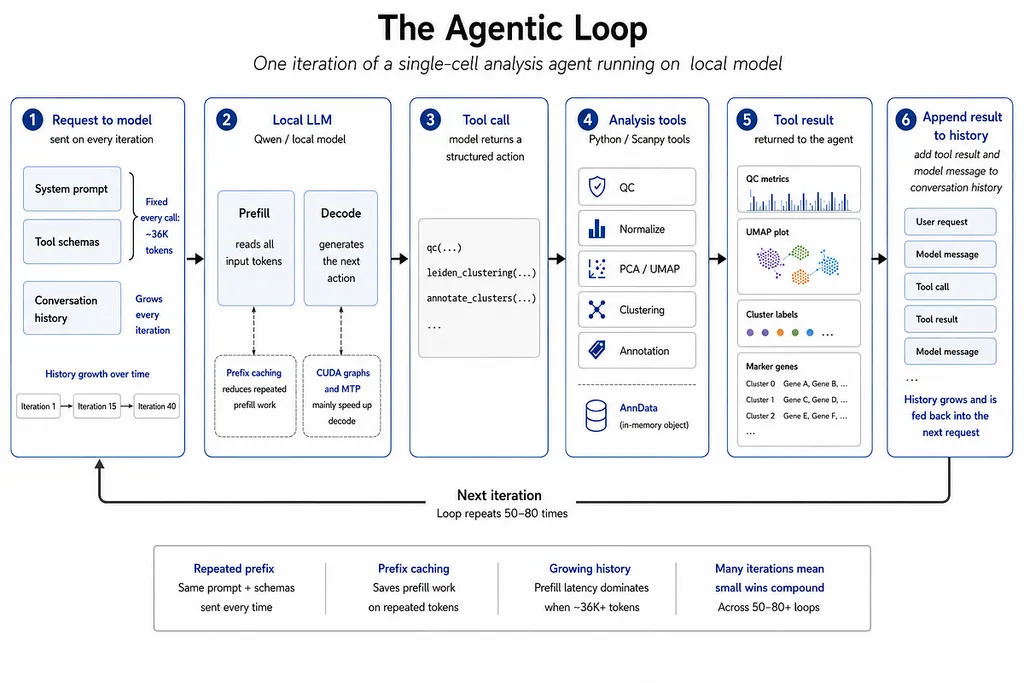
The article discusses the challenges and solutions in building a local language model (LLM) agent for automated single-cell RNA-seq analysis. It highlights the importance of reproducibility and structured data management in scientific workflows, which are often overlooked in simpler chatbot implementations. The author shares insights on optimizing inference speed and managing context for long-running sessions to enhance the usability of the agent.
- ▪Building a local LLM agent requires more than just downloading weights and starting a server; it involves managing complex workflows.
- ▪Scientific analysis demands reproducibility and structured records, which are not adequately addressed by standard chatbot skills.
- ▪The author implemented optimizations to improve inference speed and context management for long sessions in their agent.
Hacker News (AI / LLM) files mainly under ai. We currently carry 3,311 of its stories.
Story provenance
Source · retrieval · rights · ranking — open for full record
inspect →
Story provenance
Attribution is not the same as permission. This drawer separates discovery metadata, excerpts, WeSearch-generated summaries, reuse status, and whether the publisher receives the visit. Nothing here claims a legal grant the publisher has not made.
Record
| Original publisher | Medium |
| Canonical URL | https://medium.com/@hussenmi/the-infrastructure-behind-actually-useful-local-llm-agents-67040167bf1a |
| Publication time | Mon, 18 May 2026 15:10:12 +0000 |
| Retrieval time | 2026-05-18T15:29:56.629Z |
| Last seen | 2026-05-18T15:29:56.629Z |
| Headline source | Publisher (no WeSearch rewrite) |
| Excerpt source | publisher body |
| Excerpt method | First ~120 words (~800 chars) of extracted publisher body, fair-use limited. |
| Summary | WeSearch · cerebras-chat (WeSearch summarizer) |
| Summary source text | contentText |
| Citation coverage | Summary is a WeSearch-generated derivative; primary citation is the original publisher URL. |
| Cluster | beCv1wbfnU8A |
| Cluster logic | Grouped by semantic title/content similarity across sources within a rolling window. Same-publisher template collisions are excluded from coverage comparison. |
| Ranking reason | Story pages are not engagement-ranked. Hub feeds use recency, with optional source-diversified chronological ordering (cap consecutive stories per source). No personalized ranking. |
| Publisher visit | Yes — open original |
| Substitutes article? | No — link-out required for full text |
Rights status (four layers)
WeSearch handling by dimension
| Indexing | May the item be indexed (stored, ranked, made findable)? | Allowed |
| Snippet | May a short excerpt of the publisher's text be shown? | Allowed |
| AI summary | May WeSearch generate its own short summary of the article? | Limited |
| Retrieval / RAG | May the content be exposed for third-party retrieval-augmented generation? | Not asserted |
| Model training | May the content be used to train AI models? | Not asserted |
| Commercial reuse | May the content be reused commercially? | Not permitted |
Basis: Derived from the published RSS/Atom feed. Contact: [email protected]. Reviewed: 2026-07-24.
Opening excerpt (first ~120 words) tap to expand
The Infrastructure Behind Making Local LLM Agents Actually UsefulHussen Mohammed Ibrahim17 min read·5 hours ago--ListenShareRunning a language model locally sounds straightforward. Download the weights, start the server, and send requests. That works for a chatbot, but it doesn’t automatically work for an agent. In my case, I’ve been building an agent for automated single-cell RNA-seq analysis. The idea is that, given raw data, the agent can run the full pipeline on its own, deciding which tools to call, reading the results, and working through the analysis step by step.You might ask why not just use something like Claude Code with a single-cell analysis Skill. The short answer is that for scientific workflows, that’s not quite enough.
…
Excerpt limited to ~120 words for fair-use compliance. The full article is at Medium.
Discussion
0 commentsMore from Medium