The invisible fabric of AI: chips aren't a US-China war, but a 30-country chain
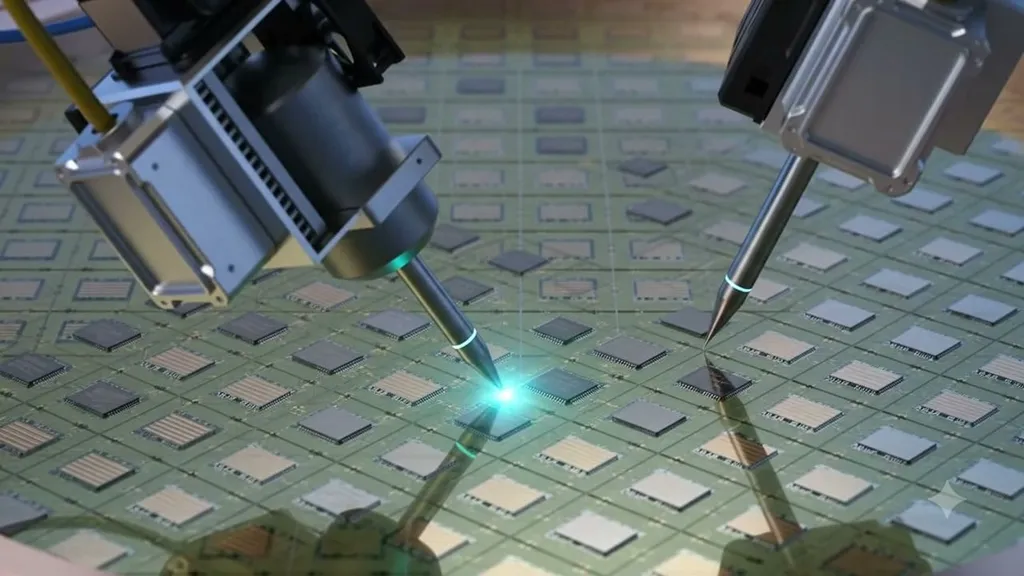
The article discusses the complex global supply chain of AI chips, emphasizing that it involves over thirty countries rather than just a US-China rivalry. It highlights Europe's significant role in this supply chain and the need for a strategic approach to leverage its capabilities in AI. The narrative surrounding the chip war oversimplifies the interdependencies that exist in the production of advanced processors.
- ▪AI chips require components and expertise from more than thirty countries.
- ▪The narrative of a US-China chip war obscures the structural interdependence of the global supply chain.
- ▪Europe holds several technical monopolies in the AI chip supply chain and could play a crucial role if it acts as a bloc.
Hacker News (Newest) files mainly under programming. We currently carry 5,306 of its stories.
Story provenance
Source · retrieval · rights · ranking — open for full record
inspect →
Story provenance
Attribution is not the same as permission. This drawer separates discovery metadata, excerpts, WeSearch-generated summaries, reuse status, and whether the publisher receives the visit. Nothing here claims a legal grant the publisher has not made.
Record
| Original publisher | zoopa.es |
| Canonical URL | https://zoopa.es/en/innovation-technology/invisible-fabric-ai-chips-geopolitics/ |
| Publication time | Sun, 24 May 2026 11:23:44 +0000 |
| Retrieval time | 2026-05-24T11:37:32.397Z |
| Last seen | 2026-05-24T11:37:32.397Z |
| Headline source | Publisher (no WeSearch rewrite) |
| Excerpt source | publisher body |
| Excerpt method | First ~120 words (~800 chars) of extracted publisher body, fair-use limited. |
| Summary | WeSearch · cerebras-chat (WeSearch summarizer) |
| Summary source text | contentText |
| Citation coverage | Summary is a WeSearch-generated derivative; primary citation is the original publisher URL. |
| Cluster | -1ygL8geTpHH |
| Cluster logic | Grouped by semantic title/content similarity across sources within a rolling window. Same-publisher template collisions are excluded from coverage comparison. |
| Ranking reason | Story pages are not engagement-ranked. Hub feeds use recency, with optional source-diversified chronological ordering (cap consecutive stories per source). No personalized ranking. |
| Publisher visit | Yes — open original |
| Substitutes article? | No — link-out required for full text |
Rights status (four layers)
WeSearch handling by dimension
| Indexing | May the item be indexed (stored, ranked, made findable)? | Allowed |
| Snippet | May a short excerpt of the publisher's text be shown? | Allowed |
| AI summary | May WeSearch generate its own short summary of the article? | Limited |
| Retrieval / RAG | May the content be exposed for third-party retrieval-augmented generation? | Not asserted |
| Model training | May the content be used to train AI models? | Not asserted |
| Commercial reuse | May the content be reused commercially? | Not permitted |
Basis: Derived from the published RSS/Atom feed. Contact: [email protected]. Reviewed: 2026-07-24.
Opening excerpt (first ~120 words) tap to expand
The invisible fabric of AI: chips are not a war between two, but a global fabric By Carlos Ortet · From 498A, a European AI lab · May 23, 2026 Illustration: Tara Jacoby. Every AI chip that trains a model at OpenAI, Anthropic or Mistral needs a set of mirrors polished in a German factory, a chemical resin mixed in a Japanese laboratory, and a packaging building in Taiwan whose waiting list runs past a year. Without any one of these three elements, the chip does not exist. None of them is American or Chinese. Almost nobody describes this international fabric: the supply chain of an advanced processor depends on the coordinated work of more than thirty countries. Not two.
…
Excerpt limited to ~120 words for fair-use compliance. The full article is at zoopa.es.
Discussion
0 commentsMore from zoopa.es