The pyramids' missing casing stones have a better story than "thieves"
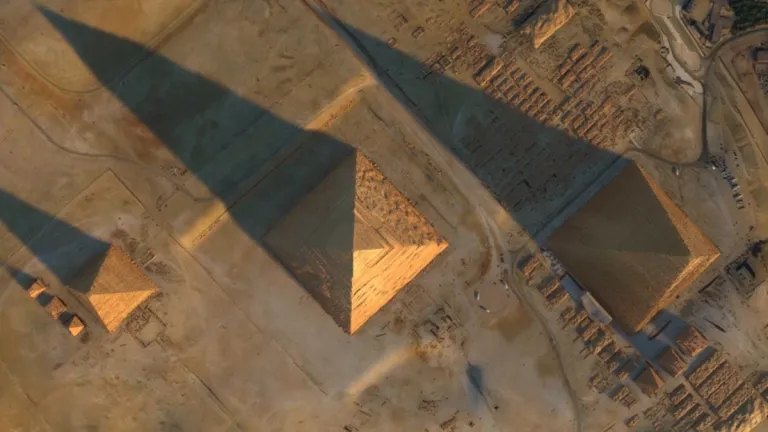
The missing casing stones of the Egyptian pyramids have a more complex history than simply being stolen. Research suggests that natural forces may have caused some stones to fall off, which were later removed by people. The Bent Pyramid, which retains much of its original cladding, offers valuable insights into the construction of these ancient monuments.
- ▪The pyramids were originally smooth and white, but now appear as giant staircases due to missing casing stones.
- ▪History for Granite argues that natural forces contributed to the loss of casing stones, rather than solely theft.
- ▪The Bent Pyramid is significant as it still has much of its original limestone cladding, providing evidence of ancient construction techniques.
Boing Boing files mainly under tech. We currently carry 372 of its stories.
Story provenance
Source · retrieval · rights · ranking — open for full record
inspect →
Story provenance
Attribution is not the same as permission. This drawer separates discovery metadata, excerpts, WeSearch-generated summaries, reuse status, and whether the publisher receives the visit. Nothing here claims a legal grant the publisher has not made.
Record
| Original publisher | Boing Boing |
| Canonical URL | https://boingboing.net/2026/05/29/the-pyramids-missing-casing-stones-have-a-better-story-than-thieves.html |
| Publication time | Fri, 29 May 2026 18:18:45 +0000 |
| Retrieval time | 2026-05-29T18:55:02.459Z |
| Last seen | 2026-05-29T18:55:02.459Z |
| Headline source | Publisher (no WeSearch rewrite) |
| Excerpt source | publisher body |
| Excerpt method | First ~120 words (~800 chars) of extracted publisher body, fair-use limited. |
| Summary | WeSearch · cerebras-chat (WeSearch summarizer) |
| Summary source text | contentText |
| Citation coverage | Summary is a WeSearch-generated derivative; primary citation is the original publisher URL. |
| Cluster | tWiSgmcWrVmL |
| Cluster logic | Grouped by semantic title/content similarity across sources within a rolling window. Same-publisher template collisions are excluded from coverage comparison. |
| Ranking reason | Story pages are not engagement-ranked. Hub feeds use recency, with optional source-diversified chronological ordering (cap consecutive stories per source). No personalized ranking. |
| Publisher visit | Yes — open original |
| Substitutes article? | No — link-out required for full text |
Rights status (four layers)
WeSearch handling by dimension
| Indexing | May the item be indexed (stored, ranked, made findable)? | Allowed |
| Snippet | May a short excerpt of the publisher's text be shown? | Allowed |
| AI summary | May WeSearch generate its own short summary of the article? | Limited |
| Retrieval / RAG | May the content be exposed for third-party retrieval-augmented generation? | Not asserted |
| Model training | May the content be used to train AI models? | Not asserted |
| Commercial reuse | May the content be reused commercially? | Not permitted |
Basis: Derived from the published RSS/Atom feed. Contact: [email protected]. Reviewed: 2026-07-24.
Opening excerpt (first ~120 words) tap to expand
The pyramids' missing casing stones have a better story than "thieves" Jason Weisberger 11:18 am Fri May 29, 2026 Pyramids in Egypt. Photo: GLF Media / Shutterstock.com The pyramids used to be smooth, white, and blinding in the sun. Now they look like giant ancient staircases, and the usual explanation is that people stole the good bits. History for Granite says the truth is messier and far more interesting. The simple story is that people stripped the pyramids for building material. That happened, but it does not explain everything. Looking at the damage patterns, History for Granite argues that some pyramids were not quarried directly so much as shed their casing stones through natural forces, with people later hauling off what had already fallen.
…
Excerpt limited to ~120 words for fair-use compliance. The full article is at Boing Boing.
Discussion
0 commentsMore from Boing Boing