There’s No Earthly Way of Knowing Which Direction We Are Going…
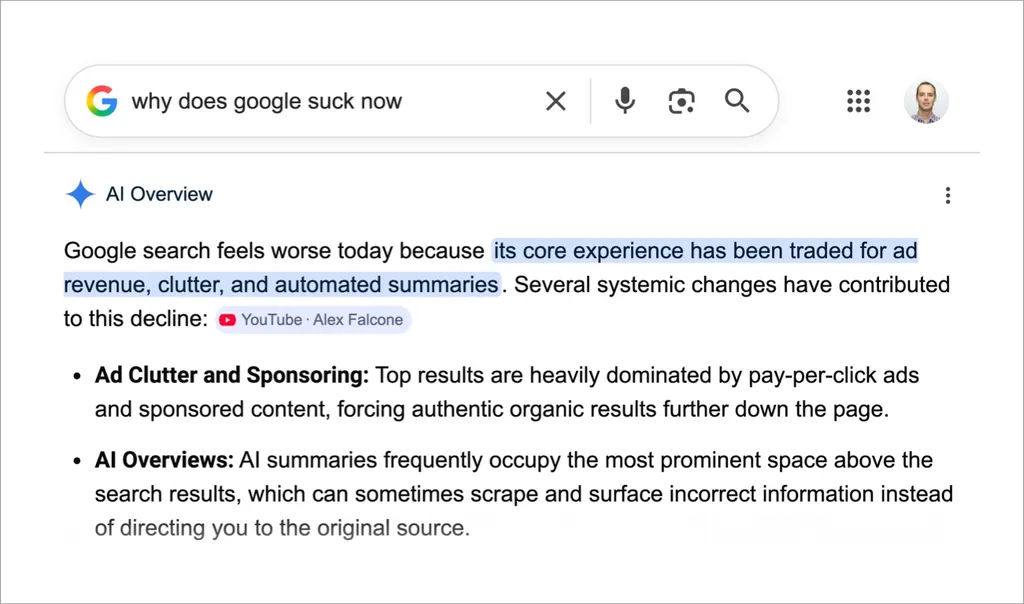
Google has announced a significant update to its Search feature during the Google I/O conference. The new AI-powered search will provide interactive experiences instead of just a list of links. Additionally, users will have access to tools that create personalized mini apps and information agents to gather data for them.
- ▪Google introduced an AI-powered overhaul of its Search feature at the Google I/O conference.
- ▪The new search experience will include interactive elements rather than just a list of links.
- ▪Users will be able to create personalized mini apps and utilize information agents for data gathering.
kottke.org files mainly under culture. We currently carry 82 of its stories.
Story provenance
Source · retrieval · rights · ranking — open for full record
inspect →
Story provenance
Attribution is not the same as permission. This drawer separates discovery metadata, excerpts, WeSearch-generated summaries, reuse status, and whether the publisher receives the visit. Nothing here claims a legal grant the publisher has not made.
Record
| Original publisher | kottke.org |
| Canonical URL | https://kottke.org/26/05/theres-no-earthly-way-of-knowing-which-direction-we-are-going |
| Publication time | 2026-05-19T21:22:14Z |
| Retrieval time | 2026-05-19T21:34:58.272Z |
| Last seen | 2026-05-19T21:34:58.272Z |
| Headline source | Publisher (no WeSearch rewrite) |
| Excerpt source | publisher body |
| Excerpt method | First ~120 words (~800 chars) of extracted publisher body, fair-use limited. |
| Summary | WeSearch · cerebras-chat (WeSearch summarizer) |
| Summary source text | contentText |
| Citation coverage | Summary is a WeSearch-generated derivative; primary citation is the original publisher URL. |
| Cluster | E2ebPNWfNIXz |
| Cluster logic | Grouped by semantic title/content similarity across sources within a rolling window. Same-publisher template collisions are excluded from coverage comparison. |
| Ranking reason | Story pages are not engagement-ranked. Hub feeds use recency, with optional source-diversified chronological ordering (cap consecutive stories per source). No personalized ranking. |
| Publisher visit | Yes — open original |
| Substitutes article? | No — link-out required for full text |
Rights status (four layers)
WeSearch handling by dimension
| Indexing | May the item be indexed (stored, ranked, made findable)? | Allowed |
| Snippet | May a short excerpt of the publisher's text be shown? | Allowed |
| AI summary | May WeSearch generate its own short summary of the article? | Limited |
| Retrieval / RAG | May the content be exposed for third-party retrieval-augmented generation? | Not asserted |
| Model training | May the content be used to train AI models? | Not asserted |
| Commercial reuse | May the content be reused commercially? | Not permitted |
Basis: Derived from the published RSS/Atom feed. Contact: [email protected]. Reviewed: 2026-07-24.
Opening excerpt (first ~120 words) tap to expand
At its Google I/O conference on Tuesday, Google unveiled an AI-powered overhaul of Search centered around a reimagined “intelligent search box” — what the company describes as the biggest change to this entry point to the web since the search box debuted more than 25 years ago.Instead of returning a simple list of links, Google Search will drop users into AI-powered interactive experiences at times. Google is also introducing tools that can dispatch “information agents” to gather information on a user’s behalf, along with tools that let users build personalized mini apps tailored to their needs.The resulting experience will no longer look much like how people envision Google Search, which has long been defined by ranked links to websites that have the information you need.
Excerpt limited to ~120 words for fair-use compliance. The full article is at kottke.org.
Discussion
0 commentsMore from kottke.org