These 100-year-old flounder photos look like abstract design studies
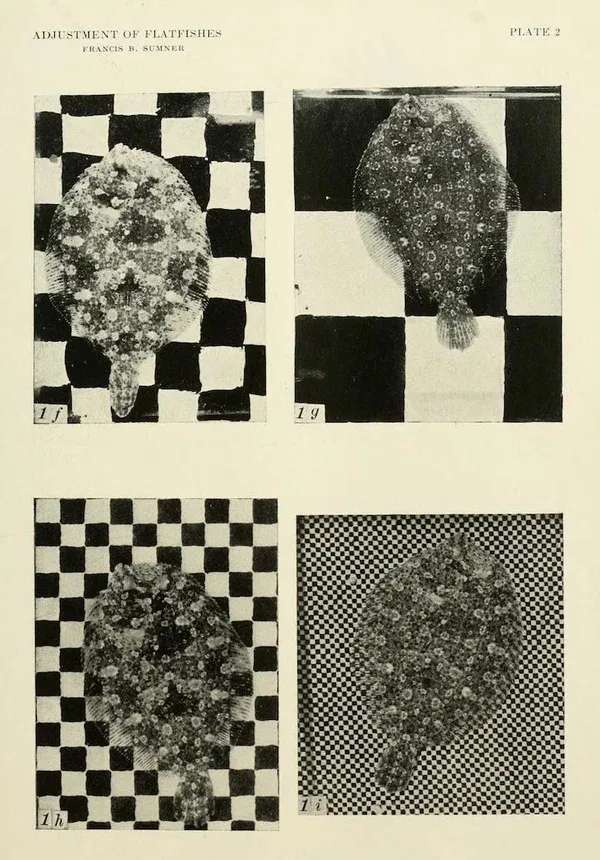
A collection of 100-year-old photographs of flounders showcases their adaptive camouflage abilities. Taken by zoologist Francis Bertody Sumner, the images document how flounders change color and pattern against contrasting backgrounds. The black and white photos have a modern, abstract quality that highlights the fish's unique adaptations.
- ▪The photographs were part of a study published in 1911 by zoologist Francis Bertody Sumner.
- ▪Sumner observed how flounders adapted their appearance to blend into various artificial backgrounds.
- ▪Among the species studied, Rhomboidichthys podas exhibited particularly strong camouflage abilities.
Boing Boing files mainly under tech. We currently carry 375 of its stories.
Story provenance
Source · retrieval · rights · ranking — open for full record
inspect →
Story provenance
Attribution is not the same as permission. This drawer separates discovery metadata, excerpts, WeSearch-generated summaries, reuse status, and whether the publisher receives the visit. Nothing here claims a legal grant the publisher has not made.
Record
| Original publisher | Boing Boing |
| Canonical URL | https://boingboing.net/2026/05/18/these-100-year-old-flounder-photos-look-like-abstract-design-studies.html |
| Publication time | Mon, 18 May 2026 19:22:41 +0000 |
| Retrieval time | 2026-05-18T19:44:56.940Z |
| Last seen | 2026-05-18T19:44:56.940Z |
| Headline source | Publisher (no WeSearch rewrite) |
| Excerpt source | publisher body |
| Excerpt method | First ~120 words (~800 chars) of extracted publisher body, fair-use limited. |
| Summary | WeSearch · cerebras-chat (WeSearch summarizer) |
| Summary source text | contentText |
| Citation coverage | Summary is a WeSearch-generated derivative; primary citation is the original publisher URL. |
| Cluster | K1te6QlC5bVI |
| Cluster logic | Grouped by semantic title/content similarity across sources within a rolling window. Same-publisher template collisions are excluded from coverage comparison. |
| Ranking reason | Story pages are not engagement-ranked. Hub feeds use recency, with optional source-diversified chronological ordering (cap consecutive stories per source). No personalized ranking. |
| Publisher visit | Yes — open original |
| Substitutes article? | No — link-out required for full text |
Rights status (four layers)
WeSearch handling by dimension
| Indexing | May the item be indexed (stored, ranked, made findable)? | Allowed |
| Snippet | May a short excerpt of the publisher's text be shown? | Allowed |
| AI summary | May WeSearch generate its own short summary of the article? | Limited |
| Retrieval / RAG | May the content be exposed for third-party retrieval-augmented generation? | Not asserted |
| Model training | May the content be used to train AI models? | Not asserted |
| Commercial reuse | May the content be reused commercially? | Not permitted |
Basis: Derived from the published RSS/Atom feed. Contact: [email protected]. Reviewed: 2026-07-24.
Opening excerpt (first ~120 words) tap to expand
These 100-year-old flounder photos look like abstract design studies Popkin 12:22 pm Mon May 18, 2026 These images of flounders come from an early 20th-century study published in 1911 in the Journal of Experimental Zoology by American zoologist Francis Bertody Sumner. Working between research stations in Naples, Italy, and Woods Hole, US, he tested how flounders adapt their appearance when placed on sharply contrasting, artificial-looking backgrounds designed to challenge their camouflage. Sumner photographed the fish as they gradually shifted color and pattern to blend into each new setting, documenting the process as it unfolded. Among the species he observed, Rhomboidichthys podas showed particularly strong adaptive camouflage compared to the others.
…
Excerpt limited to ~120 words for fair-use compliance. The full article is at Boing Boing.
Discussion
0 commentsMore from Boing Boing