This 260-Million-Year-Old Reptile Fossil Is Reshaping the Story of Turtle Evolution
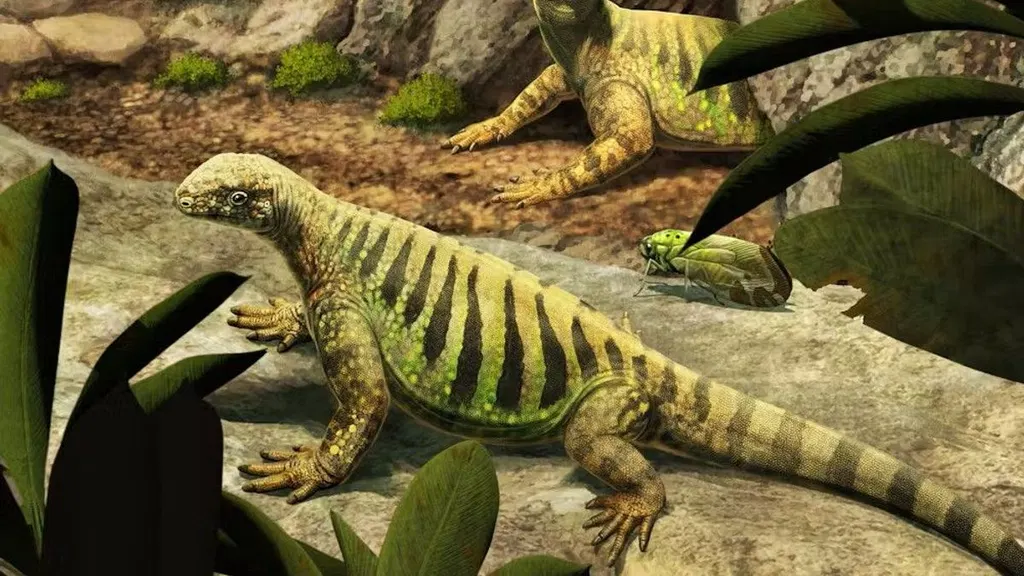
A recent study has redefined the evolutionary history of turtles by examining the fossil Eunotosaurus africanus. Researchers found that this 260-million-year-old reptile is not an early turtle but belongs to a separate lineage that independently developed turtle-like features. This discovery aligns fossil evidence with genetic studies, suggesting turtles are closely related to archosaurs.
- ▪Eunotosaurus africanus was previously thought to be an early ancestor of turtles.
- ▪CT scans revealed that Eunotosaurus is more closely related to millerettids, a group of extinct stem reptiles.
- ▪The study suggests that the turtle lineage diverged from archosaurs later than previously believed.
Discover Magazine files mainly under science. We currently carry 86 of its stories.
Story provenance
Source · retrieval · rights · ranking — open for full record
inspect →
Story provenance
Attribution is not the same as permission. This drawer separates discovery metadata, excerpts, WeSearch-generated summaries, reuse status, and whether the publisher receives the visit. Nothing here claims a legal grant the publisher has not made.
Record
| Original publisher | Discover Magazine |
| Canonical URL | https://www.discovermagazine.com/this-260-million-year-old-reptile-fossil-is-reshaping-the-story-of-turtle-evolution-49172 |
| Publication time | Fri, 29 May 2026 19:50:00 GMT |
| Retrieval time | 2026-05-29T20:00:03.801Z |
| Last seen | 2026-05-29T20:00:03.801Z |
| Headline source | Publisher (no WeSearch rewrite) |
| Excerpt source | publisher body |
| Excerpt method | First ~120 words (~800 chars) of extracted publisher body, fair-use limited. |
| Summary | WeSearch · cerebras-chat (WeSearch summarizer) |
| Summary source text | contentText |
| Citation coverage | Summary is a WeSearch-generated derivative; primary citation is the original publisher URL. |
| Cluster | GxiF51aHWibE |
| Cluster logic | Grouped by semantic title/content similarity across sources within a rolling window. Same-publisher template collisions are excluded from coverage comparison. |
| Ranking reason | Story pages are not engagement-ranked. Hub feeds use recency, with optional source-diversified chronological ordering (cap consecutive stories per source). No personalized ranking. |
| Publisher visit | Yes — open original |
| Substitutes article? | No — link-out required for full text |
Rights status (four layers)
WeSearch handling by dimension
| Indexing | May the item be indexed (stored, ranked, made findable)? | Allowed |
| Snippet | May a short excerpt of the publisher's text be shown? | Allowed |
| AI summary | May WeSearch generate its own short summary of the article? | Limited |
| Retrieval / RAG | May the content be exposed for third-party retrieval-augmented generation? | Not asserted |
| Model training | May the content be used to train AI models? | Not asserted |
| Commercial reuse | May the content be reused commercially? | Not permitted |
Basis: Derived from the published RSS/Atom feed. Contact: [email protected]. Reviewed: 2026-07-24.
Opening excerpt (first ~120 words) tap to expand
Eunotosaurus africanus seemed to capture an early stage in turtle evolution. It had wide, flattened ribs, a shortened trunk, and a body that, to generations of paleontologists, looked unmistakably like a shell in the making.For nearly two decades, the 260-million-year-old reptile sat near the base of the turtle family tree, offering one of the earliest clues to how turtles began evolving their shells. Then, a team of researchers looked inside its skull.In a new study published in Current Biology, researchers used CT scanning to examine the internal anatomy of Eunotosaurus in new detail.
…
Excerpt limited to ~120 words for fair-use compliance. The full article is at Discover Magazine.
Discussion
0 commentsMore from Discover Magazine