Top 10 Python Libraries for Data Engineering in 2026
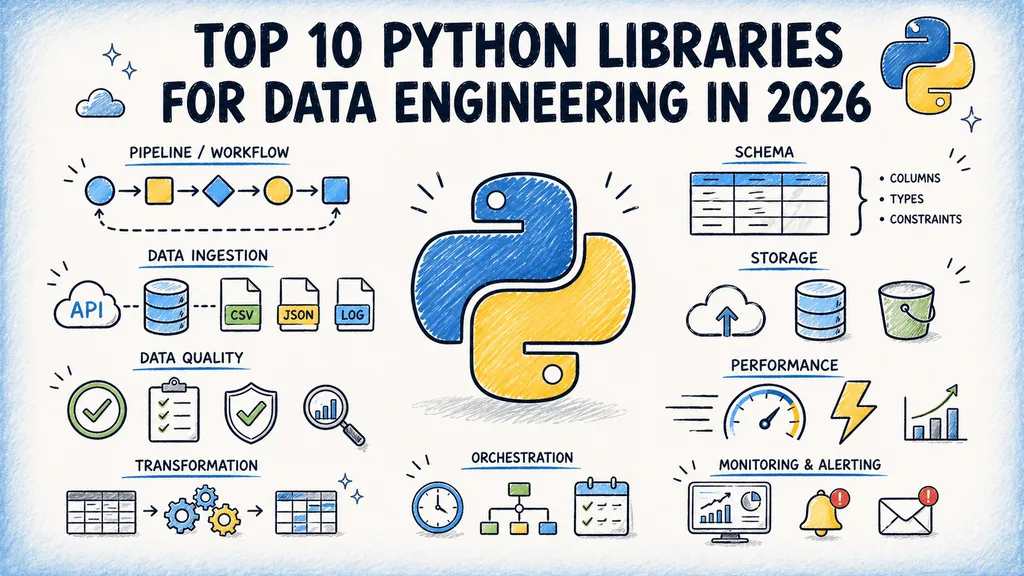
The article discusses the top Python libraries for data engineering in 2026, focusing on tools that enhance pipeline orchestration, data ingestion, and data quality management. It highlights libraries like Prefect, SQLMesh, dlt, and Bytewax, which aim to simplify and improve various aspects of data engineering workflows. Each library is accompanied by a learning resource to help users quickly implement these tools in their projects.
- ▪Prefect is a modern workflow orchestration library that simplifies scheduling and monitoring data pipelines.
- ▪SQLMesh is an open-source framework that manages SQL transformations with CI/CD capabilities.
- ▪dlt allows users to build data ingestion pipelines with minimal code and auto-generates schemas.
- ▪Bytewax is a stream processing framework that enables real-time data processing using a native Python API.
KDnuggets files mainly under ai. We currently carry 40 of its stories.
Story provenance
Source · retrieval · rights · ranking — open for full record
inspect →
Story provenance
Attribution is not the same as permission. This drawer separates discovery metadata, excerpts, WeSearch-generated summaries, reuse status, and whether the publisher receives the visit. Nothing here claims a legal grant the publisher has not made.
Record
| Original publisher | KDnuggets |
| Canonical URL | https://www.kdnuggets.com/top-10-python-libraries-for-data-engineering-in-2026 |
| Publication time | Tue, 19 May 2026 12:00:04 +0000 |
| Retrieval time | 2026-05-19T12:09:57.517Z |
| Last seen | 2026-05-19T12:09:57.517Z |
| Headline source | Publisher (no WeSearch rewrite) |
| Excerpt source | publisher body |
| Excerpt method | First ~120 words (~800 chars) of extracted publisher body, fair-use limited. |
| Summary | WeSearch · cerebras-chat (WeSearch summarizer) |
| Summary source text | contentText |
| Citation coverage | Summary is a WeSearch-generated derivative; primary citation is the original publisher URL. |
| Cluster | 5YHpou_1FYh- |
| Cluster logic | Grouped by semantic title/content similarity across sources within a rolling window. Same-publisher template collisions are excluded from coverage comparison. |
| Ranking reason | Story pages are not engagement-ranked. Hub feeds use recency, with optional source-diversified chronological ordering (cap consecutive stories per source). No personalized ranking. |
| Publisher visit | Yes — open original |
| Substitutes article? | No — link-out required for full text |
Rights status (four layers)
WeSearch handling by dimension
| Indexing | May the item be indexed (stored, ranked, made findable)? | Allowed |
| Snippet | May a short excerpt of the publisher's text be shown? | Allowed |
| AI summary | May WeSearch generate its own short summary of the article? | Limited |
| Retrieval / RAG | May the content be exposed for third-party retrieval-augmented generation? | Not asserted |
| Model training | May the content be used to train AI models? | Not asserted |
| Commercial reuse | May the content be reused commercially? | Not permitted |
Basis: Derived from the published RSS/Atom feed. Contact: [email protected]. Reviewed: 2026-07-24.
Opening excerpt (first ~120 words) tap to expand
# Introduction Data engineering has never been more demanding. Pipelines are expected to be faster, more reliable, and easier to maintain — all while the volume and variety of data keeps growing. Most data engineers have their go-to stack, but the Python ecosystem has expanded well beyond the usual suspects, and some of the most useful tools for the job are still flying under the radar. In this article, we'll walk through Python libraries organized around four areas that eat up the most time in data engineering work: Pipeline orchestration and workflow management for building reliable, observable data flows Data ingestion and format handling for connecting to diverse sources efficiently Data quality and schema management for keeping your pipelines honest Storage, serialization, and…
Excerpt limited to ~120 words for fair-use compliance. The full article is at KDnuggets.
Discussion
0 commentsMore from KDnuggets