Top 7 Python Libraries for Large-Scale Data Processing
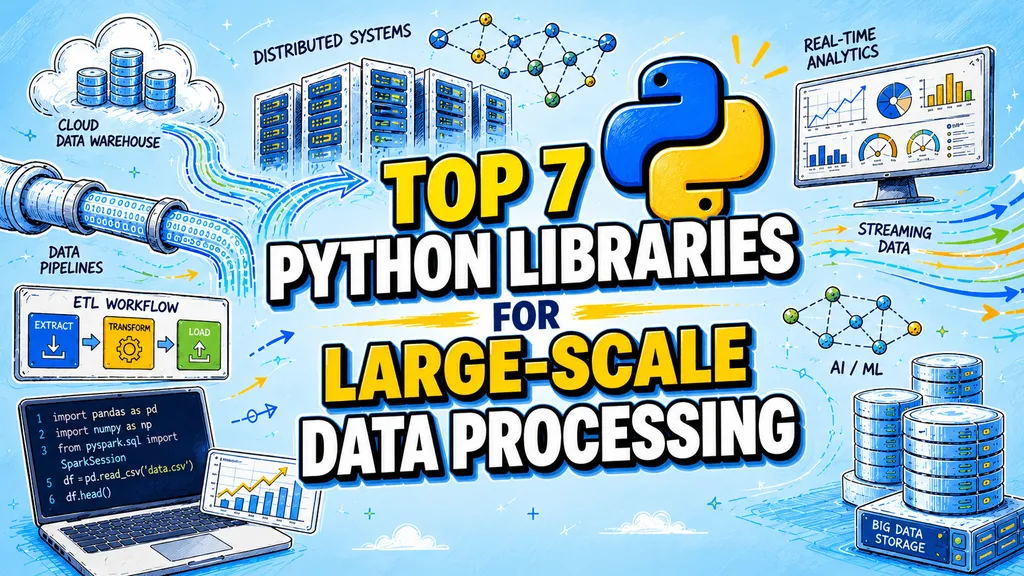
The article discusses seven Python libraries designed for large-scale data processing. These libraries address challenges such as handling datasets larger than memory and performing distributed computations. Each library is tailored for specific tasks, including ETL processes, machine learning, and real-time data workloads.
- ▪PySpark is the Python API for Apache Spark, enabling distributed large-scale data processing.
- ▪Dask scales pandas and NumPy workflows to datasets larger than memory by breaking data into chunks.
- ▪Polars is a high-performance DataFrame library that outperforms pandas and supports lazy query optimization.
2 outlets in our directory ran this story, first to last over 13 hours. All of the coverage we found sits in one bucket: centre. That one-sidedness is itself worth noticing.
- ▪ What’s your process for printing photos at large scale — r/graphic_design
KDnuggets files mainly under ai. We currently carry 40 of its stories.
Story provenance
Source · retrieval · rights · ranking — open for full record
inspect →
Story provenance
Attribution is not the same as permission. This drawer separates discovery metadata, excerpts, WeSearch-generated summaries, reuse status, and whether the publisher receives the visit. Nothing here claims a legal grant the publisher has not made.
Record
| Original publisher | KDnuggets |
| Canonical URL | https://www.kdnuggets.com/top-7-python-libraries-for-large-scale-data-processing |
| Publication time | Tue, 26 May 2026 12:00:29 +0000 |
| Retrieval time | 2026-05-26T12:02:48.623Z |
| Last seen | 2026-05-26T12:02:48.623Z |
| Headline source | Publisher (no WeSearch rewrite) |
| Excerpt source | publisher body |
| Excerpt method | First ~120 words (~800 chars) of extracted publisher body, fair-use limited. |
| Summary | WeSearch · cerebras-chat (WeSearch summarizer) |
| Summary source text | contentText |
| Citation coverage | Summary is a WeSearch-generated derivative; primary citation is the original publisher URL. |
| Cluster | pphgKHrltF10 · 2 stories |
| Cluster logic | Grouped by semantic title/content similarity across sources within a rolling window. Same-publisher template collisions are excluded from coverage comparison. |
| Ranking reason | Story pages are not engagement-ranked. Hub feeds use recency, with optional source-diversified chronological ordering (cap consecutive stories per source). No personalized ranking. |
| Publisher visit | Yes — open original |
| Substitutes article? | No — link-out required for full text |
Rights status (four layers)
WeSearch handling by dimension
| Indexing | May the item be indexed (stored, ranked, made findable)? | Allowed |
| Snippet | May a short excerpt of the publisher's text be shown? | Allowed |
| AI summary | May WeSearch generate its own short summary of the article? | Limited |
| Retrieval / RAG | May the content be exposed for third-party retrieval-augmented generation? | Not asserted |
| Model training | May the content be used to train AI models? | Not asserted |
| Commercial reuse | May the content be reused commercially? | Not permitted |
Basis: Derived from the published RSS/Atom feed. Contact: [email protected]. Reviewed: 2026-07-24.
Opening excerpt (first ~120 words) tap to expand
# Introduction Python has a super rich ecosystem of libraries for handling data at scale. As datasets grow into the gigabytes and beyond, standard tools like pandas hit their limits fast. When you're processing billions of rows, running distributed machine learning pipelines, or streaming real-time events, you need libraries built for the job. This article covers libraries that handle: Datasets that exceed single-machine memory Distributed computation across cores and clusters Real-time and streaming data workloads Integration with cloud storage and data warehouses Production-ready data pipelines Now let's explore each library. # 1.
…
Excerpt limited to ~120 words for fair-use compliance. The full article is at KDnuggets.
Discussion
0 commentsMore from KDnuggets