
Unhealthy code makes AI agents consume 35-50% more tokens
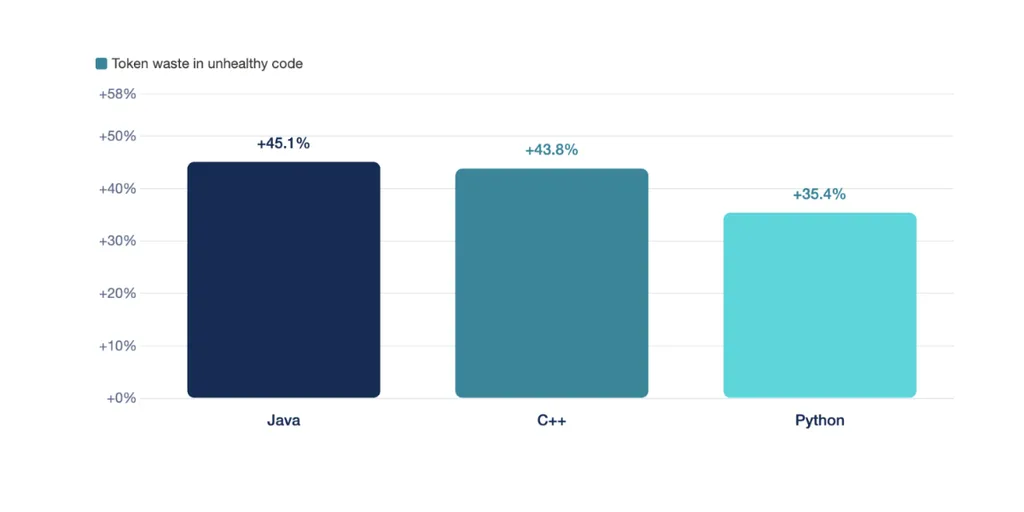
Research indicates that AI agents working with unhealthy codebases consume 35-50% more tokens to complete tasks compared to healthier code. This increased token consumption is accompanied by a higher risk of defects and poorer output quality. The findings highlight the importance of maintaining code health to reduce costs and improve AI performance.
- ▪Agents working on unhealthy codebases consume up to 50% more tokens for the same tasks.
- ▪The research analyzed C++, Java, and Python codebases, revealing that less healthy code leads to higher token consumption.
- ▪Healthy code reduces error-generation risk and allows AI to operate more predictably, resulting in lower token costs.
Hacker News (AI / LLM) files mainly under ai. We currently carry 3,312 of its stories.
Story provenance
Source · retrieval · rights · ranking — open for full record
inspect →
Story provenance
Attribution is not the same as permission. This drawer separates discovery metadata, excerpts, WeSearch-generated summaries, reuse status, and whether the publisher receives the visit. Nothing here claims a legal grant the publisher has not made.
Record
| Original publisher | Codescene |
| Canonical URL | https://codescene.com/blog/unhealthy-code-is-burning-your-token-usage-heres-the-data |
| Publication time | Fri, 29 May 2026 08:52:45 +0000 |
| Retrieval time | 2026-05-29T09:04:59.937Z |
| Last seen | 2026-05-29T09:04:59.937Z |
| Headline source | Publisher (no WeSearch rewrite) |
| Excerpt source | publisher body |
| Excerpt method | First ~120 words (~800 chars) of extracted publisher body, fair-use limited. |
| Summary | WeSearch · cerebras-chat (WeSearch summarizer) |
| Summary source text | contentText |
| Citation coverage | Summary is a WeSearch-generated derivative; primary citation is the original publisher URL. |
| Cluster | uU0R0i2T2kMj |
| Cluster logic | Grouped by semantic title/content similarity across sources within a rolling window. Same-publisher template collisions are excluded from coverage comparison. |
| Ranking reason | Story pages are not engagement-ranked. Hub feeds use recency, with optional source-diversified chronological ordering (cap consecutive stories per source). No personalized ranking. |
| Publisher visit | Yes — open original |
| Substitutes article? | No — link-out required for full text |
Rights status (four layers)
WeSearch handling by dimension
| Indexing | May the item be indexed (stored, ranked, made findable)? | Allowed |
| Snippet | May a short excerpt of the publisher's text be shown? | Allowed |
| AI summary | May WeSearch generate its own short summary of the article? | Limited |
| Retrieval / RAG | May the content be exposed for third-party retrieval-augmented generation? | Not asserted |
| Model training | May the content be used to train AI models? | Not asserted |
| Commercial reuse | May the content be reused commercially? | Not permitted |
Basis: Derived from the published RSS/Atom feed. Contact: [email protected]. Reviewed: 2026-07-24.
Opening excerpt (first ~120 words) tap to expand
Our research across C++, Java, and Python shows that agents working on unhealthy codebases consume up to 50% more tokens to complete the same tasks. That’s in addition to the increased defect risk covered in earlier research. You're not just getting worse output. You're paying significantly more for it. Knowing that your unhealthy code burns excess tokens is useful. Having a workflow that prevents it from getting worse with every agent commit is what changes the outcome. What the data reveals on token consumption To benchmark token consumption, CodeScene's research team analyzed two tasks: single-prompt test case generation and agentic refactoring. The studies covered Python, Java, and C++ codebases.
…
Excerpt limited to ~120 words for fair-use compliance. The full article is at Codescene.
Discussion
0 commentsMore from Codescene


