Visualizing the Artemis II Mission
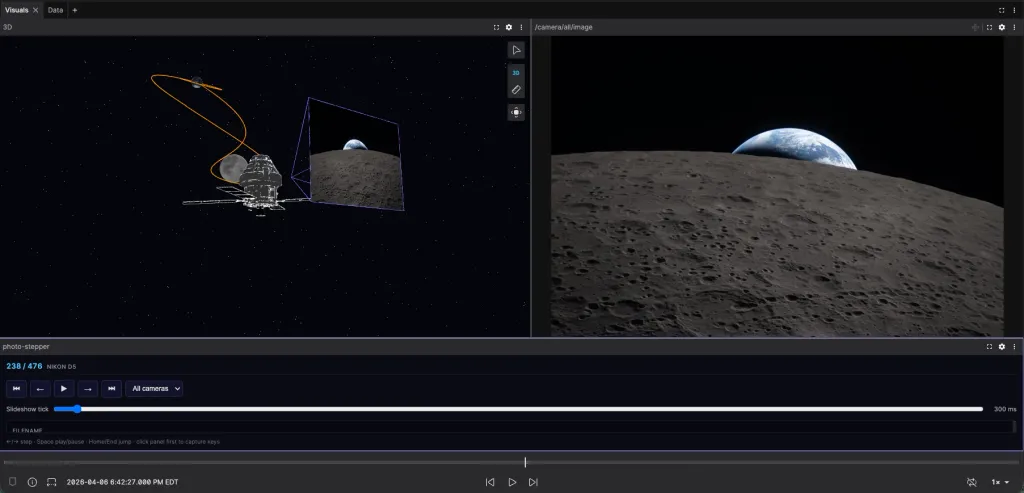
The article describes a project that visualizes the Artemis II mission using the Foxglove platform, integrating Orion’s trajectory and mission photos into a synchronized timeline. Data were sourced from the JPL Horizons API for the spacecraft’s path and from Hank Green’s Artemis‑Timeline repository for the images. Custom extensions, including a photo‑stepper panel, were built to allow interactive exploration of the mission’s ten‑day duration.
- ▪The trajectory data was obtained from the JPL Horizons API, which provides precise ephemeris for solar‑system objects.
- ▪Hank Green’s Artemis‑Timeline project supplied timestamps, camera details, and high‑resolution photos for the mission.
- ▪The 3D scene employed NASA’s AROW Orion model via Ian Dees’s artemis‑viewer, with accurate solar‑array configurations.
- ▪A custom photo‑stepper extension synchronized image navigation with the 3D view and other panels on a shared timeline.
Hacker News (Front Page) files mainly under programming. We currently carry 996 of its stories. Top-voted stories on Hacker News.
Story provenance
Source · retrieval · rights · ranking — open for full record
inspect →
Story provenance
Attribution is not the same as permission. This drawer separates discovery metadata, excerpts, WeSearch-generated summaries, reuse status, and whether the publisher receives the visit. Nothing here claims a legal grant the publisher has not made.
Record
| Original publisher | Foxglove |
| Canonical URL | https://foxglove.dev/blog/visualizing-the-artemis-ii-mission |
| Publication time | Sun, 26 Jul 2026 23:50:25 +0000 |
| Retrieval time | 2026-07-27T01:24:49.175Z |
| Last seen | 2026-07-27T01:25:06.346Z |
| Headline source | Publisher (no WeSearch rewrite) |
| Excerpt source | publisher body |
| Excerpt method | First ~120 words (~800 chars) of extracted publisher body, fair-use limited. |
| Summary | WeSearch · cerebras-chat (WeSearch summarizer) |
| Summary source text | contentText |
| Citation coverage | Summary is a WeSearch-generated derivative; primary citation is the original publisher URL. |
| Cluster | qT3L4cBjqasW |
| Cluster logic | Grouped by semantic title/content similarity across sources within a rolling window. Same-publisher template collisions are excluded from coverage comparison. |
| Ranking reason | Story pages are not engagement-ranked. Hub feeds use recency, with optional source-diversified chronological ordering (cap consecutive stories per source). No personalized ranking. |
| Publisher visit | Yes — open original |
| Substitutes article? | No — link-out required for full text |
Rights status (four layers)
WeSearch handling by dimension
| Indexing | May the item be indexed (stored, ranked, made findable)? | Allowed |
| Snippet | May a short excerpt of the publisher's text be shown? | Allowed |
| AI summary | May WeSearch generate its own short summary of the article? | Limited |
| Retrieval / RAG | May the content be exposed for third-party retrieval-augmented generation? | Not asserted |
| Model training | May the content be used to train AI models? | Not asserted |
| Commercial reuse | May the content be reused commercially? | Not permitted |
Basis: Derived from the published RSS/Atom feed. Contact: [email protected]. Reviewed: 2026-07-24.
Opening excerpt (first ~120 words) tap to expand
Visualizing the Artemis II Mission Orion's real trajectory, hundreds of mission photos, and a custom photo-stepper extension — all replayable on one Foxglove timeline Author: Nathan Johnson July 20, 2026 Share this post CommunityTutorialVisualization In April 2026, four astronauts flew around the Moon for the first time in over fifty years. Hank Green, a science communicator and YouTuber, built an awesome website to visualize the many photos taken on and around the spacecraft throughout the mission. I was inspired by Hank’s project (as I am by most of his projects and content), and as a recent addition to the Foxglove team, I saw a great opportunity to both learn our tool and explore the same dataset in a new way.
…
Excerpt limited to ~120 words for fair-use compliance. The full article is at Foxglove.
Discussion
0 commentsMore from Foxglove