
What's Left for AI-Assisted Coding
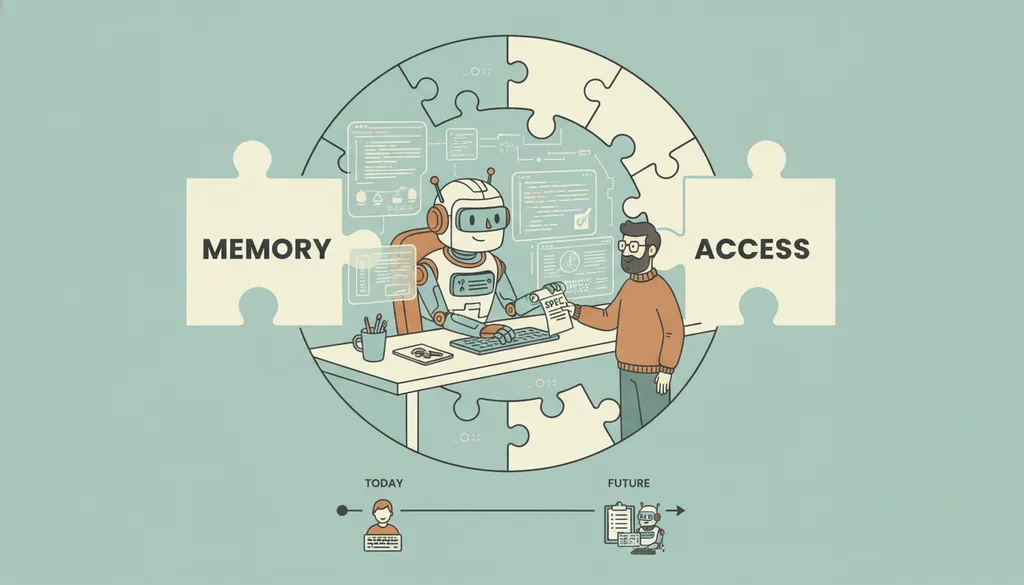
AI-assisted coding tools are effective for clear tasks but struggle with larger projects involving multiple decisions. Two key challenges remain: memory management for context retention and the ability for agents to conduct end-to-end testing independently. Addressing these issues could significantly change the role of engineers, shifting their focus to specifications rather than coding.
- ▪AI tools excel at specific tasks when given clear instructions and context.
- ▪Large projects present challenges due to the need for memory and context retention.
- ▪End-to-end testing capabilities are crucial for agents to verify their work independently.
Hacker News (Newest) files mainly under programming. We currently carry 5,306 of its stories.
Story provenance
Source · retrieval · rights · ranking — open for full record
inspect →
Story provenance
Attribution is not the same as permission. This drawer separates discovery metadata, excerpts, WeSearch-generated summaries, reuse status, and whether the publisher receives the visit. Nothing here claims a legal grant the publisher has not made.
Record
| Original publisher | Bochinski |
| Canonical URL | https://stephen.bochinski.dev/blog/2026/05/24/whats-left-for-ai-assisted-coding/ |
| Publication time | Sun, 24 May 2026 22:28:29 +0000 |
| Retrieval time | 2026-05-24T22:37:34.934Z |
| Last seen | 2026-05-24T22:37:34.934Z |
| Headline source | Publisher (no WeSearch rewrite) |
| Excerpt source | publisher body |
| Excerpt method | First ~120 words (~800 chars) of extracted publisher body, fair-use limited. |
| Summary | WeSearch · cerebras-chat (WeSearch summarizer) |
| Summary source text | contentText |
| Citation coverage | Summary is a WeSearch-generated derivative; primary citation is the original publisher URL. |
| Cluster | nQYAGZYSxEiX |
| Cluster logic | Grouped by semantic title/content similarity across sources within a rolling window. Same-publisher template collisions are excluded from coverage comparison. |
| Ranking reason | Story pages are not engagement-ranked. Hub feeds use recency, with optional source-diversified chronological ordering (cap consecutive stories per source). No personalized ranking. |
| Publisher visit | Yes — open original |
| Substitutes article? | No — link-out required for full text |
Rights status (four layers)
WeSearch handling by dimension
| Indexing | May the item be indexed (stored, ranked, made findable)? | Allowed |
| Snippet | May a short excerpt of the publisher's text be shown? | Allowed |
| AI summary | May WeSearch generate its own short summary of the article? | Limited |
| Retrieval / RAG | May the content be exposed for third-party retrieval-augmented generation? | Not asserted |
| Model training | May the content be used to train AI models? | Not asserted |
| Commercial reuse | May the content be reused commercially? | Not permitted |
Basis: Derived from the published RSS/Atom feed. Contact: [email protected]. Reviewed: 2026-07-24.
Opening excerpt (first ~120 words) tap to expand
What's Left for AI-Assisted Coding May 24, 2026 The tools are already good at the work in front of them. Give an agent a clear task and enough context and it will write something reasonable. The harder questions show up on large projects with large teams, where the code is one part of a much bigger system of decisions, and two pieces are still missing. The first is memory. Most of the effort right now goes into steering the agent and making sure it has the right context. There is no agreed upon approach for what a developer should carry between sessions, or for what a team should share across them. Without that, context goes missing and the agent fills the gap with its own assumptions. In the worst case it makes a decision that is quietly wrong and nobody catches it until later.
…
Excerpt limited to ~120 words for fair-use compliance. The full article is at Bochinski.
Discussion
0 commentsMore from Bochinski


