Why l (new runtime for k and q)
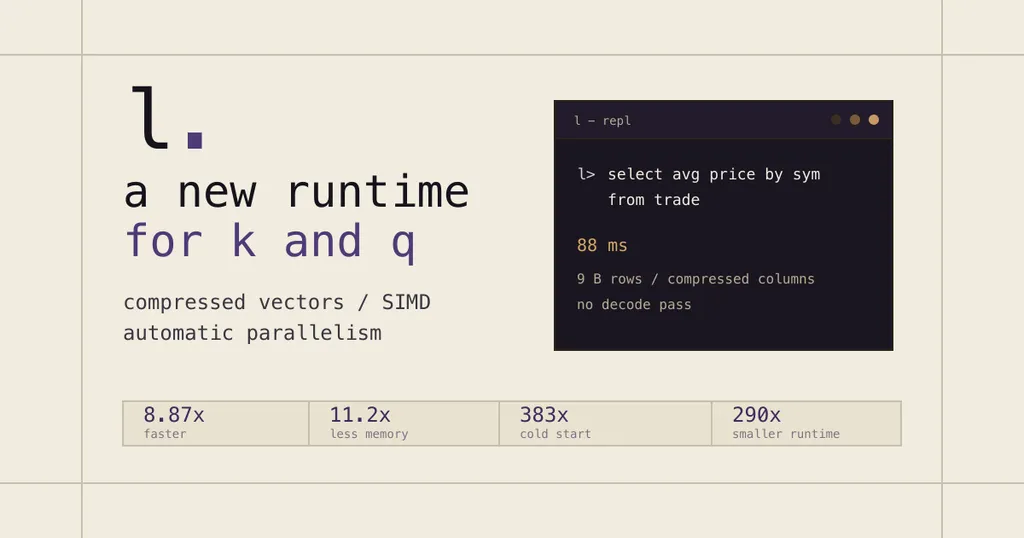
The author, a long-time user of K and Q, proposes a new runtime called l to modernize the execution engine without altering the language itself. l is built around four core concepts—SIMD as a default primitive, automatic parallelism, transparent fusion to eliminate intermediate allocations, and runtime-aware compression. These ideas aim to leverage contemporary multi‑core CPUs, GPUs, and specialized accelerators while preserving existing codebases.
- ▪The author has worked with K and Q since 2001 and respects Arthur Whitney’s original language design.
- ▪l treats SIMD as a first‑class primitive, ensuring every operator automatically utilizes vector instructions.
- ▪Parallel execution is integrated into the runtime, with small arrays processed on a single core and larger ones distributed across threads or accelerators.
- ▪Transparent fusion removes intermediate data structures, allowing operations like sum sqrt x to be executed in a single pass.
- ▪Compression is handled at runtime, enabling primitives to operate directly on compressed data to reduce memory bandwidth usage.
Lobsters files mainly under programming. We currently carry 187 of its stories.
Story provenance
Source · retrieval · rights · ranking — open for full record
inspect →
Story provenance
Attribution is not the same as permission. This drawer separates discovery metadata, excerpts, WeSearch-generated summaries, reuse status, and whether the publisher receives the visit. Nothing here claims a legal grant the publisher has not made.
Record
| Original publisher | Lv1 |
| Canonical URL | https://lv1.sh/blog/why-l/ |
| Publication time | Tue, 21 Jul 2026 01:50:14 -0500 |
| Retrieval time | 2026-07-21T07:07:04.087Z |
| Last seen | 2026-07-21T07:07:04.087Z |
| Headline source | Publisher (no WeSearch rewrite) |
| Excerpt source | publisher body |
| Excerpt method | First ~120 words (~800 chars) of extracted publisher body, fair-use limited. |
| Summary | WeSearch · cerebras-chat (WeSearch summarizer) |
| Summary source text | contentText |
| Citation coverage | Summary is a WeSearch-generated derivative; primary citation is the original publisher URL. |
| Cluster | None |
| Cluster logic | Not yet clustered, or no peer story found in the clustering window. |
| Ranking reason | Story pages are not engagement-ranked. Hub feeds use recency, with optional source-diversified chronological ordering (cap consecutive stories per source). No personalized ranking. |
| Publisher visit | Yes — open original |
| Substitutes article? | No — link-out required for full text |
Rights status (four layers)
WeSearch handling by dimension
| Indexing | May the item be indexed (stored, ranked, made findable)? | Allowed |
| Snippet | May a short excerpt of the publisher's text be shown? | Allowed |
| AI summary | May WeSearch generate its own short summary of the article? | Limited |
| Retrieval / RAG | May the content be exposed for third-party retrieval-augmented generation? | Not asserted |
| Model training | May the content be used to train AI models? | Not asserted |
| Commercial reuse | May the content be reused commercially? | Not permitted |
Basis: Derived from the published RSS/Atom feed. Contact: [email protected]. Reviewed: 2026-07-24.
Opening excerpt (first ~120 words) tap to expand
Back to blog May 4, 2026 / -jl Why l. Twenty-five years with k and q. I did not want a new language. I wanted to rebuild the engine underneath it. essay I have been working with K and Q since 2001, nearly twenty-five years now. I will say the obvious part first: Arthur Whitney is a genius. K and Q remain extraordinary languages. Their design is small, dense, and beautiful. But despite years of optimization, extension, and correction, the core implementation model is still rooted in Arthur’s original insight from the 1990s. I did not want to change the language. I am not arrogant enough to think I should invent a new one. What I wanted to do was reimagine the implementation for the machines we actually use today. Computers in 2026 are not the computers of 1997. CPUs are wider.
…
Excerpt limited to ~120 words for fair-use compliance. The full article is at Lv1.
Discussion
0 commentsMore from Lv1