Why Vietnam won’t steal the show at Shangri-La Dialogue 2026
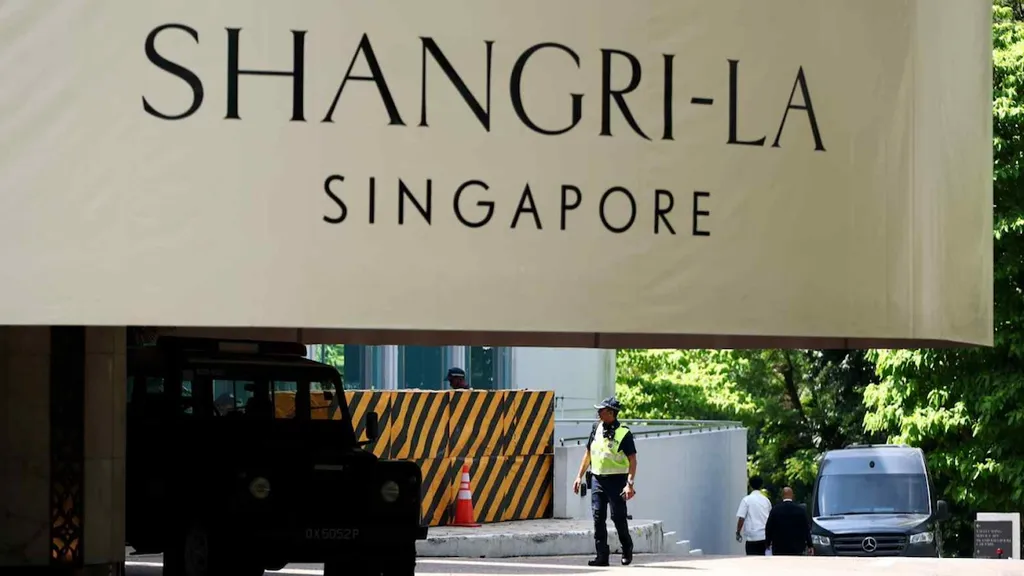
The Shangri-La Dialogue is a key platform for defense ministers and military chiefs from over 40 countries to discuss regional security. Vietnam's leader, To Lam, will be the first from his country to deliver the keynote address, highlighting Vietnam's growing role in regional security discussions. The effectiveness of his message will be assessed against the backdrop of Vietnam's deepening ties with China and its strategic autonomy.
- ▪The Shangri-La Dialogue is an annual event held in Singapore that focuses on Indo-Pacific security.
- ▪To Lam's keynote address marks a significant moment for Vietnam in regional security conversations.
- ▪China's participation in the dialogue has varied over the years, impacting bilateral meetings.
Asia Times files mainly under world. We currently carry 156 of its stories.
Story provenance
Source · retrieval · rights · ranking — open for full record
inspect →
Story provenance
Attribution is not the same as permission. This drawer separates discovery metadata, excerpts, WeSearch-generated summaries, reuse status, and whether the publisher receives the visit. Nothing here claims a legal grant the publisher has not made.
Record
| Original publisher | Asia Times |
| Canonical URL | https://asiatimes.com/2026/05/why-vietnam-wont-steal-the-show-at-shangri-la-dialogue-2026/ |
| Publication time | Mon, 25 May 2026 10:30:50 +0000 |
| Retrieval time | 2026-05-25T10:32:36.622Z |
| Last seen | 2026-05-25T10:32:36.622Z |
| Headline source | Publisher (no WeSearch rewrite) |
| Excerpt source | publisher body |
| Excerpt method | First ~120 words (~800 chars) of extracted publisher body, fair-use limited. |
| Summary | WeSearch · cerebras-chat (WeSearch summarizer) |
| Summary source text | contentText |
| Citation coverage | Summary is a WeSearch-generated derivative; primary citation is the original publisher URL. |
| Cluster | 7LL1B5CRmK3z |
| Cluster logic | Grouped by semantic title/content similarity across sources within a rolling window. Same-publisher template collisions are excluded from coverage comparison. |
| Ranking reason | Story pages are not engagement-ranked. Hub feeds use recency, with optional source-diversified chronological ordering (cap consecutive stories per source). No personalized ranking. |
| Publisher visit | Yes — open original |
| Substitutes article? | No — link-out required for full text |
Rights status (four layers)
WeSearch handling by dimension
| Indexing | May the item be indexed (stored, ranked, made findable)? | Allowed |
| Snippet | May a short excerpt of the publisher's text be shown? | Allowed |
| AI summary | May WeSearch generate its own short summary of the article? | Limited |
| Retrieval / RAG | May the content be exposed for third-party retrieval-augmented generation? | Not asserted |
| Model training | May the content be used to train AI models? | Not asserted |
| Commercial reuse | May the content be reused commercially? | Not permitted |
Basis: Derived from the published RSS/Atom feed. Contact: [email protected]. Reviewed: 2026-07-24.
Opening excerpt (first ~120 words) tap to expand
The Shangri-La Dialogue, held every year in Singapore, is one of the Indo-Pacific’s premier signaling platforms. A leader takes the keynote podium, and the room reads it for cues about where a country is heading: what partnerships it is prioritizing, what risks it is willing to name and how it sees the regional order. The SLD draws defense ministers and military chiefs from over 40 countries, and much of its value has always rested less on the speeches than on the sideline bilateral meetings they facilitate across a wide range of relationships, from Japan-Australia defense coordination to India-ASEAN engagement. In recent years, gauging great power rivalry has become a key purpose of the forum, and China’s level of participation has drawn particular scrutiny.
…
Excerpt limited to ~120 words for fair-use compliance. The full article is at Asia Times.
Discussion
0 commentsMore from Asia Times