With coding agents, specs feel more like source code
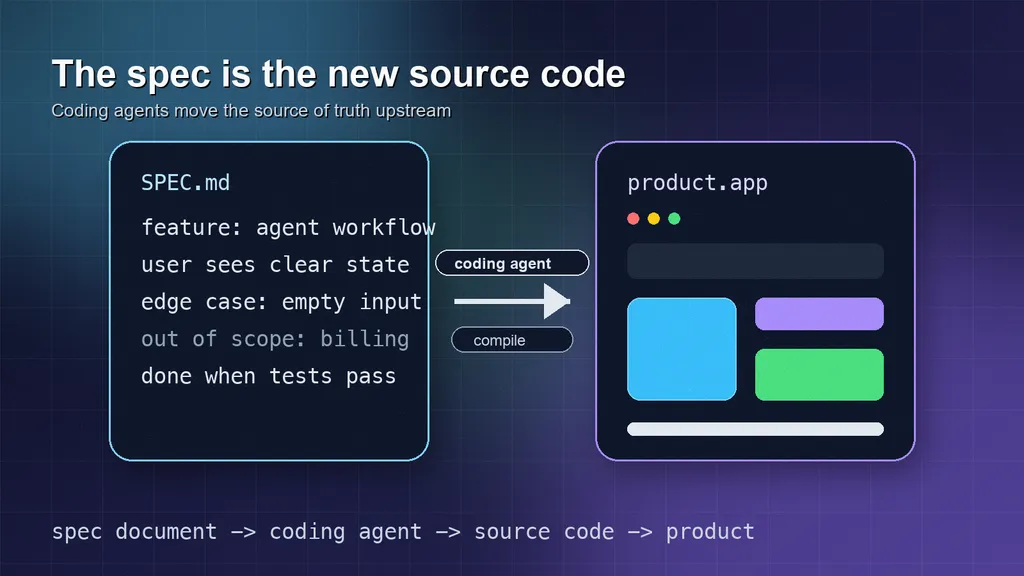
The role of source code is evolving as coding agents become more integrated into the development process. Developers are increasingly focusing on specifications and documentation, as the quality of the output from coding agents heavily relies on the clarity of these documents. This shift emphasizes the importance of clear communication and detailed specifications in software development.
- ▪The traditional model of coding has shifted from human-written source code to a process that begins with a spec document.
- ▪Developers are now spending more time on prompts and specifications rather than just writing code.
- ▪A vague specification can lead to incorrect assumptions by coding agents, resulting in products that may not meet the intended requirements.
Hacker News (Newest) files mainly under programming. We currently carry 5,306 of its stories.
Story provenance
Source · retrieval · rights · ranking — open for full record
inspect →
Story provenance
Attribution is not the same as permission. This drawer separates discovery metadata, excerpts, WeSearch-generated summaries, reuse status, and whether the publisher receives the visit. Nothing here claims a legal grant the publisher has not made.
Record
| Original publisher | Yushi's Blog |
| Canonical URL | https://blog.yushi91.com/blog/spec-is-the-new-source-code/ |
| Publication time | Thu, 28 May 2026 01:15:59 +0000 |
| Retrieval time | 2026-05-28T01:28:05.981Z |
| Last seen | 2026-05-28T01:28:05.981Z |
| Headline source | Publisher (no WeSearch rewrite) |
| Excerpt source | publisher body |
| Excerpt method | First ~120 words (~800 chars) of extracted publisher body, fair-use limited. |
| Summary | WeSearch · cerebras-chat (WeSearch summarizer) |
| Summary source text | contentText |
| Citation coverage | Summary is a WeSearch-generated derivative; primary citation is the original publisher URL. |
| Cluster | xtggN2bACFof |
| Cluster logic | Grouped by semantic title/content similarity across sources within a rolling window. Same-publisher template collisions are excluded from coverage comparison. |
| Ranking reason | Story pages are not engagement-ranked. Hub feeds use recency, with optional source-diversified chronological ordering (cap consecutive stories per source). No personalized ranking. |
| Publisher visit | Yes — open original |
| Substitutes article? | No — link-out required for full text |
Rights status (four layers)
WeSearch handling by dimension
| Indexing | May the item be indexed (stored, ranked, made findable)? | Allowed |
| Snippet | May a short excerpt of the publisher's text be shown? | Allowed |
| AI summary | May WeSearch generate its own short summary of the article? | Limited |
| Retrieval / RAG | May the content be exposed for third-party retrieval-augmented generation? | Not asserted |
| Model training | May the content be used to train AI models? | Not asserted |
| Commercial reuse | May the content be reused commercially? | Not permitted |
Basis: Derived from the published RSS/Atom feed. Contact: [email protected]. Reviewed: 2026-07-24.
Opening excerpt (first ~120 words) tap to expand
The shift I didn’t expectThe more I use coding agents, the less source code feels like the thing I personally write.I know. Strange sentence from someone with a computer science background.At university, the model was clean: humans write source code, the compiler turns it into machine code, and the final product runs from there. Source code was the serious artifact. You shaped it, reviewed it, argued over it, maintained it.That model is still true. It just feels incomplete now.In my day-to-day work with agents, the thing I keep touching is the spec. The PRD. The design note. The acceptance criteria.
…
Excerpt limited to ~120 words for fair-use compliance. The full article is at Yushi's Blog.
Discussion
0 commentsMore from Yushi's Blog